Project - Demand response energy consumption
Development of technologies for demand response and reduced environ-mental impact at substantial energy consumers in Central Denmark Region
Project start 2009. Ended in December 2011.
The project is completed.
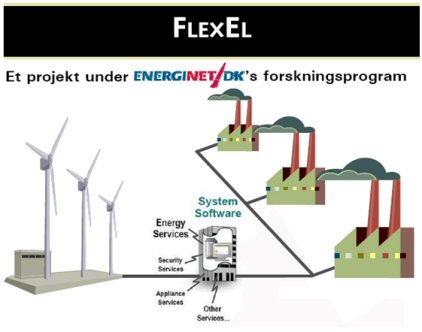
The objective of the project is to identify, develop and demonstrate technological control systems that can ensure large-scale energy consumers (power consumption exceeding 0.1 GWh/year) a more flexible power consumption so they can reduce energy costs and the impact on the environment as well as utilise periods with large environmental power generation and minimum load on the grid.
The project is also supported by: 
Objectives
In the course of the project, technical solutions will be developed to ensure a transparent energy consumption, to visualise the advantages of demand response in relation to a price signal and to disseminate information to the relevant control systems.
The objective of the project is to safeguard the following advantages:
- Reduced energy costs.
- Reduced environmental impact.
- Transparent power consumption.
- Flexible power consumption.
- Companies with a large fossil energy consumption wil be able to utilise electricity during periods with large environmentally friendly power production and minor load on the grid.
The project is supported by the Development Forum of Central Denmark Region and therefore the project mainly involves companies from that area. The project is also supported by Energinet.dk (under the Danish ForskEL programme) which in general is responsible for reliability of supply in Denmark. Subsidies can be applied for as a more flexible power system i.a. will result in increased electricity integration into the system from wind mills.
As the flow from wind mills is expected to be cheaper, the project will make it possible for energy consuming companies to obtain savings on their electricity bills. At the same time, society will benefit from the integration of an increased wind power flow on the grid.
Examples of equipment that can be used in connection with demand response con-sumption are heat pumps or refrigeration systems that can be used together with cold stores. 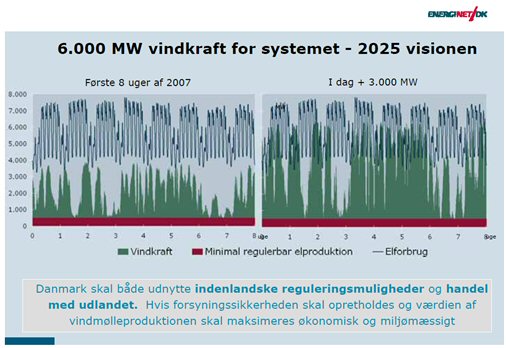
Participants
The project group consists of:
- Grid Manager A/S - Mogens Birkelund
- Danfoss Solutions A/S - Erik Andersen
- EnergiDanmark A/S - Peter Lønbro Lehm
- Danish Technological Institute, Energy and Climate - Anders Mønsted, Project Manager
- Danish Technological Institute, Technology Partnership - Hans Henrik Bruhn
Please read our specialist webpage regarding Technology Transfer and Technology Partnership.
Activities
The project is expected to proceed according to the following main phases:
1. Survey of existing knowledge and experience and summary utility studies
2. Involvement of relevant companies
3. Survey of user needs, potentials and barriers
4. Technology development
5. Demonstration projects in interaction with users
6. Knowledge dissemination.
Project Status
Phase 1: Gathering experience
Apparently, there is a need for a more flexible system in future. The current electricity price structure makes it difficult for the companies to obtain savings by navigating on the spot market. Therefore, it is common sense to assess the possibilities of the companies participating in the project in relation to bidding on the balance power market.
Another important point is that it still is more profitable for the company to cut down on the amount of consumed kWh. That falls in line with the project as transparency in relation to energy consumption also is an important parameter with regard to flexible electricity consumption. With an outline of the companies' energy consumption it is possible to point out energy savings and to consider the possibilities for an electricity consumption that is more flexible.
Phase 2: Involvement of relevant companies
In this phase, electricity consumption data from 50 companies was analysed. 5 companies were selected in the light of their circadian rhythm and electricity consumption. Therefore, the demonstration companies have very different profiles with regard to consumption and circadian rhythm.
The 7 selected demonstration companies are:
- Gramo A/S, bookbinder's shop in Balling
- Damolin A/S, moler products, production on Mors and Fur
- Valdemar Birn A/S, iron foundry in Holstebro
- Skjern Papirfabrik A/S, paper manufacturer in Skjern
- BC Catering A/S, catering service in Odense
- Danfloor A/S, carpet producer
- IS Skovgården, farm near Vojens
Phase 3: Survey of user needs in the demonstration companies
An innovation tool has been prepared and tested in 4 of the demonstration companies. The tool will has made it easier to understand, which conditions can influence changes in a company in relation to daily routines.
Objectives:
- to create a structure that can be used by many production companies without becoming too cost-intensive.
- to propose solutions to the content of the guide so innovation and implementation are ensured.
- to give examples of how a business can be created on innovation.
Phase 4: Technology development
GridManager has developed equipment that can be used to measure, control and adjust production equipment on the basis of the electricity prices.Danfoss Solutions A/S will use their platform to calculate the obtained savings on the production according to flexible prices on electricity.
Phase 5: Demonstration projects
GridManager equipment is mounted at 4 of the 7 demonstration companies. Data concerning the electricity consumption and prices of the individual processes in the companies can be obtained through the GridManager system called "GridPortal".