
Energy Labelling for Heat Pumps - Accredited Testing and EPREL Compliance
INDSÆT EN FAKTABOKS
Information for Homeowners and Private Buyers:
If you are a consumer looking to compare energy-labelled heat pumps for private residential heating in Denmark, please consult Varmepumpelisten (The Heat Pump List). Administered by Danish Technological Institute on behalf of the Danish Energy Agency, it provides an independent, searchable overview of energy-labelled heat pumps verified for the Danish climate.
INDSÆT LINK TIL VARMEPUMPELISTEN PÅ SPARENERGI.DK I FAKTABOKSEN
Securing an accurate EU energy label requires rigorous laboratory testing, verified seasonal calculations, and compliance with European Ecodesign and labelling directives. Independent test data from Danish Technological Institute ensures documented energy classes and mitigates the risk of market surveillance failure.
Under EU Regulation No 811/2013 and Ecodesign Regulation (EU) No 813/2013, space heaters and combination heat pumps placed on the European market must display an official energy efficiency label and be registered in the EPREL database. Because heat pump efficiency fluctuates depending on outdoor ambient temperatures and supply flow temperatures, energy labelling is determined by empirical performance mapped across standardised climate profiles.
The Heat Pump Test Laboratory at Danish Technological Institute provides ISO/IEC 17025 accredited testing to determine Seasonal Space Heating Energy Efficiency (ηs), heating capacity, and sound power levels (LWA), establishing the documented foundation required for third-party certification and market access.
INDSÆT FAKTABOKS
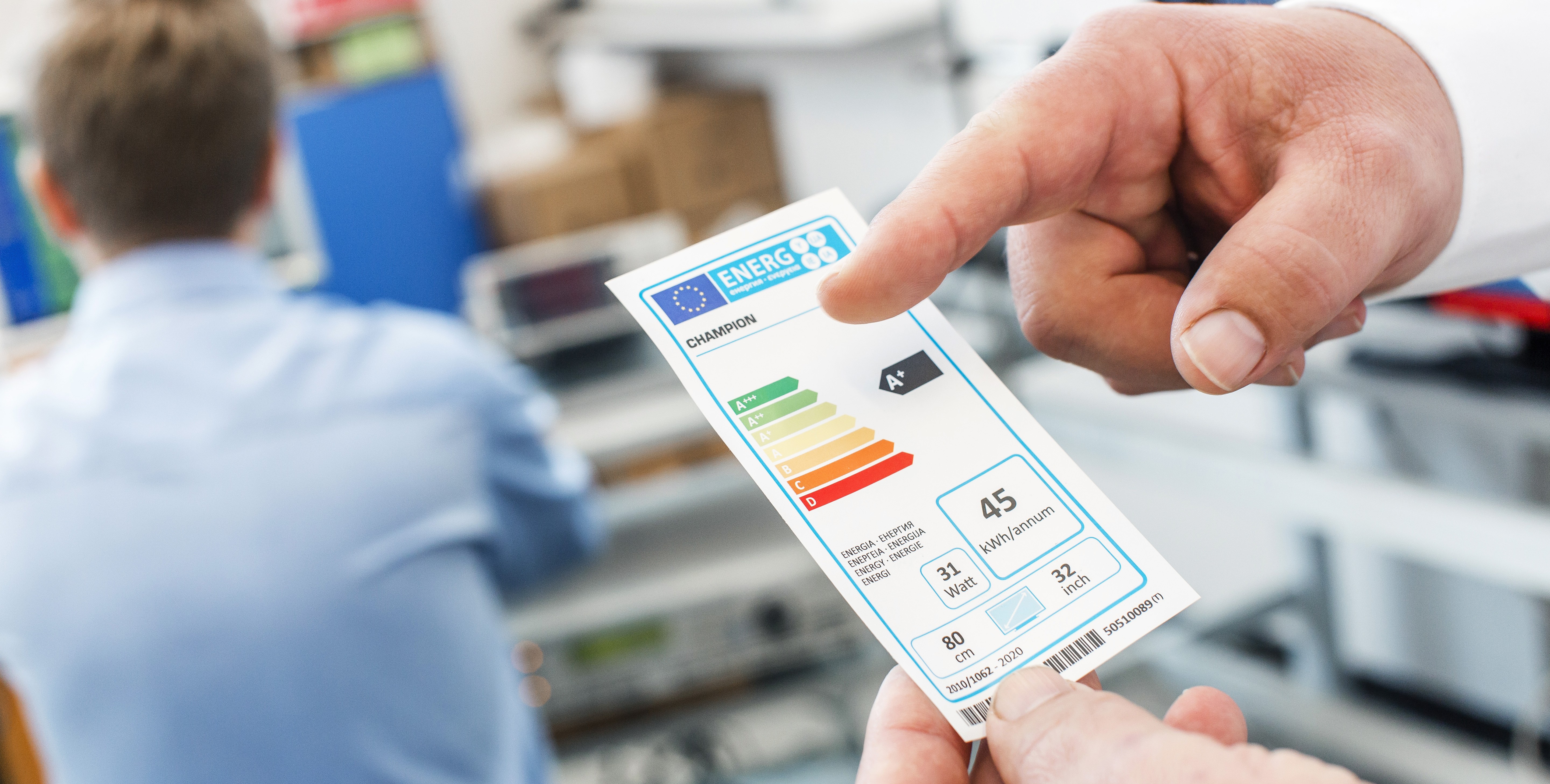
The EU Heat Pump Energy Label categorises space heaters from A+++ to D based on their Seasonal Space Heating Energy Efficiency (ηs). Regulated under Directive 2010/30/EU and Regulations (EU) No 811/2013 and 813/2013, the declared rating requires empirical test data from EN 14511 and seasonal calculation under EN 14825 across three European reference climate zones.
What Does the Heat Pump Energy Label Indicate?
The European energy label provides market authorities, specifiers, and purchasers with standardised, comparable performance metrics: Categorises heating performance on a scale from A+++ down to D based on the Seasonal Space Heating Energy Efficiency (ηs). Defines the declared thermal output under average, colder, and warmer European climate zones. Declares acoustic noise emissions in decibels (dB), measured in accordance with EN 12102-1 for both indoor and outdoor units. For combination heaters, the energy label indicates domestic hot water production efficeincy based on standardised tapping cycles (EN 16147).Energy Efficiency Class
Rated Heat Output (Prated in kW)
Sound Power Level (LW A)
Water Heating Efficiency (ηwh)
Commercial and Regulatory Value Across the Supply Chain
Energy labelling is not merely a compliance requirement; it is a decisive market driver across European heating markets. Achieving verified top-tier ratings provides the empirical backing needed to differentiate product platforms and navigate commercial risk:
Independent verification of declared performance ratings eliminates the legal and financial risks of product recalls, sanctions, and forced EPREL label modifications. Furthermore, accredited test reports provide the documented proof required to qualify for European subsidy programmes (such as BAFA in Germany and CEE in France), where an A++ or A+++ rating is a mandatory technical threshold. Independent batch testing and empirical validation of supplier specifications prior to major procurement contracts, framework agreements, and commercial tenders, ensuring products deliver to declared technical parameters.For Manufacturers and Importers
For Wholesalers and OEM Branders
Critical Rules and Manufacturer Responsibilities
Compliance with the EU Energy Labelling framework is legally binding for market access. Here is how you as a manufacturer must navigate:
Mandatory EPREL Registration
Before you can place a heat pump on the EU market, you must – as a manufacturer or importer – register the model in the EPREL (European Product Registry for Energy Labelling) database. This means that you must upload the official product fiche, energy label, and technical compliance documentation.
Testing Responsibility and Market Surveillance
You as a manufacturer are not strictly required to use a third-party test laboratory. However, you are legally responsible for all declared performance data. National market surveillance authorities conduct random verification tests annually, and discrepancies between declared and actual laboratory results can lead to penalties, mandatory recalls, loss of subsidy eligibility, and reputational damage.
The Interplay Between Energy Labelling and Ecodesign
While Energy Labelling ranks compliant products from best to worst performing, Ecodesign sets the mandatory minimum efficiency baseline. Underperforming models that fail to meet minimum seasonal thresholds cannot obtain an energy label and are prohibited from being sold in the EU.
How is the Heat Pump Energy Class Calculated?
For space heating heat pumps, the energy label class is determined by the Seasonal Space Heating Energy Efficiency (ns), derived from tests conducted according to EN 14511 and EN 14825:

The heat pump is tested at standardised part-load conditions to establish the SCOP (Seasonal Coefficient of Performance). SCOP is converted to ηs by dividing by the EU electricity conversion factor (2.5) and adjusting for standard system and control losses. The resulting ηs percentage defines the official energy label class.1. Seasonal Testing
2. Primary Energy Conversion
3. Classification Table
*MÅSKE SKAL VI HAVE ET SKEMA MED ENERGIKLASSERNE (eller er det nok med billedet fra Rasmus’ lab).*
Fast-track your documentation and ensure compliance before market launch:
Get verified performance, SCOP, and sound power data. Ensure all required technical parameters, product data sheets, and tolerance margins are correctly prepared for the EU database registration. Mitigate market surveillance risks with independent test reports from an accredited laboratory. Receive technical feedback to improve your heat pump’s seasonal performance and reach higher energy labelling classes.Benefit from Our Laboratory Testing
Accredited Laboratory Testing
EPREL Data Preparation
Third-Party Credibility
Design Optimisation
Ready to Document Your Heat Pump?
We look forward to helping you verify and document your product performance through accredited testing in our state-of-the-art laboratory facilities.
Contact our Experts
Please contact our specialists for further information.

Lasse has overall responsibility for the team, the laboratory and its technical direction. He has more than 25 years of experience in refrigeration and heat pump technology, covering product testing, laboratory measurements, and market surveillance, as well as energy efficiency and the implementation of international standards. He is an expert in testing in accordance with international standards and has extensive experience with heat pumps, refrigeration systems, condensing units and related components for both public authorities and industry.
Preben has worked in the energy sector for more than 20 years. He specialises in testing heat pumps as well as providing technical consultancy and product assessment. He is a member of national and international standardisation committees, and he is also a member of an international committee of test laboratories.