European experts: High-temperature heat pumps are the future of process heating
Published: 02/03/2026
This year’s High-Temperature Heat Pump Symposium confirmed that high-temperature heat pumps are crucial to decarbonising industry and ensuring security of supply.
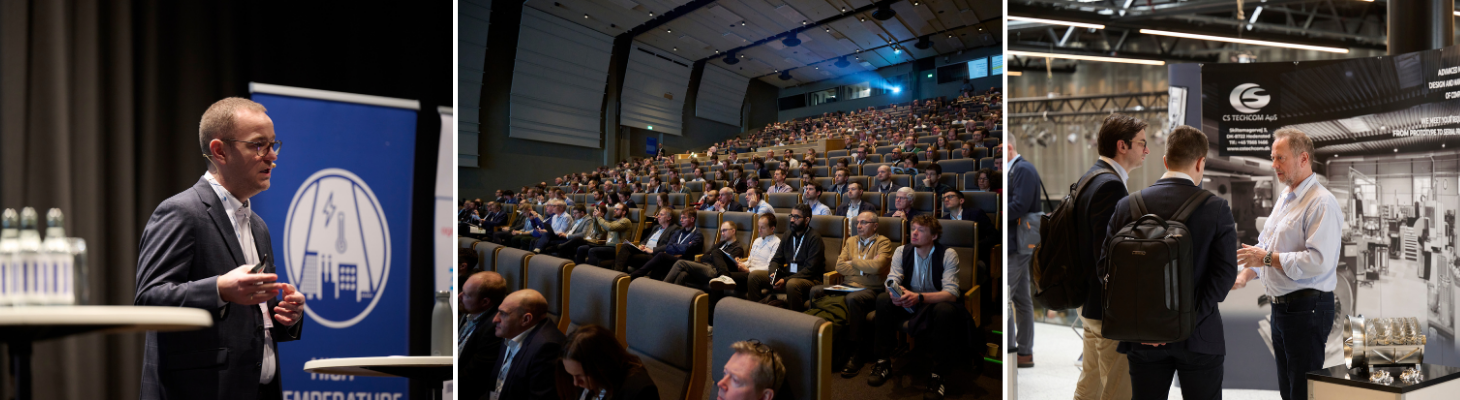
Last month, Danish Technological Institute hosted the High-Temperature Heat Pump Symposium in Copenhagen for the fifth time. The symposium attracted 530 experts from across the world who all share a common interest in electrification and decarbonisation.
High-temperature heat pumps can replace gas, oil, and coal in large-scale manufacturing companies – for example in paper, food, and pharmaceutical production. At the same time, heat pumps can play a pivotal role in CCUS facilities as they can effectively remove carbon from processes that still rely on fossil fuels.
Green process heating for industry
Put simply, high-temperature heat pumps serve as a fundamental driving force on the road towards green process heat. The technology plays a central role in improving energy efficiency and reducing CO2 emissions from industrial processes. High-temperature heat pumps are actually more important than ever for the green transition of industry as well as for competitiveness and security of supply.
In addition to this comes the EU ban on Russian gas, which becomes effective in 2027. High-temperature heat pumps are an obvious solution in this area, but targeted research, development, and demonstrations are still required before we can implement the technologies demanded by the industries to the full extent.
We need to clear the remaining hurdles
The symposium focused on the hurdles we must clear before heat pumps can fully replace fossil fuels in industry. Through technical presentations and concrete cases, the participants gained new knowledge on how we can reach higher temperatures, greater efficiency, and increased capacity. And, last but not least, demonstrate how it is now possible to integrate heat pumps into industrial processes where fossil fuels currently play a leading role.
High-temperature heat pumps are set to play a central role in the decarbonisation of industry. The first systems are in operation, and the technology is applied in everything from large, central process heating plants to process-integrated solutions connected directly to selected steps in the production. This broad applicability makes it possible to replicate and scale the solutions, while at the same time standardising and preparing them for large-scale deployment.
The technologies are now market ready
Technologies and suppliers are both increasingly ready for the market. The next step is, therefore, to raise knowledge levels, temperatures, efficiencies, and capacities so that the full potential can be realized.
At Danish Technological Institute, we are working on several international projects which demonstrate electrification in industry. For example, together with manufacturers, endusers, and universities, we are developing and demonstrating industrial high-temperature heat pumps, reaching temperatures up to 200°C. At such high temperatures, we can replace fossil fuels with renewable energy in many of the most demanding industrial processes.
Without energy, the world grinds to a halt
Energy has become a central element in our global security policy. Without energy, the world simply grinds to a halt. And, here, heat pumps are one of the key components to ensure a robust and flexible energy system.
The technology makes us independent of energy supplies from countries whose agendas differ from that of Europe. At the same time, we can create an industry which is driven by renewable energy from the sun and the wind.
United around renewable and independent energy
At the symposium, it was encouraging to see the entire value chain represented from knowledge institutions to manufacturers and endusers. Cross-sector collaboration is necessary if we are to reach our goals.
Thank you to all participants and to our co-organisers, DTU and SINTEF, for helping to put the spotlight on the electrification of industry. Together, we can turn knowledge and demonstration projects into full-scale solutions, paving the way for a fossil-free industry in the future. See you again in 2028!