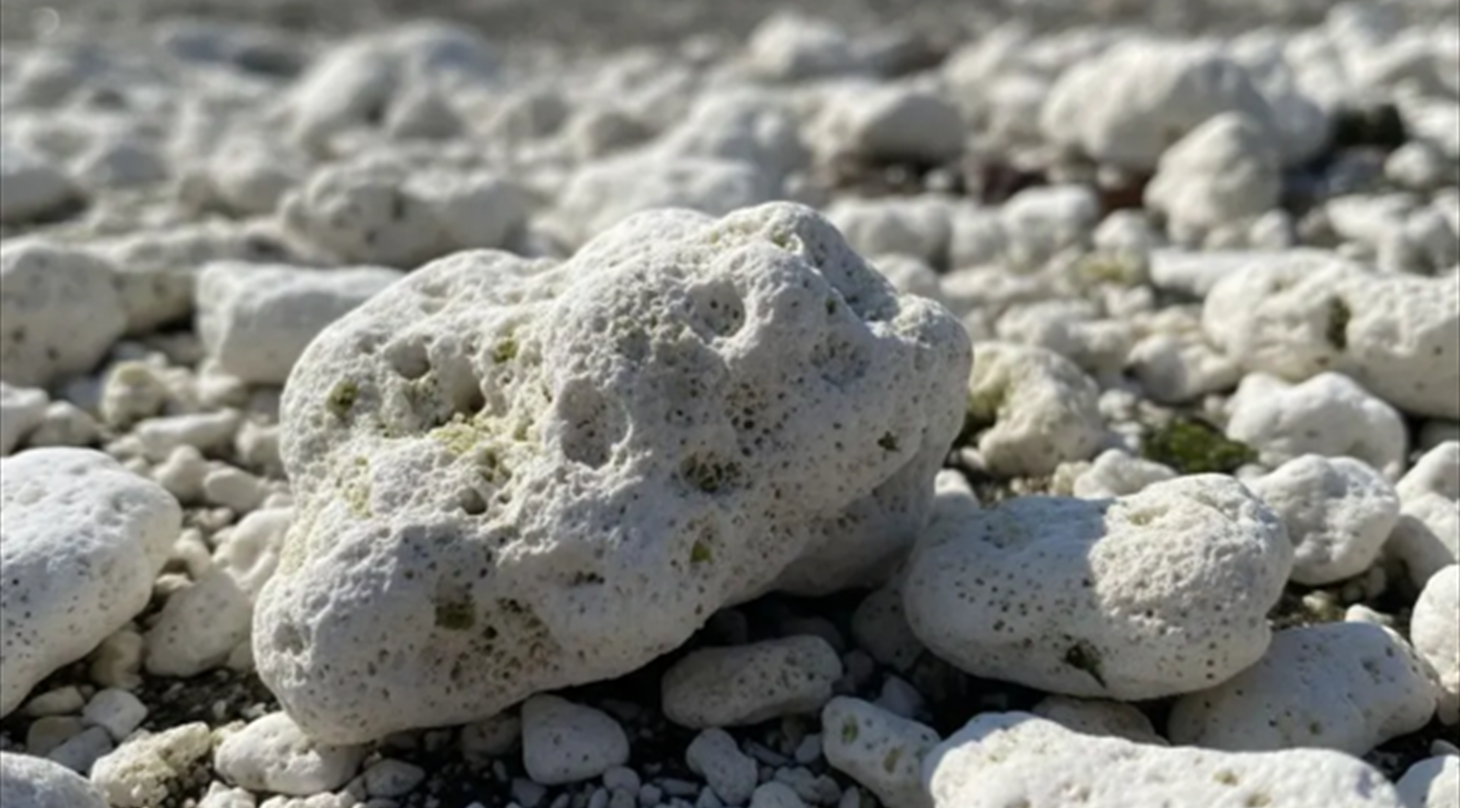
Marine limestone for concrete
The construction industry is one of the most climate-intensive sectors globally, both due to large process emissions from cement production and the high consumption of virgin raw materials such as limestone from quarries, where approximately 4 million tons of fossil limestone are extracted annually in Denmark. At the same time, society is facing a massive task of reducing the CO2 content of the atmosphere – not only by limiting new emissions, but also by removing CO2 that has already been emitted.
FlowMinerals is developing an electro-chemical technology for Direct Ocean Capture (DOC) – a recognized method within Carbon Dioxide Removal (CDR) – in which CO2 is actively extracted from seawater and bound as solid CaCO3 (marine limestone). This marine limestone has the potential to replace virgin sand and aggregates in concrete, as well as a portion of the cement. In this way, concrete with marine limestone can both achieve a reduced CO2 footprint per m³ and at the same time function as a CO2 storage, as the bound CO2 remains stored in the finished building material.
Marine limestone has the potential to make concrete significantly more climate-friendly – and in the future, depending on the CO2 value of the marine limestone and its dosage, certain concrete mixes could potentially even achieve an overall negative CO2 footprint. The project also supports regulation-driven demand, as both the EU taxonomy and Danish public tenders are increasingly imposing requirements for low-CO2 concrete.
The innovation project is supported by WE BUILD DENMARK and the Danish Board of Business Development, with project start in October 2025. The project is expected to be completed in April 2026.
Project objectives
The project is carried out as a close collaboration between FlowMinerals and the Danish Technological Institute. The purpose is to test, document, and validate whether marine limestone produced via FlowMinerals’ electro-chemical Direct Ocean Capture technology can be used as a replacement for virgin limestone in concrete.
The project’s measurable success criteria include:
- Replacement of virgin aggregates without compromising the workability, mechanical properties, and durability of concrete with marine limestone
- Replacement of cement with marine limestone filler without compromising the workability, mechanical properties, and durability of concrete with marine limestone
- Testing and documentation of the properties of marine limestone
- LCA screening with calculated climate indicators (e.g. CO2 footprint of marine limestone) and assessment of the substitution potential compared to virgin aggregates
- Technical/commercial focus points for the next steps towards large-scale demonstration in collaboration with industrial partners
Project partners
Dissemination
The project’s results and potentials will be communicated to relevant target groups in the construction industry and the broader public, e.g. via the industry association, WeBuildDenmark’s network, and the Danish Technological Institute.