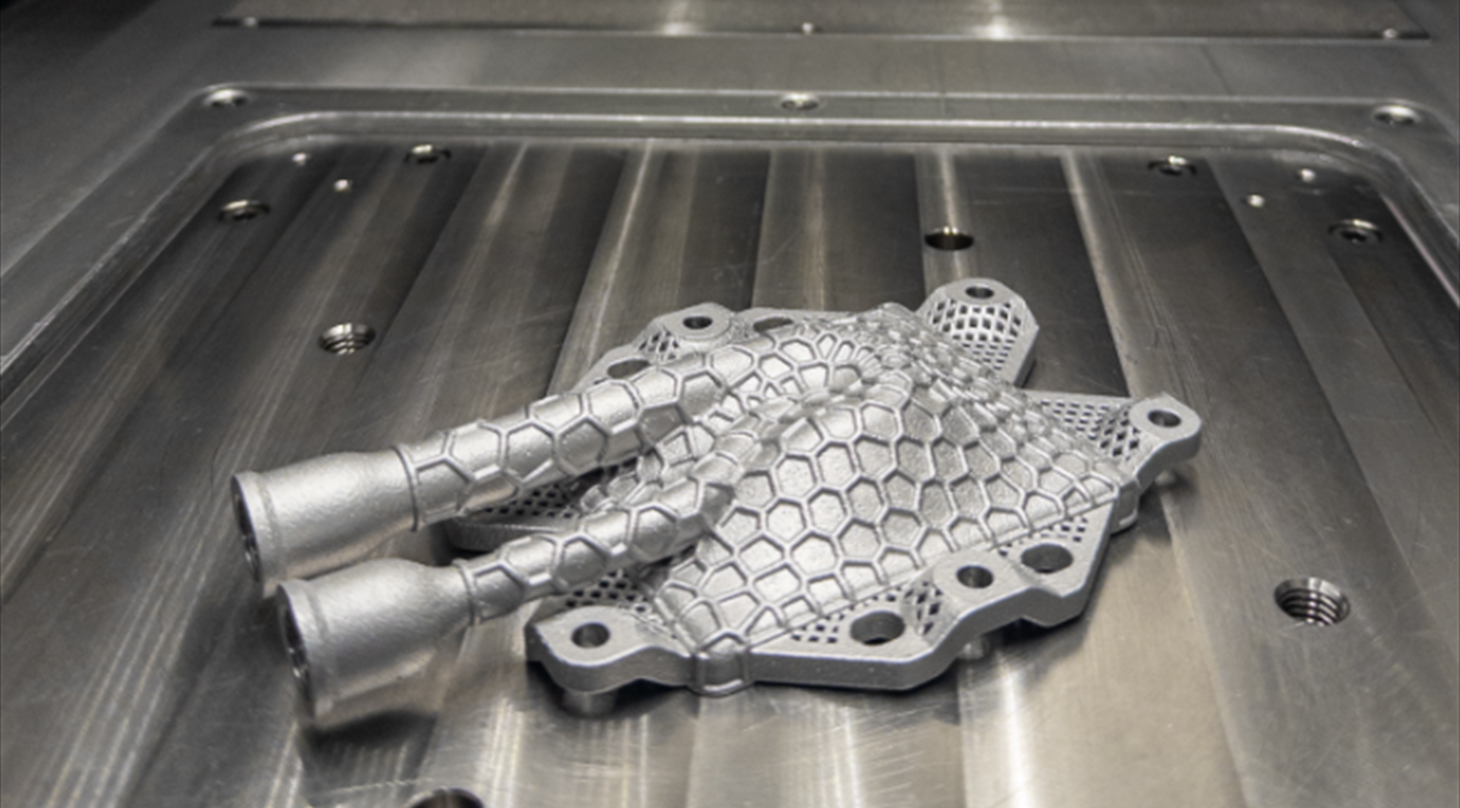
A new 3D-printed solution significantly reduces energy consumption for cooling in data centers
Press Release - januar 2026
Danish Technological Institute and Heatflow develop energy-saving cooling solution for data centers using 3D printing. In the long term, it could make excess heat usable for district heating.
Data centers face a growing challenge with increasing energy consumption for cooling servers and GPUs. A European research project has now demonstrated a new cooling solution that significantly reduces energy use and extends the lifespan of computer chips – while enabling the reuse of waste heat.
In the recently concluded AM2PC project, Danish Technological Institute and Heatflow, together with two international partners, have developed and tested a 3D-printed cooling component for data centers and high-performance computers. The solution uses passive two-phase cooling and achieved a cooling capacity of 600 watts in tests – 50 percent more than the original target of 400 watts.
This development comes at a time when energy consumption by data centers is a growing challenge. In countries like Ireland, for example, data centers use such a large share of total energy consumption that legal restrictions have been introduced.
- Besides the actual IT hardware, the corresponding cooling infrastructure is one of the major energy consumers in a data center - and therefore the greatest potential to improve overall system efficiency, explains Simon Brudler, 3D-printing specialist and senior consultant at Danish Technological Institute.
At the same time, GPU power consumption has risen from 100–200 watts just a few years ago to several hundred or even kilowatts today, so there is also a need for more efficient cooling.
- We are seeing a development where the power density in servers is increasing faster than ever before, and traditional air cooling is simply no longer sufficient. With our two-phase solution, we can remove heat passively without pumps or fans, which significantly reduces the energy consumption for cooling, says Paw Mortensen, CEO of Heatflow, who led the AM2PC project.
Passive cooling without energy consumption
The new solution differs from conventional air cooling by using a coolant that evaporates at the hot surface. The vapor naturally rises due to differences in density, condenses elsewhere (where it releases heat), and returns as liquid through gravity. This passive two-phase process with coolant – a so-called thermosiphon principle – requires no pumps and thus consumes no energy for heat removal. At the same time, evaporation is much more efficient than traditional cooling with air and liquid, so the amount of heat removed from the computer chip is much higher – and the chip remains cooler, helping to extend its lifespan.
The key component in the system is an evaporator, which Heatflow and Danish Technological Institute have developed and manufactured with 3D printing.
- By 3D printing the component in aluminium, we can integrate all necessary functions into a single part. This eliminates assembly points, reduces the risk of leaks, and makes the component more reliable. At the same time, we use only one material, which makes it easier to recycle, explains Simon Brudler.
Enables reuse of excess heat
The project’s focus has been to develop and manufacture the evaporator and validate its performance. This has succeeded beyond all expectations – but a central result of the project is also that the solution removes heat at temperatures between 60 and 80 degrees Celsius. When heat is extracted at such high temperatures, it can be used directly in the district heating network without additional energy input, but it could also be used for other industrial processes within e.g. food and beverage, textile, paper and pulp, or in agriculture for heating greenhouses - if they are located close to the heat source.
In comparison, traditional air cooling of servers typically removes heat at lower temperatures, making it less suitable for district heating and industrial processes.
- In the project, we did not focus on the integration with district heating itself, but we have demonstrated that the technology enables it. This is an important step toward more energy-efficient data centers that can contribute positively to the overall energy balance, emphasizes Simon Brudler.
Less material use and better recyclability
Besides the energy savings during operation, the project also shows environmental benefits in manufacturing. By using 3D printing, the overall material usage is reduced compared to conventional solutions that consist of several components made of different materials.
And since the component is produced from a single material, it can be more easily recycled at the end of its lifetime, as there is no need to separate materials.
As this is a demonstration project, it is too early to talk about final environmental benefits, but life cycle analyses indicate that the solution can reduce total emissions by 25–30 percent per unit.
About the AM2PC project
AM2PC is a European research project focused on developing a 3D-printed component for two-phase cooling of data centers. The project is supported by M-ERA.NET, with Danish funding from Innovation Fund Denmark. The total budget is DKK 10 million, and the project period is from 2023 to 2025. In addition to Heatflow ApS and Danish Technological Institute, Open Engineering from Belgium and Fraunhofer IWU from Germany are also participating.
Further information
Senior Consultant Simon Brudler, Danish Technological Institut, mobile: 7220 2571, email: sib@teknologisk.dk
CEO Paw Mortensen, Heatflow ApS, mobile: 6196 7378, email: paw.mortensen@heatflow.dk