Danish development project aims to recover end-of-life circuit boards
Press Release - june 2026
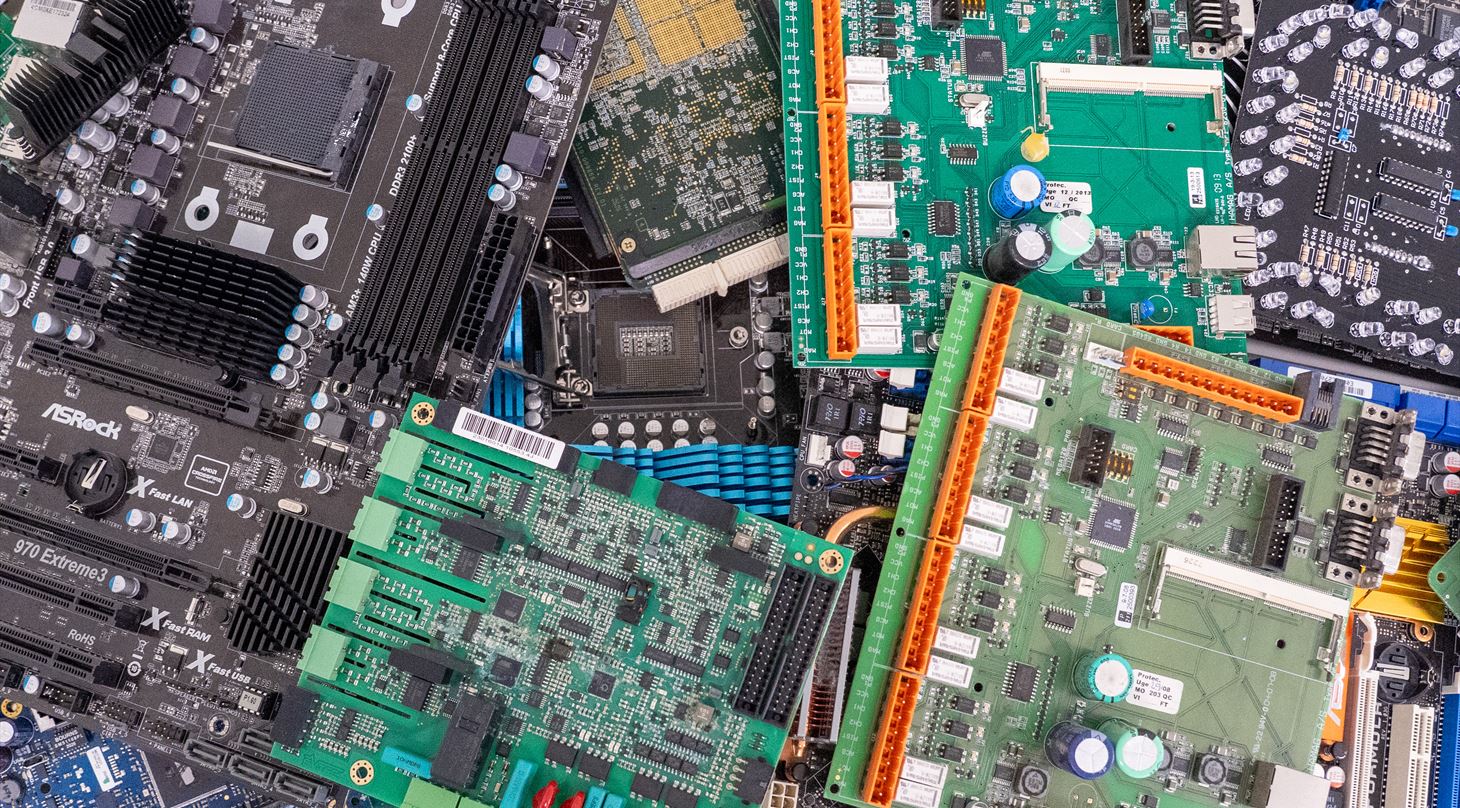
When used electronics are discarded, printed circuit boards (PCBs) containing critical and strategic raw materials worth millions often end up in high-temperature treatment, where much of their value goes up in smoke. Now, a Danish development project aims to save electronic waste from destruction to ensure that valuable components and raw materials are recycled and reused.
E-waste is one of the world’s fastest-growing waste streams - with global volumes increasing by 82 percent from 2010 to 2022. At the same time, Europe is heavily dependent on imports of critical raw materials and electronic components.
A Danish industrial consortium now plans to recycle printed circuit boards and electronic components, thereby keeping critical raw materials in circulation, benefitting both decarbonization and European supply security.
“When we discard electronics, we are also discarding materials and components that Europe desperately needs. At the same time, printed circuit boards and electronic components account for most of the carbon footprint of electronic products. There are therefore several good reasons to increase the circularity of printed circuit boards, and that is precisely what we aim to do at CIRCUIT,” explains project manager Aisha Rafique from Danish Technological Institute.
Three paths to circular electronics
The CIRCUIT project is working on three parallel tracks: component reuse, responsible design, and recovery of critical raw materials.
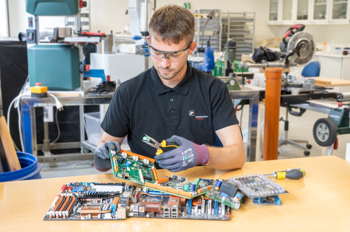
Many PCBs are coated with epoxy-based materials, which makes them difficult to disassemble without destroying valuable parts. The CIRCUIT project will develop methods for gentle disassembly and quality assurance so that functional components can be reused.
“If we can remove the components in a gentle and efficient way, it opens up new business opportunities for reused and quality-assured electronic components,” says Casper Roensbech from El Recycling, the project’s lead applicant.
The CIRCUIT project also focuses on developing new design principles that reduce the climate footprint of future PCB production.
“If we succeed in designing PCBs with a lower carbon footprint without compromising quality or functionality, it can significantly reduce the product’s overall carbon footprint,” says Peter Chr. Petersen from LINAK.
For DEIF, CIRCUIT opens new ways of collaborating.
“For DEIF, CIRCUIT is particularly valuable because the project brings together the entire PCB value chain – from design and production to end-of-life management. This enables us to explore solutions that can be integrated into DEIF’s existing development and design processes,” says Senior R&D Manager Gitte Jespersen at DEIF A/S
Finally, the project will work on recovering critical raw materials that would otherwise be lost. Here, Nordic Salt Cycle has developed a molten salt technology that can recover valuable materials such as tantalum and rare earth elements at lower temperatures than conventional melting processes.
- Europe is almost entirely dependent on imported critical minerals, but much of that value is already in our waste. We unlock that potential by providing the low-cost refining technology that Europe currently lacks, says CTO James Amphlett from Nordic Salt Cycle.
Aiming to strengthen European supply security
The global market for critical minerals for the energy transition has, according to the Draghi report, doubled over five years, and demand is expected to increase by a factor of 4–6 by 2040. At the same time, export restrictions from raw material suppliers such as China have increased fivefold since 2009. During the chip crisis of 2020–2023, hundreds of industries experienced production stoppages because the supply of components collapsed.
By recovering critical raw materials, the project contributes to the strategic supply security targeted by the EU’s Critical Raw Materials Act.
“The global chip shortage hit the entire industry hard. Our solutions can help ensure that Danish companies have access to the components they need - even when supply chains are under pressure,” says Thomas Krahn Jessen from HJHansen Recycling Group.
FACTS ABOUT CIRCUIT
CIRCUIT (2026–2028) will develop methods for reusing electronic components from end-of-life PCBs and recycling critical raw materials from electronic waste (WEEE).
PCB’s and electronic components account for the majority of the carbon footprint of electronic products, partly due to the energy consumption involved in the extraction and processing of raw materials. Apple estimates that the amount of gold and copper in 1 tonne of used phones is equivalent to having to extract 2,000 tonnes of ore from a mine.
CIRCUIT is supported by the Danish Environmental Protection Agency’s Environmental Technology Development and Demonstration Program (MUDP) under the Ministry of the Environment and has a total budget of DKK 9.2 million.
CIRCUIT is a collaboration between El Recycling (lead applicant), the Danish Technological Institute (project manager and knowledge partner), HJHansen Recycling Group, NCAB Group, DEIF, LINAK, and Nordic Salt Cycle.
Contact:
Aisha Rafique
Project Manager, Danish Technological Institute
Mobile: 7220 2336
Mail: araf@teknologisk.dk
René Wad Andersen
Senior Communications Consultant, Danish Technological Institute
Mobile: 7220 1474
Mail: rea@teknologisk.dk