Danish partnership aims to recycle overlooked textiles
Press Release - march 2026
Carpets and upholstery fabrics from ships and hotels have significant recycling potential that is not currently being fully utilised. A Danish partnership aims to change that.
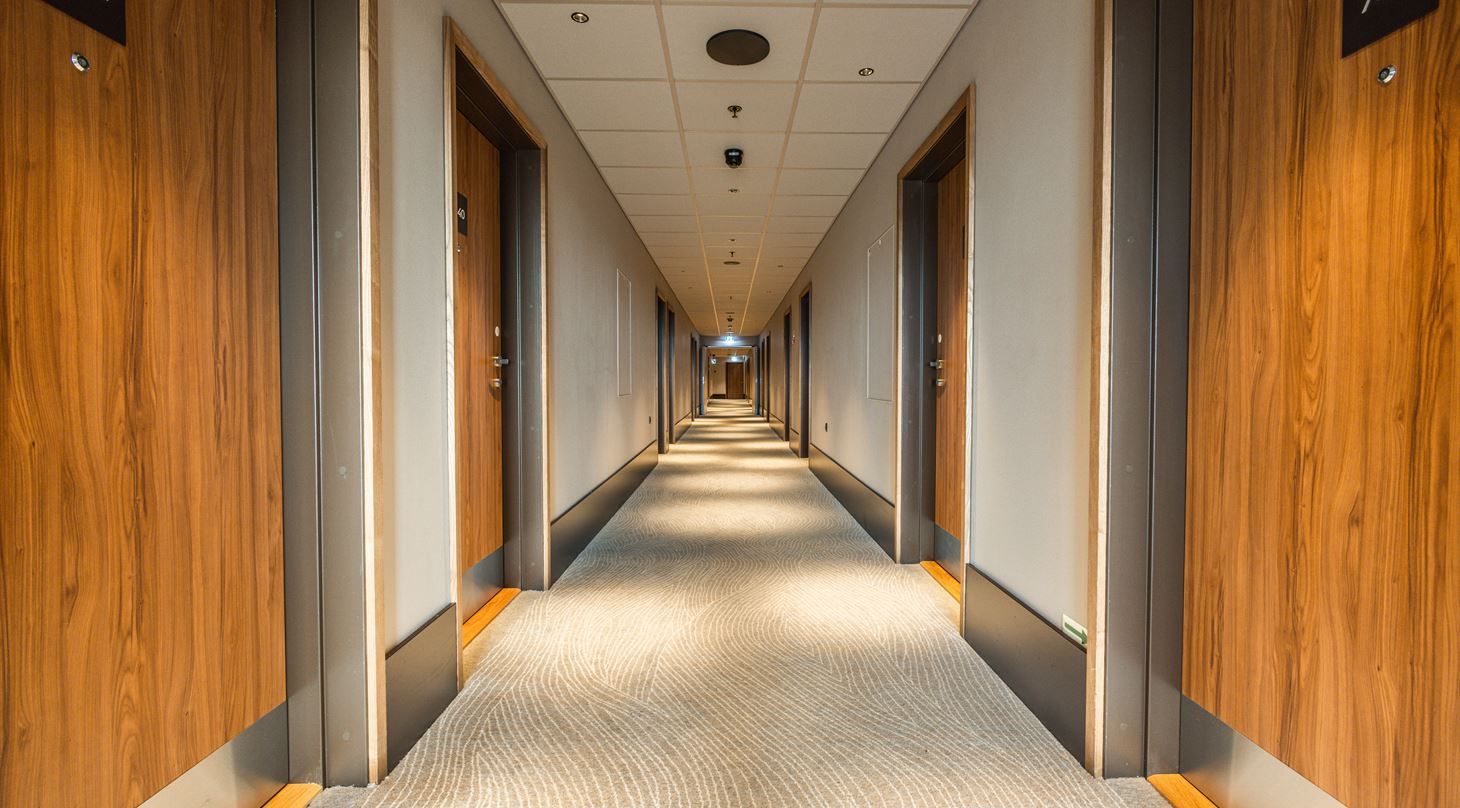
Many offices, hotels, ships and other public spaces are fitted with carpets and upholstery fabrics made from wool-nylon blends. The combination of materials gives the products a very long lifespan, but complicates the recycling process when they are replaced. Manufacturers, researchers and knowledge partners have joined forces in the UnBlend partnership, which aims to make textiles easier to reuse and recycle.
Aiming to extend the lifespan of wool-nylon textiles
Tons of high-quality carpets and upholstery fabrics go up in smoke when offices, hotels, ships, libraries, theatres and other public spaces refurbish their interiors. In the EU alone, an estimated 1.6 million tonnes of carpets are disposed of every year, and the vast majority are incinerated or end up in landfill.
The challenge with carpets and upholstery fabrics is that the textiles often consist of complex blended materials such as wool and nylon, which are currently difficult to recycle, even though the material quality is high. It’s a shame, says Business Manager Julie Brender Trads from Danish Technological Institute, who heads the UnBlend partnership:
– Wool-nylon blends are high-quality materials that are easily overlooked because they make up only a small part of the total textile stream. On the other hand, it is a large and uniform textile stream that can be collected when a hotel or ship changes its interior or undergoes renovation. A cruise ship can easily be covered with enough carpet to cover 5–10 football pitches. These large quantities are an advantage when the ambition is large-scale recycling.
From circular design to unique products
UnBlend takes a holistic approach to the challenge of wool-nylon blends. Rather than focusing solely on a single technical solution, the project partners are working in parallel on three tracks: better design, creative reuse and recycling technologies.
The design track explores how products can be constructed more intelligently, for example using fewer types of adhesive and more appropriate material combinations, facilitating later disassembly and recycling among other things. At the same time, the partners are experimenting with reusing and redesigning textile scraps into unique products. Finally, existing and new recycling technologies are being tested to find effective methods for separating wool and nylon, so that the two fibres can be recycled separately and returned to the cycle.
– If we succeed in separating wool and nylon effectively, we can ensure the continuous recycling of high-quality materials. By recycling materials in a closed loop, we can simultaneously reduce the environmental impact significantly compared to wool and nylon produced from new raw materials, says Jeppe Emil Mogensen, Design Director at the textile company Gabriel.
Interdisciplinary collaboration as a prerequisite
The UnBlend partnership was established by Danish Technological Institute, which has brought together textile manufacturers (Gabriel, Dansk Wilton, SheWorks), researchers and knowledge partners (DTU and Danish Technological Institute) and designer researchers (Design School Kolding).
– For many years, we have been working in various ways on solutions within circularity and recycling, but there is a lack of commercial solutions for our type of material composition. That is why it is relevant for us to be part of UnBlend, which brings together many areas of expertise and enables new solutions, says Lone Ditmer, CEO at Dansk Wilton, a global manufacturer of carpets for the international hospitality industry.
About UnBlend
UnBlend is supported by just under DKK 11 million from TRACE and will run for two years. TRACE is a mission-driven research and innovation partnership working to create a circular economy for plastics and textiles by 2050.
Partners: Gabriel, SheWorks, Dansk Wilton, DTU, Design School Kolding and the Danish Technological Institute.
Wool-nylon blends are currently used in large quantities on cruise ships, in hotels, offices and public buildings, particularly in carpets and furniture upholstery. Yet tonnes of high-quality carpets and furniture textiles are sent for incineration or landfill when interiors are replaced.
Contacts
Julie Brender Trads
Business Manager, PhD, Danish Technological Institute
Email: jutr@teknologisk.dk
Mobile: +45 72 20 36 71
René Wad Andersen
Senior Communications Consultant, Danish Technological Institute
Email: rea@teknologisk.dk
Mobile: +45 72 20 14 74