Danish Technological Institute helps Danish SME test new technology for recycling copper wires
The company EcoAdvice has set out to develop a sustainable and circular process for recycling copper wires. This led to a project under MUDP, and during the project the Danish Technological Institute has been responsible for testing the copper wires in the laboratory.
EcoAdvice is a small Danish consulting company specializing in circular economy, which they advise their clients on daily. In the course of their day-to-day advisory work, EcoAdvice’s ambition grew to develop and follow a concept all the way through themselves. That ambition became the starting point for a preliminary project under MUDP, which is part of the Danish Environmental Protection Agency, where the goal is to develop a sustainable and circular process for recycling copper wires.
- I have a practical background as a craftsman and electrician, and therefore I have also wanted to be involved in the practical part of having something in my hands and not letting go of a project before it has been realized, says Kåre Hinz, co‑founder of EcoAdvice.
Cross-disciplinary collaboration to ensure correct development
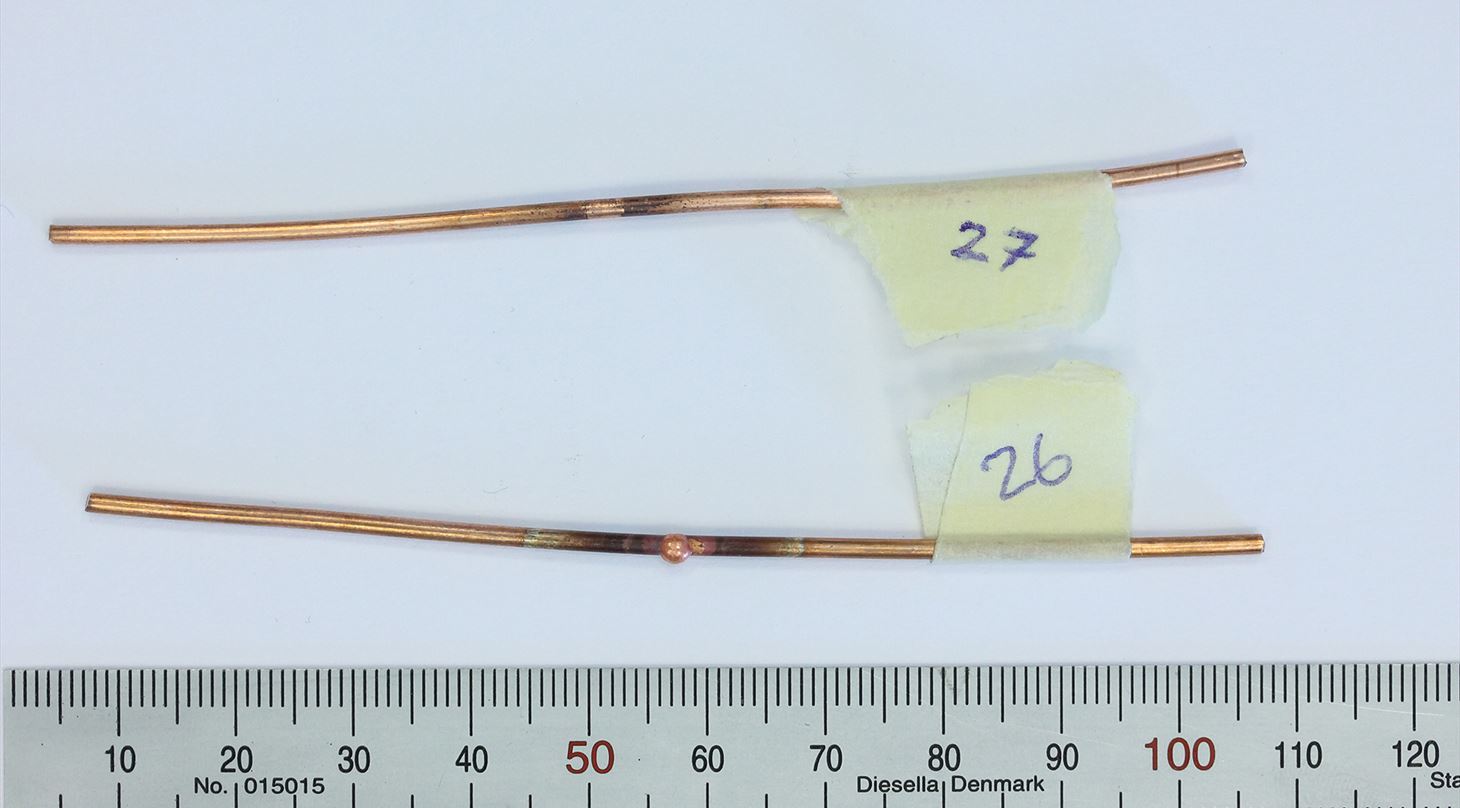
With the desire to be able to carry a project across the finish line themselves, Kåre Hinz chose to submit an application for an MUDP preliminary project in order to have the idea of recycling copper wires tried out and tested. The Danish Technological Institute was contacted, and during the preliminary project the institute has been responsible for testing the quality of the submitted test specimens in its laboratories. Among other things, the mechanical properties of the re‑manufactured copper wire were examined under the microscope.
“The aim of the preliminary project has been to prove that our idea is viable, and it was precisely in this context that the Danish Technological Institute came into the picture. We lacked the specific knowledge and technological equipment that the Danish Technological Institute possesses in order to ensure a sufficient quality of our test specimens,” says Kåre Hinz, and adds:
This has meant that the Danish Technological Institute has contributed both technical expertise and technological know‑how, and they have also helped to verify the project idea itself. It’s one thing that I think it is a good idea and still believe in it, but it’s another thing whether others also believe that it can turn into something – and it is in this area that I have used the Danish Technological Institute.
- Kåre Hinz, EcoAdvice
The goal is to develop a safe and circular design concept
For EcoAdvice, circular economy plays an absolutely essential role, which has also been the starting point of the project, where the goal is to develop final cable products based on a safe and circular design concept. Therefore, EcoAdvice wants to retain the value through re‑manufacturing copper wires instead of traditional recycling, where high‑value copper wires are broken down into copper granulate.
Although there is already a well-functioning infrastructure for recycling cable scrap, it is interesting to explore the opportunities offered by the circular economy. These potential opportunities also show how the current method is not necessarily very appropriate.
-So why should we be satisfied with copper wire being chopped into small pieces and remelted in order to be reused? That is what is interesting to question, says Kåre Hinz.
Trials already show huge CO2 savings
In addition to the fact that the test specimens have been evaluated in the preliminary project, the focus has also been on analysing the business potential and calculating the derived environmental effects of the re‑manufacturing technology. The calculations in particular have shown very positive results for efficient and appropriate handling of cable scrap.
The calculations show a huge CO22 saving compared to traditional production, and that is simply because we do not have to send copper granulate to the other side of the globe to be remelted. Our technology can enable more local processing of materials while at the same time we do not have to melt it down with this method
- Kåre Hinz, EcoAdvice
Application for continuation of the project has already been submitted
With the positive results from the preliminary project, EcoAdvice has taken the next step and submitted an application for another MUDP project – and if the application is approved, the next project will focus on developing an integrated pilot plant where the technology can be tested in practice.
At present, sorting cable scrap is a resource‑intensive process. EcoAdvice therefore aims to develop a concept with systems and service packages that create an incentive for electricians and demolition contractors to spend a little extra time on disassembly. In this way, they avoid cutting the cable scrap into pieces that are too small, and at the same time they sort the cables while they already have them in their hands.
- The future development concept is to provide a logistics solution and a pricing method that makes it relevant for existing actors to selectively dismantle and sort the cable scrap, concludes Kåre Hinz.
About MUDP
The vision for MUDP is that Danish companies should be leaders in the development, commercialization and use of future environmental technology solutions. Therefore, in 2022 the MUDP fund is making DKK 120 million available for projects that pave the way for and strengthen new innovative ideas, contribute to greener solutions, and create jobs and exports of environmental technology.