Danish Technological Institute performed accredited tensile tests on prematurely dissolved sutures
When the maternity ward at Aarhus University Hospital discovered that the suture thread used to stitch women after perineal tears during vaginal birth was dissolving faster than expected, a larger investigation was initiated. During the investigation, the Danish Technological Institute assisted with accredited tensile tests on the suture threads.
At Aarhus University Hospital, women who experience perineal tears during vaginal birth are stitched with suture thread and subsequently checked two days after suturing. Normally, the suture thread will maintain the same tensile strength for five days and then lose half of its tensile strength, finally losing its tensile strength completely within ten days. It was precisely during the routine check by midwives on day two that a suspicion of a clinical problem arose at Aarhus University Hospital.
- We wondered why it appeared that the thread in some of the women had snapped. We know the properties of the thread and have therefore been able to see that it looks as if the thread has crumbled away or has been pulverized far too quickly, says Sara Kindberg, midwife, PhD, and clinical specialist in birth tears at Aarhus University Hospital.
The problem was investigated from several angles
It is standard procedure that women are locally anaesthetized with either Xylocain gel or Xylocain spray before they are sutured. And it was precisely in connection with the local anaesthesia that a suspicion of a clinical problem arose among midwives and doctors at Aarhus University Hospital: perhaps it was not necessarily the quality of the suture thread that was the problem – instead, the local anaesthetic or its additives might be a contributing factor to the premature dissolution of the suture.
Therefore, midwives and obstetricians set up a laboratory experiment in which the suture threads were placed in a warming cabinet for 72 hours to achieve the closest possible resemblance to human body temperature, with four different tests in which the threads were exposed to different types of anaesthesia. After the 72 hours, it became clear that in one of the tests the thread had lost its strength and snapped after a shorter time than in the other test setups. That local anaesthetic was then also withdrawn from use in the delivery ward at the Department of Obstetrics, Aarhus University Hospital.
We wondered why it appeared that the thread in some of the women had snapped. We know the properties of the thread and have therefore been able to see that it looks as if the thread has crumbled away or has been pulverized far too quickly.
- Sara Kindberg, Aarhus University Hospital
The Danish Technological Institute assisted with accredited measurements
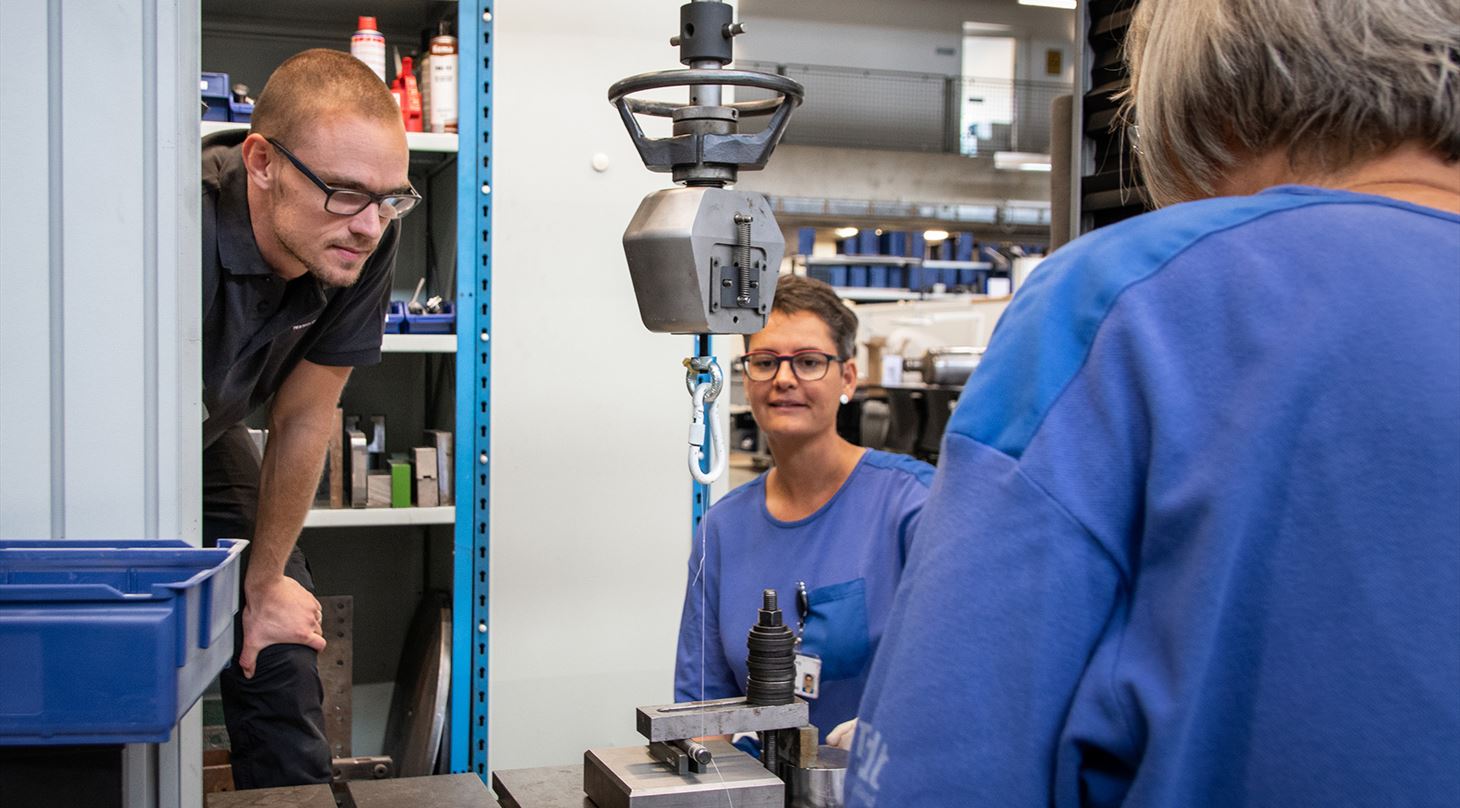
To get closer to confirming or disproving the hypothesis regarding the prematurely dissolving suture thread, the Danish Technological Institute was involved in the investigation. In collaboration with Aarhus University Hospital, the suture thread was examined via accredited tensile tests, where a machine and software setup was implemented that could measure tensile strength with great precision based on the data set.
The local anaesthetic that Aarhus University Hospital suspects of being the cause of the prematurely dissolving suture thread has, at the time of writing, been removed from use in the maternity ward.