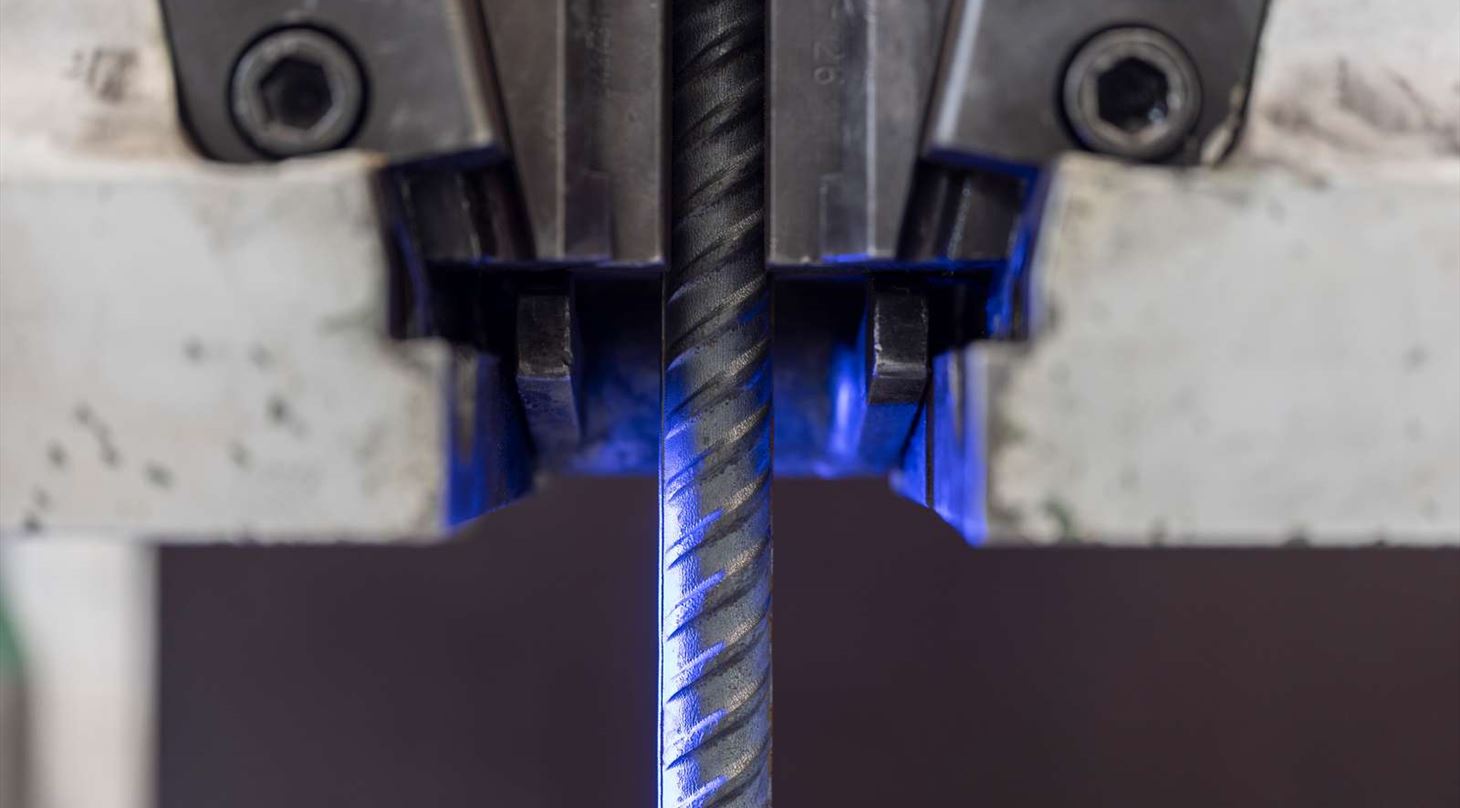
Do you know the quality of your materials?
If you work with metallic materials, the concept of “quality control” is probably not new to you. But beyond creating assurance, documentation of quality can also create value. How? We provide some insight below.
There can be many reasons why it is valuable to know the quality of your materials. One of the key ones is that the better you know your material, the more you can rely on it – and then it becomes easier to dimension your components and products optimally.
When a component is being designed, many people work with a safety factor that they add to account for uncertainties – for example, you might choose a larger bolt size to be sure it can withstand the load. But if you have greater knowledge of your material and how it behaves in different situations, you have the opportunity already in the design phase to optimize your components and dimension them more precisely, thereby reducing waste in production.
Unfortunately, quality control is not free, and there will naturally be situations where it is not worthwhile to thoroughly test the material because it does not match the price or importance of the component. Therefore, you should always look at the context in which the material will be used – and assess how much testing is needed.
- Sometimes it may simply be more economical to go one bolt size up to be safe, or to make the wall thickness twice as large. That could be the case for one‑off productions or small series. But where the material is critical, it has to be specified and documented more precisely so you know it can hold, says Otto Lundgren Hejgaard, Product Manager and testing expert at the Danish Technological Institute.
For large production runs or where weight and space are an issue, there can also be economic or design advantages to reducing the amount of material as much as possible, and here you also need to know the quality of the material to know whether less material will still be strong enough.
Another important reason to know the quality of your materials is if you need to document it to your customers. If you have a high degree of documentation on your materials and components, the customer will gain confidence in them more quickly. It signals that “you can trust what I am delivering here,” and then you do not need to have had a 10‑year collaboration to know that the product will last.
Where will the documentation be used – and why?
There are a number of industries where documentation of material quality and properties is built in as a requirement. This applies, for example, to the offshore industry, where it is extremely difficult to fix things if they fail, and therefore the aim is to minimize risk as much as possible. For example, large wind turbine manufacturers and ship designers require all subcontractors throughout the supply chain to have a very high level of documentation of their materials and to test everything very specifically. In this way, the initial costs are higher, because documentation is expensive, but the companies have concluded that in the end it pays off compared to the cost of repairs later on.
Quality assurance is also increasingly used in the manufacturing industry, where we see a trend towards projects becoming larger and more complex, with many subcontractors who each only play a small part in a larger project. This increases the risk, and then the need arises to reduce it.
In Denmark, it is often subcontractors to, for example, large car manufacturers and wind turbine producers or major construction projects that face requirements for testing and documentation of the metals used in the construction processes. It therefore makes sense to be ahead of the curve, because the norm is moving in the direction of more documentation
- Otto Lundgren Hejgaard, Danish Technological Institute
Another domestic example where there can be great value in documenting quality is metal 3D printing. Here, the roll‑out has been slower than expected, and studies have shown that this is partly due to skepticism about quality. Documentation of quality can therefore help convince industry that the quality is in order.
Test til formålet – og dokumentér det
When testing and documenting quality, you typically look very closely at the mechanical properties of the material you receive. There are some general international standards – for example, what structural steel S355 must be able to withstand mechanically. These are completely official requirements that can be tested to see whether the material meets them or not.
In addition, there are the more user‑specific requirements related to how the material is to be used. If a material is to be used in district heating systems, for example, it may need to maintain the same mechanical properties at 150 degrees Celsius – but the standards often say nothing about that. In such cases, you test whether the material at the specific operating temperatures meets the user‑specific requirements.
Many large companies impose this type of user‑specified requirement on their sub‑ and material suppliers. This can include everything from tensile tests, where you test basic mechanical properties such as ultimate tensile strength, yield strength, and elongation, to Charpy impact testing and notch formation, where the component is dynamically loaded to test how quickly it begins to crack. In addition, fatigue testing can be carried out to investigate the material’s ability to withstand fatigue failure, which is a major problem and the cause of many breakdowns.
- Fatigue tests are very widely used for simulating larger projects, especially because there is rarely very good standard data on how well a material performs in relation to fatigue failure. We carry out quite a lot of these tests at the Danish Technological Institute – both to characterize the material itself and also joints when they are welded together. So these are the most common tests used to describe mechanical properties: tensile tests, impact (notch) tests and fatigue, says Otto Lundgren Hejgaard.
A specific scenario could be, for example, that you have received a requirement from a customer that your component must withstand a yield strength of 250 megapascals. That is a user‑specific requirement, and you therefore test that your component meets it. You end up with a test report showing what the yield strength is – for example 280 megapascals – and then the customer has that report as documentation that your component meets the requirements. Alternatively, you can go to your material supplier and complain if the test documents that the material does not meet the specified requirements – so you can get replacement goods if necessary. The test results can also be used if you are unsure whether the delivered quality meets your requirements – for example in the case of a new supplier.
Quality documentation creates value
The value of knowing the quality of your materials is that you can document it when necessary. This means, for example, that you can enter into collaborations where documentation is required, or that you can document your quality in the event of a failure – these are two important areas.
In addition, in the vast majority of tenders there is both a price factor and a quality factor. Here you can gain a competitive advantage if, with accredited tests, you can document and guarantee your quality – even if your solution is slightly more expensive. So even if your competitor is perhaps 10% cheaper, you can win the tender if the competitor only has in‑house quality control as documentation.
There can also be value to be gained in a development context. More and more people are using Finite Element calculations, and often you will use databases with standard values for, for example, structural steel. But you risk lacking a lot of data if you only have the standard databases – for example, how the material behaves over time, how it behaves at elevated temperature, or how it performs in relation to fatigue. If you have these data from quality tests, they can be imported into the models, and to be able to build good models, it is important to have as solid a data basis as possible.
A number of the tests mentioned above cannot be carried out in‑house by a subcontractor. In such cases, the Danish Technological Institute is ready to help. We have extensive experience with all types of material testing, which we carry out in our accredited test laboratory. In this way, you can also be completely sure that the documentation is valid and that the test data are representative of reality.
Feel free to contact us to hear more about the different options.