Increasing stability of bolted assemblies for space applications using a new tool
Danish Technological Institute has verified the stress levels applied when joining a bolted assembly and verified a favourable stress distribution when using a newly developed tool by OHB.
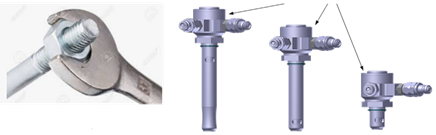
Conventional bolt and wrench (left) and TFTT (right)
The benefit of using the tool is less tension on the bolt, and thereby less risk of warping during or after a launch, ensuring the best dimensional stability.
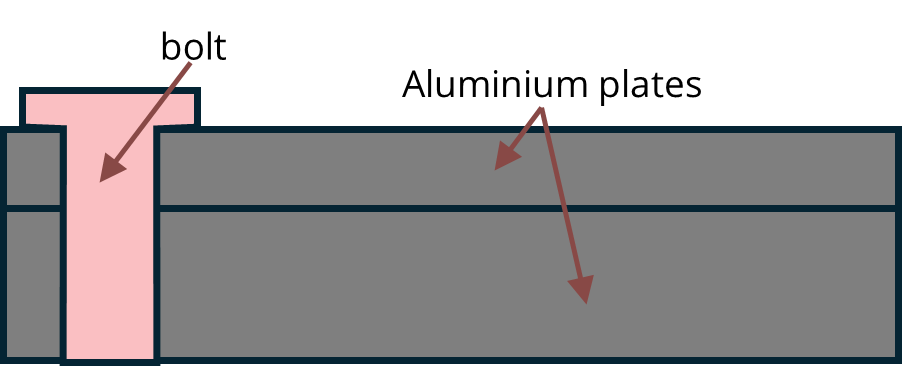
Sketch of measured samples
Minimizing stress during tightening
In a bolted assembly, unfavourable tensile stress distribution is applied to the bolt during tightening. OHB has developed a new method - the Torque Free Tension Tool (TFTT) - for joining two plates. This method minimizes the tensile stress by applying pre-tension to the bolt before and during assembly.
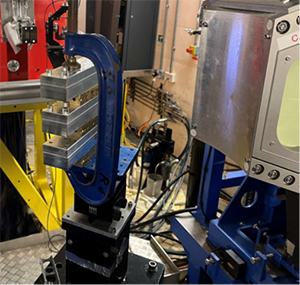 Danish Technological Institute has measured the stress in assemblies consisting of two joined aluminium plates and verified that the TFTT produces a much more favourable stress distribution compared to the conventional assembly with a torque wrench.
The imga eto the right shows samples mounted at the instrument at EnginX, ISIS.
Using non-destructive measurements
As the stress of interest is mechanically imposed stress in a full assembly, a non-destructive measurement technique is needed to evaluate it. Measurements were therefore performed using neutron diffraction. This enabled us to map the applied stress in the bolt, relative to an unassembled bolt, through the thick aluminium plates.
The measurements show that the conventional bolt assembly has a sharp stress gradient from the shaft to the head. The TFTT tool gives a uniform stress distribution in the shaft and through the head. By evening out the high stress gradient in the shaft, the risk of stress related failures and deformations is minimized.
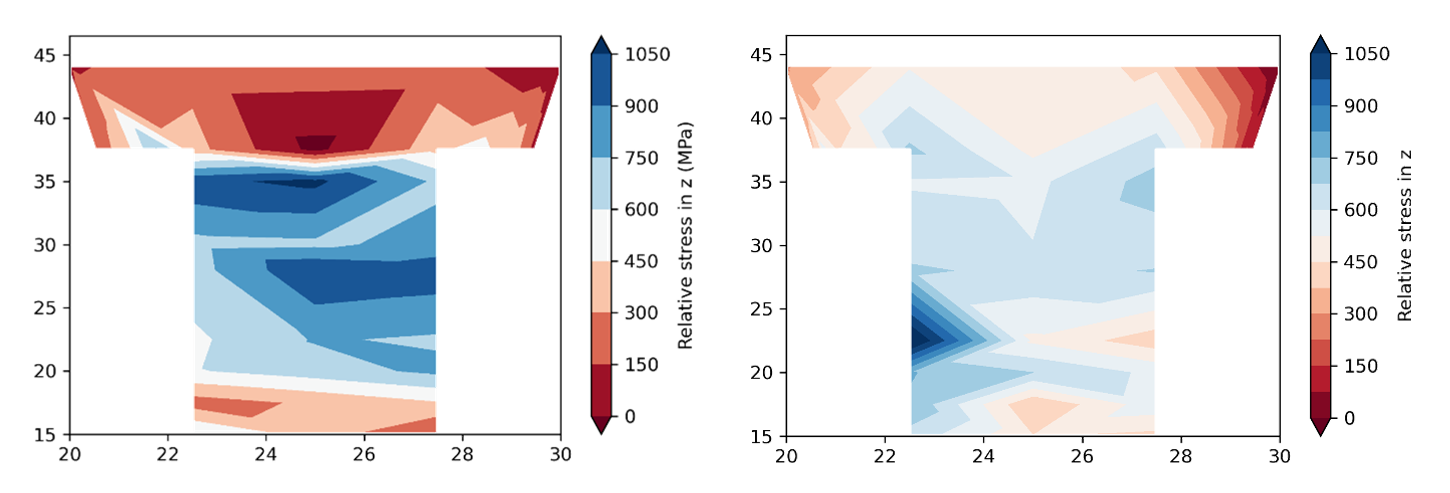
To the left, we see applied stresses in the bolt along its axial direction of the conventional joining using bolt and wrench. To the right, we see Applied stresses in the bolt along its axial direction of the TFTT tool.
This work was funded by the EASI-STRESS project that has received funding from the European Union’s Horizon 2020 research and innovation programme under grant agreement No 953219.