Robots with AI-powered eyes give new life to used electronics
31 October 2025
By combining artificial intelligence with advanced robotics, the Danish Technological Institute (DTI) is working to pave the way for a new era in which electronics no longer end up as waste but can instead be repaired, upgraded and given a new lease of life.
More and more of us are both producing and consuming electronics. But far too much of what we discard could, in fact, have been given a new life.
According to the UN’s latest report, "The Global E-waste Monitor 2024", the world generated a total of 62 million tonnes of electronic waste in 2022 – a trend which, according to the experts behind the report, is only expected to grow in the coming years.
That corresponds to half a billion laptops.
The report also shows that only one in five devices is handled by established collection and recycling systems, while the rest ends up as rubbish.
This trend is the background for the ambitious EU project RoboSapiens, in which DTI, together with colleagues from across Europe, is working to push the boundaries of what robots can do.
By using AI and advanced robotic technology, the aim is to make it not only possible, but also profitable, to repair and refurbish electronics – including laptops – on a large scale.
This will both save valuable materials and reduce CO₂ emissions.
– As a society, we are producing and consuming more and more electronics. And a great deal of it is thrown away, even though it could actually be repaired. It takes a lot of CO₂ to produce all these products. And they contain a lot of valuable and rare materials that it makes good sense to retain, says Mikkel Labori Olsen, Product Manager at DTI.
Robots that learn along the way
The core of the RoboSapiens project is to make robots intelligent and adaptive.
Today, most industrial robots can only perform one type of task in one specific way. But repairing used electronics requires the ability to navigate a multitude of models, faults and unforeseen situations.
– The purpose of RoboSapiens is to extend how much robots can adapt to new or unseen events. Especially when working with used products, there is a need for the robot to be able to deal with different models that it may not have been programmed for initially, explains Mikkel Labori Olsen.
The project brings together a number of European partners − including Aarhus University − and is funded by the Horizon Europe research and innovation programme.
As part of the project, demonstrations are being carried out − including refurbishment cases at Danish companies, where robots handle complex tasks such as replacing defective laptop screens.
A process that has so far been so varied and labour-intensive that manual labour was required – and capacity limited.
A collaboration between human and machine
A crucial element of the project is that the robot does not take over all the work, but supports and collaborates with the operator.
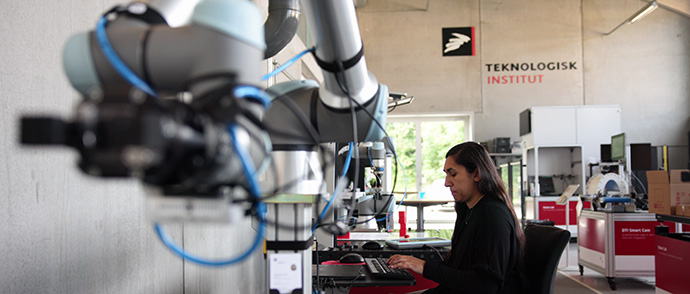
– We are working on using a robot to help us disassemble a computer and then reassemble it. So if, for example, we have a damaged screen, we can use this robot to help us automate the process. It figures out which steps I need to go through in order to remove the screen, fit a new screen, and then refurbish it – ready as new, says Malaika Din Hashmi, Consultant at DTI.
Here, robots, advanced vision technologies and AI-based decision logic are used.
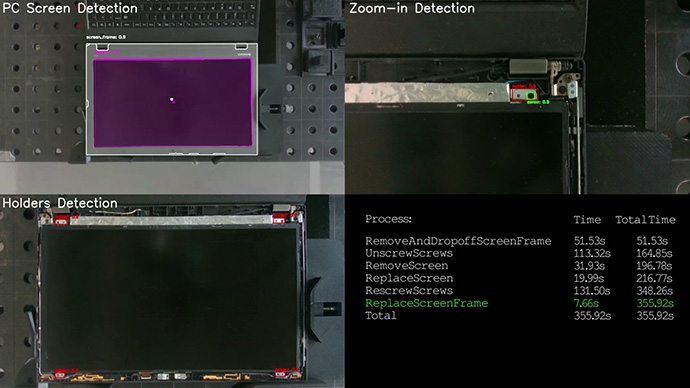
Among other things, the robot uses cameras to identify the model, dimensions and faults – and can adjust its working routine if, for example, a screw is missing or if the computer model differs.
This makes the solution adaptive and generalisable – and not dependent on every single work process having to be programmed individually.
– In reality, robots are actually very dumb. They only do what they are told. That is not much use if you don’t know which computer you will receive, or how it has broken down. The difficult thing about repairing laptops is that there are big differences in how they have broken and how they must then be repaired, says Mikkel Labori Olsen.
– In this project, we are creating a combination of completely standard automation components, which ensure high efficiency and robustness, combined with some new innovations within AI that enable us to deal with changing faults and the localisation of them. For example, if some of the screws needed to mount the screen are missing, it can take this into account and still complete the task, says Mikkel Labori Olsen.
Great potential
The reality is that the volume of used electronics is growing far faster than the number of hands available to handle it. As long as disassembly of, for example, laptops requires up to half an hour of manual work per unit, a natural barrier arises to how much can be reused and refurbished.
– That challenge can only be solved with more flexible and intelligent automation, says Malaika Din Hashmi.
– Adaptive robots can make it possible to increase capacity significantly – while keeping the operation on Danish soil. This benefits both companies, which are facing major challenges in finding enough specialised labour, and the environment, because transport, energy consumption and material waste are reduced, she adds.
If you, as a company, would like to know more about robotic technology for refurbishment or collaboration opportunities with DTI, please contact Malaika Din Hashmi on +45 72 20 28 13 or mdih@dti.dk.