Tests to document increased fatigue strength in wind turbine towers
By smoothing weld caps, it is possible to improve fatigue strength in large welded steel structures for, for example, the offshore wind industry. At least, that is the expectation in the EUDP project WindWeld – the Danish Technological Institute is responsible for the test programme that will document the results.
The WindWeld project, funded by EUDP, aims to improve fatigue life – i.e. resistance to metal fatigue – in large welded steel structures such as towers and monopiles in the offshore wind industry. The expectation is that fatigue strength can be improved by smoothing weld caps, and the project will demonstrate this by developing an automated machine that can smooth the weld caps on an industrial scale.
The “smoothed” welds must subsequently be tested. If the certifying authorities accept that the improved fatigue properties expected from the project can be used as a new design basis, steel consumption can be significantly reduced. This will generate savings throughout the value chain for the Danish wind turbine industry.
See which types of tests we offer
Before the automated smoothing technique can gain the status of an approved technique in the Danish wind supply chain, it is necessary to provide convincing documentation of the extended service life of the smoothed welds. The WindWeld project therefore includes an extensive test programme to determine the service life of test welds treated with the developed machine – and this is where the Danish Technological Institute comes into the picture.
Accredited tests ensure documentation
The idea behind smoothing weld caps is that the more you grind the welded areas, the finer the surface becomes – and thus there are fewer cracks in which fatigue failure can initiate. But what service life can these welds be expected to have when the welded elements are in operation?
This is what the Danish Technological Institute will test together with FORCE Technology, as both GTS institutes have accredited test facilities to perform the fatigue tests needed to document the expected service life. These tests are carried out on many different grinding levels of the welded areas and on different surface treatments, and the test results are subsequently compared.
- Over the course of a few hours or days, crack growth may occur to the point where the crack becomes large enough to be visible – at this point, the material has failed. The crack is to be expected, as the material has a certain service life, and the service life depends on the loads between which you are pulsating. The difference between the loads determines how many cycles are needed before the crack becomes so large that the component is destroyed. The higher the load, the shorter the time to the expected crack, says Otto Lundgren Hejgaard, Product Manager at the Danish Technological Institute.
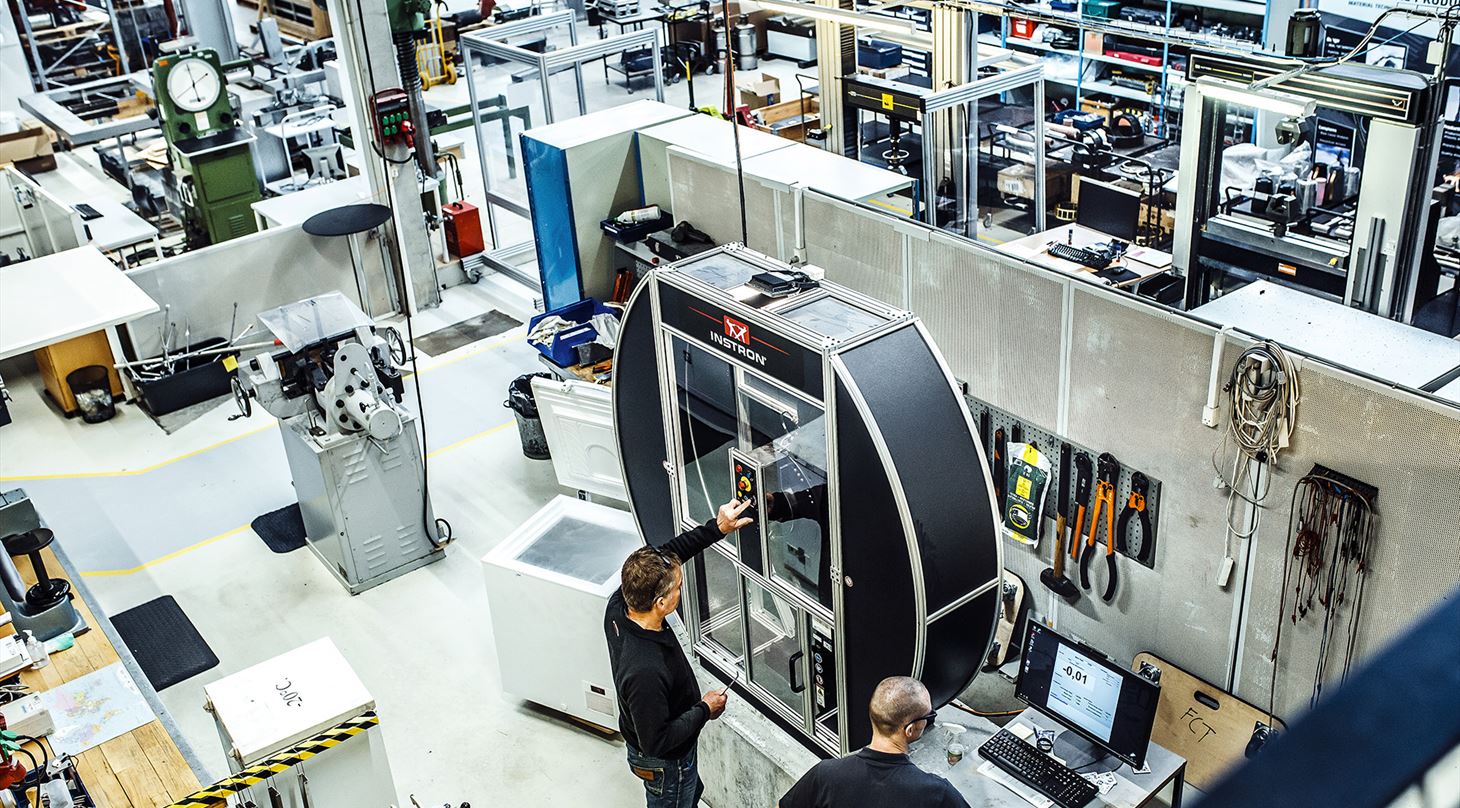
The fatigue test itself (also known as the service life test) is carried out by machining metal “dogbones” that represent the welded material. The dogbones are clamped in a machine where they pulsate between two different loads – pulled hard, unloaded, and then pulled hard again. The machine pulsates several times per second, thereby simulating daily use at an accelerated rate.
- Over the course of a few hours or days, crack growth may occur to the point where the crack becomes large enough to be visible – at this point, the material has failed. The crack is to be expected, as the material has a certain service life, and the service life depends on the loads between which you are pulsating. The difference between the loads determines how many cycles are needed before the crack becomes so large that the component is destroyed. The higher the load, the shorter the time to the expected crack, explains Otto Lundgren Hejgaard.
The next step is to determine how many cycles were required before the crack occurred – this is the key figure for determining the expected service life.
When the crack has occurred, the dogbone is pulled apart so that the exposed fracture surface shows where the crack started. For example, did it start in the weld, in the base material, or somewhere in between – and did it start in the middle of the weld or at the surface as a consequence of the surface treatment? The video below shows the large dogbones being pulled apart.
Less steel consumption or longer service life
With the results from the project, wind turbine manufacturers will potentially be able to reduce the amount of steel used in a tower, as today the amount of steel at welds is typically over‑dimensioned – alternatively, they will be able to extend the service life of the tower and thereby of the turbine. In any case, it will become easier to assess which treatments should be applied to the welded tower in order to achieve the best service life.
Roughly speaking, you can say that you can choose to do nothing and have one service life. Perhaps you can then achieve an extra five years of service life by grinding more on the weld – or use less material to achieve the same service life. So there can be many different outcomes
- Otto Lundgren Hejgaard, Danish Technological Institute
Today, there are standards for how service life is calculated. The results contributed by the Danish Technological Institute in the project can either support the standards or provide grounds for achieving better service life and utilization of the material – indicating that the current standards are too conservative.
About the project
The partners in the WindWeld project are Siemens Gamesa, Maxars, Vattenfall Vindkraft, Ørsted Wind Power, COWI, Rambøll Danmark, and DTU. The Danish Technological Institute is a subcontractor to the project.
The project ended in 2021.