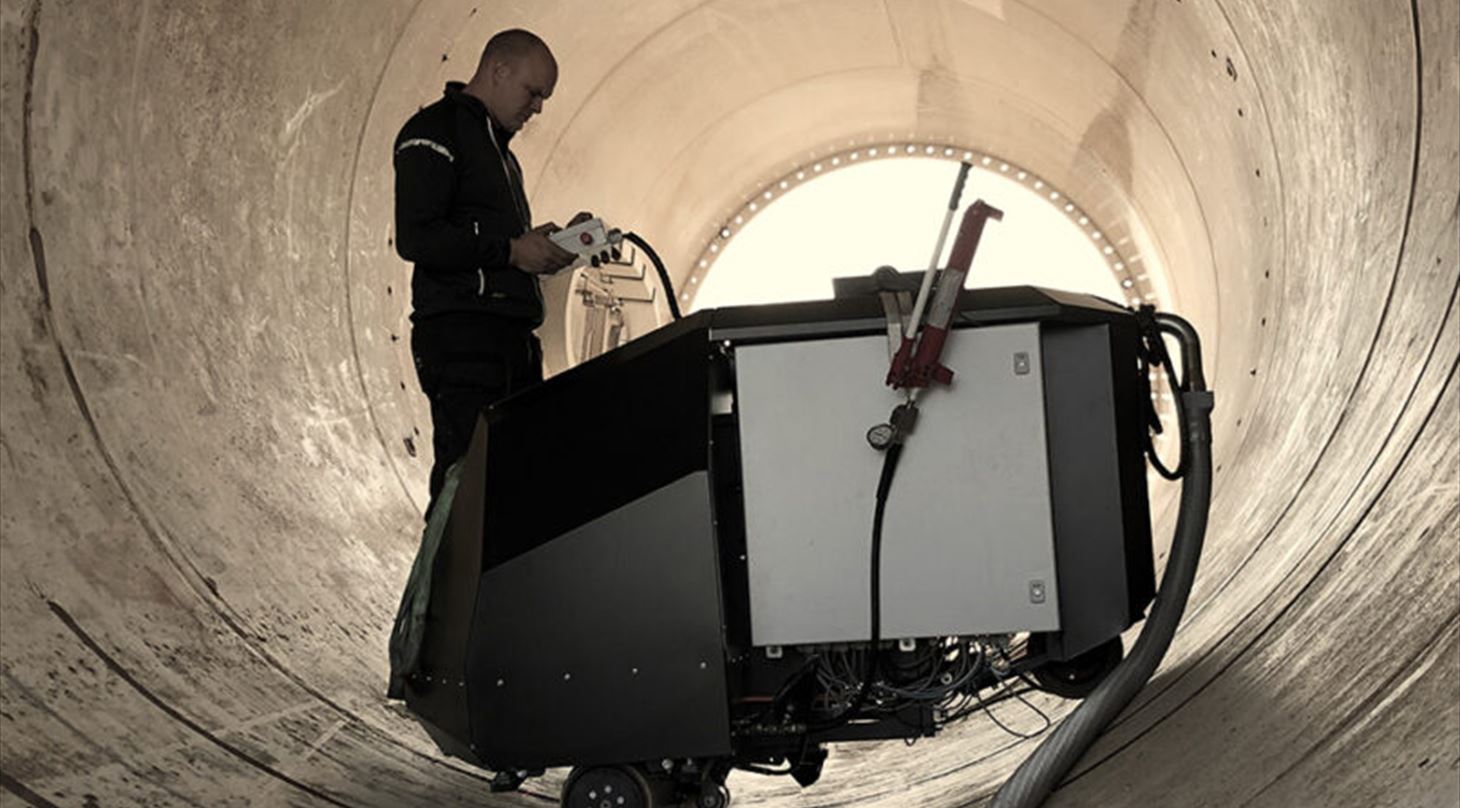
Unique milling robot tested in demonstration project – now it is ready for the market
In a MADE project, Maxars from Pandrup had their unique milling robot tested, which can, among other things, make wind turbine production more efficient. The Danish Technological Institute and FORCE Technology conducted the testing and assess that the North Jutland company’s robot is now market-ready.
Getting a wind turbine up and running is a huge project.
Maxars from Pandrup in North Jutland develops production equipment and has set out to make the process a bit easier with a unique milling robot. Weld seams in wind turbines need to be ground or milled, as this increases their strength by a factor of 1.5 – and this is where the newly developed milling robot can streamline and relieve what is otherwise a major manual task.
Morten Flatau, who is a project manager at Maxars, explains that their milling robot makes the post-processing step 20 times faster and 20 percent cheaper compared to the manual process.The production of foundations and towers for 2,700 of Vestas’ largest turbines requires approximately 10 million meters of welding. Making improvements in one of the weak links in manufacturing – namely, moving from manual to automatic post-processing and strengthening of weld seams – could have a significant impact
- Morten Flatau, Maxars
Crucial documentation secured
Through two innovation projects from MADE, Maxars has accelerated the robot’s market readiness. The latest results come from a MADE demonstration project.
- We have gained the knowledge we needed to be able to document to our customers that they can confidently mill weld seams instead of grinding them, says Morten Flatau.
In the project, specialists in advanced characterization from the Danish Technological Institute performed residual stress measurements on some of the welded samples. Residual stresses have a major impact on the material’s properties, such as fatigue strength and resistance to stress corrosion, and thus on the service life of the finished products. However, when the residual stress levels are known, it is possible, for example, to reduce excessive safety factors, decrease material consumption, and improve the service life and life‑time estimates of products.
The analysis showed that the residual stress state was identical after post-treatment for samples machined conventionally and with the Maxars robot solution
- Nikolaj Gersager Henriksen, Danish Technological Institute
In addition to the residual stress measurements, Maxar received support from FORCE Technology in creating documentation through testing and analysis of the metallurgy and the surface before and after milling with the machine.
- We saw that surface quality and metallurgy had not degraded, explains Michel Honoré, People & Project Manager at FORCE Technology, adding that the machine is now “genuinely market-ready.”
Specialists in robotics from the Danish Technological Institute were also part of the project and provided Maxar with guidance regarding the programming of the robot.