From high street to hospital: XO robot gives children a break from illness
17 December 2025
With a robot arm, nine squares and a team of public and private partners, children at the hospital in Odense now get the chance to forget their illness for a moment and challenge the hospital's newest "team-mate" to a game of tic-tac-toe.
At Hans Christian Andersen Children's Hospital in Odense, there's a robot that neither takes blood samples nor measures blood pressure. Instead, it challenges the children to a game of tic-tac-toe around the clock.
The result?
Children who voluntarily get out of bed, forget that they are fasting, and insist on "beating the robot" before anything else when they are admitted – or just visiting.
The robot is the result of a collaboration between the Danish Technological Institute (DTI), Hans Christian Andersen Children's Hospital and the Centre for Clinical Robotics (CCR) at Odense University Hospital (OUH), Universal Robots, OnRobot, the City of Odense and the Region of Southern Denmark – with support from Tryllebjergets Venner and Banko Vennerne.
A robot that gets children out of bed
For Mette Sorang Kjær, Welfare Coordinator at Hans Christian Andersen Children's Hospital, the impact is clear in the day-to-day life of the children's ward.
− The best thing about the robot is that some of our children get a really good experience for a while. They want to get out of their beds because they want to go and try the robot.
The robot creates a natural meeting point and a specific activity for in-patients, outpatients and relatives alike.
− The robot provides meaningful activity for children who are here for both shorter and longer periods. We have a lot of outpatients coming in, but we also have these children who are admitted, and I can see that the staff use it to motivate them to get up and go and try the robot.
And the robot is not just a toy. It makes a real difference for children who are in the middle of something difficult.
− I have seen an in‑patient ward use the robot as something to do while waiting for a child who was about to go into surgery, and you could see beforehand that this child was nervous. But when he was standing there playing with his mum and dad at the robot, he became completely absorbed in the game of tic-tac-toe.
In this way, the technology becomes a simple but effective way of creating calm and reassurance and gives both children and parents a brief break from their worries.
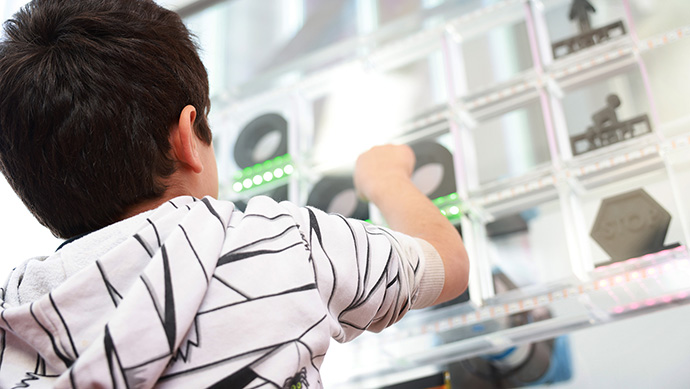
From high street to children's hospital
The tic-tac-toe robot, also known as the XO robot, is familiar from Odense's high street in Vestergade, where passers-by can challenge it to a game.
When Mette Sorang Kjær first saw the robot there, she immediately pictured a new home for it.
− I see this fantastic robot standing up in Vestergade and can immediately imagine that it would be a great offer for our children and young people here at the hospital.
The journey from high street to children's ward went via the City of Odense, which used its networks to create contact with DTI and the other partners.
DTI has, among other things, helped adapt the solution so that it works in a hospital environment − technically, practically and educationally.
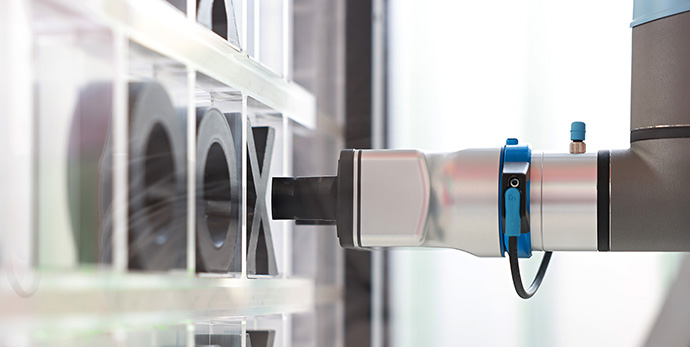
When technology and play go hand in hand
For Søren Peter Johansen, Technology Manager at DTI, the development process is a textbook example of what robotics and cross‑sector collaboration can also achieve.
− It has been incredibly exciting to help develop this noughts and crosses robot. It is a good example of how you can bring technology and play together for the benefit of patients and relatives in a hospital. And on top of that, it is a great example of how public stakeholders can work together with private companies, he says.
And there is certainly no doubt that this is a cross‑sector effort: Universal Robots has donated the UR3e robot arm, OnRobot has contributed the robot's gripper, OUH and CCR have taken the lead in bringing the robot into the clinic, while DTI has handled programming and technical qualification. The City of Odense and the Region of Southern Denmark have supported the process with networks and framework conditions.
The result of the collaboration is what really matters: One robot arm, nine squares and countless small moments when illness takes up a little less space and play takes up a little more.