Air-to-Water Heat Pump Testing: Independent Documentation for European Compliance and Market Access - Frequently asked questions
Select Page

Frequently Asked Questions About Air-to-Water Heat Pump Testing
If you have questions about testing standards, refrigerant handling, acoustic measurements or certification pathways for air-to-water heat pumps, our FAQ provides a quick overview of the most common technical and regulatory topics.
You can find answers to additional questions on our page Accredited Heat Pump Testing for Certification and European Market Access, and you are always welcome to contact Preben Eskerod directly to discuss your specific testing requirements using the contact form on the right.
Which standards and regulations apply to air-to-water heat pump testing?
Air-to-water heat pumps are tested according to harmonised European standards including EN 14511 for capacity and efficiency ratings, EN 14825 for seasonal performance and part-load calculations, EN 12102-1 for sound power determinations, and EN 16147 for domestic hot water production. These measurements provide the technical foundation required to verify compliance with the Ecodesign Directive Regulation EU 813/2013 and the Energy Labelling Regulation EU 811/2013.
How is sound testing conducted on air-to-water heat pumps?
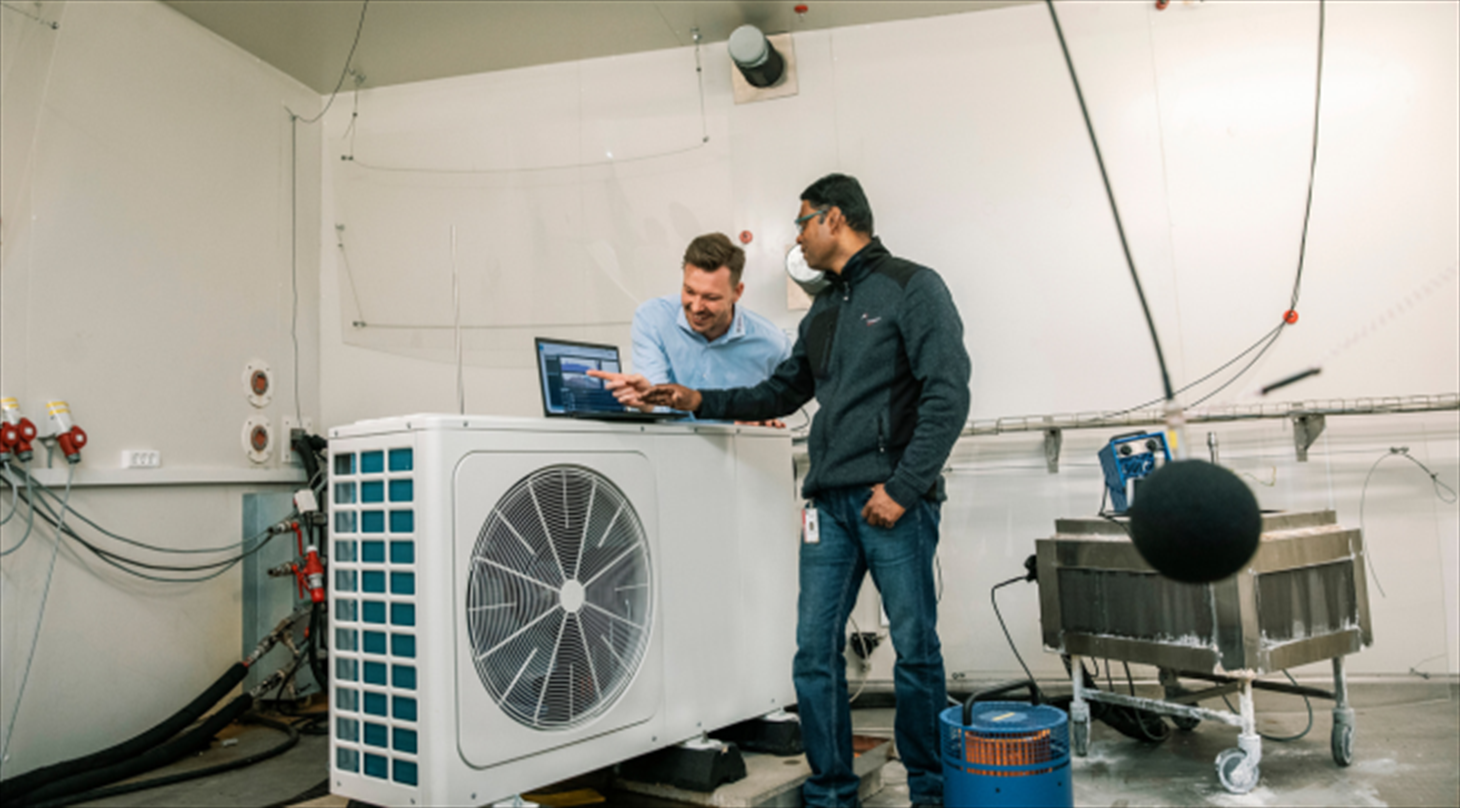
Sound power measurements are carried out in dedicated acoustic chambers in accordance with EN 12102-1 and relevant ISO standards. Our facility enables acoustic testing to be conducted while the unit operates under full thermal load across controlled ambient temperatures ranging from minus 15 C to plus 35 C, capturing realistic noise emissions across different compressor and fan modulation speeds.
Can the laboratory handle flammable and natural refrigerants?
Yes. The test facilities are equipped with safety infrastructure, ATEX ventilation, and gas detection systems to safely handle all refrigerant classifications. This includes natural refrigerants such as propane R290, isobutane R600a, carbon dioxide R744, and ammonia R717, as well as lower-GWP HFO blends like R454B, R454C, R1234ze, and conventional HFCs like R32 and R410A.
What documentation is provided in the final test report?
Depending on your test, you receive an accredited test report containing tabulated performance metrics, COP, SCOP, EER, and SEER values, continuous logs of temperatures, flow rates, and electrical inputs, acoustic frequency spectra, and photographic identification of components and rating plates to ensure complete traceability.
Can our engineering team follow the testing in real time?
Yes. We offer secure remote access to live test data, enabling your technical specialists to track operational parameters outside standard laboratory hours. If adjustments to settings, software, or refrigerant charges are required during setup, our engineers collaborate directly with your team to implement them.