COMFORT: Clean air for future space stations

In the COMFORT project, Danish Technological Institute, on behalf of the European Space Agency (ESA), is laying the foundations for a compact system designed to remove CO₂ and moisture from the air in future spacecraft. Learnings and solutions from the green transition are expected to play a key role in this innovation work.
Focus on European space innovation
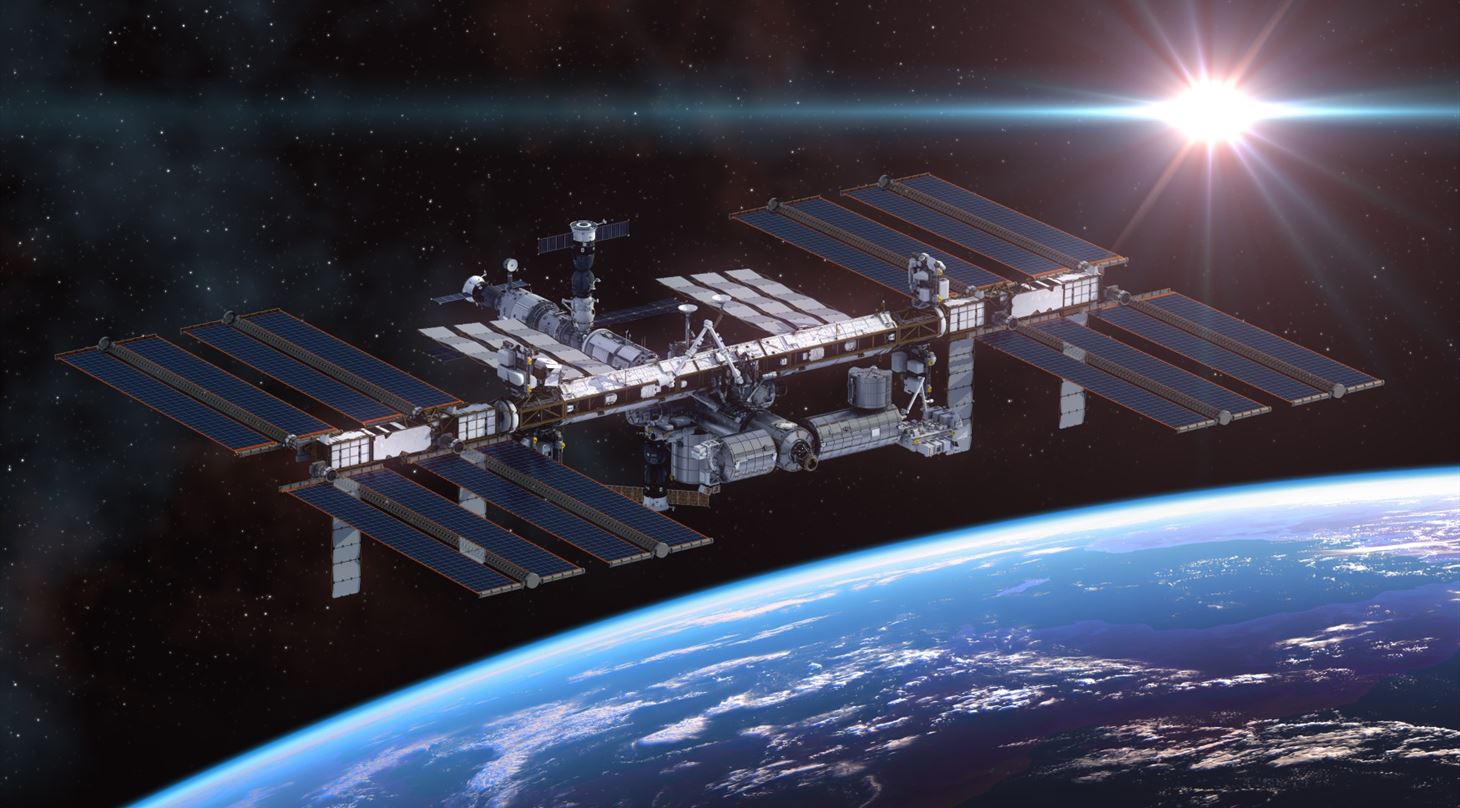
The International Space Station (ISS), which has been orbiting the Earth for over 25 years, is approaching the end of its service life and is expected to be decommissioned in 2030.
For future space stations and missions, ESA wants to be able to supply the clean-air technologies that keep astronauts alive. Today, this task is handled by several separate and predominantly American systems, such as the CDRA (Carbon Dioxide Removal Assembly). These systems are heavy, energy-intensive, and require a great deal of maintenance.
There will be neither space nor power for this in future capsules and space stations.
One system instead of several
In COMFORT, moisture removal and CO₂ capture are to be combined into a single modular system. The aim is a system that is smaller, lighter and easier to maintain than current solutions. As a new feature, the system must also be able to operate autonomously in space following prolonged periods of hibernation.
In this project, Danish Technological Institute is drawing on a broad range of specialist knowledge in the fields of CO₂ capture and advanced materials, indoor climate and air purification, computational fluid dynamics (CFD), system design and integration, mechanical design and rapid prototyping, as well as relevant experience from previous projects.
The work is also supported by DTI's laboratories, including a modular laboratory for testing CO₂ capture and a flexible indoor climate laboratory where the air quality on board a space station can be simulated.
Prototypes and lightweight components can be manufactured using quality-assured 3D printing in both metal and advanced polymer-based materials.
From the green transition to space travel
Over the years, the space sector has developed technologies that have spread to both industry and ordinary consumers.
This applies, for example, to memory foam, camera sensors in mobile phones and navigation satellites. This time, the trend is moving in the opposite direction. Denmark and Europe have been committed to the green transition for several years, and technologies relating to CO₂ capture, indoor climate, air purification and sensors are now so robust and well-proven that they can be adapted for use in space travel.
– We anticipate that several green technologies may end up being crucial to what is possible in space, says Project Manager Signe S. Grønborg from Danish Technological Institute.
A lasting presence in space
The COMFORT project is set to result in a recommended concept for an integrated system for CO₂ and humidity control, together with a plan for further development, including a timetable and draft budget.
If ESA endorses the concept, a prototype could be built and tested in the laboratory in the next phase.
Once a technology is proven to work in space, it is rarely modified, as further development is costly. Consequently, a Danish technology within a European system could secure a permanent place, open up a new market for businesses and strengthen Europe’s independence in space.
Project facts
Project name
COMFORT – Humidity removal combined with CO₂ scrubbing (HRCS), Phase 1
Funding
The European Space Agency (ESA)
Project period
August 2026 – July 2027
Clean air in space
We humans exhale CO₂, and our bodies release moisture. We usually solve this by opening a window to let in fresh air – an option not available to astronauts. Furthermore, they need to train and exercise on long-duration missions, which places even greater demands on the removal of CO₂ and moisture.
In a small space capsule of less than 10 m³, CO₂ can thus reach critical levels within a quarter of an hour, and the moisture can lead to condensation, microbial growth and rust formation.
On the ISS, this task is currently handled by several separate systems. Some capture CO₂ using materials that act like a sponge, whilst the air conditioning removes moisture. Furthermore, space poses entirely different challenges to Earth. In the absence of gravity, liquids do not simply drain away but float around as bubbles, which can damage the systems.
Moisture must therefore be kept in a gaseous state.