
Giant drones in agriculture to help save the aquatic environment

The use of heavy drones weighing up to 200 kg could become the key to reducing nitrogen leaching in Danish agriculture.
Supported by the Green Development and Demonstration Programme (GUDP)
Project period: July 2026 – December 2027
It is all about timing.
If a farmer sows catch crops in July before harvesting the cereal crops in the field, they get a head start in establishing strong roots that absorb surplus nitrogen from the soil.
If they apply foliar fertiliser to maize late during flowering, nitrogen utilisation improves.
Both practices minimise leaching into the aquatic environment. However, no one can operate a large tractor straight after a downpour or in a two-metre-high maize field without damaging the crops.
The drone solves these dilemmas.
It quite simply flies above the problems. From the air, it can sow and fertilise at the most agronomically optimal time, independent of tramlines or wet soil.
Groundbreaking Heavy-Duty Technology
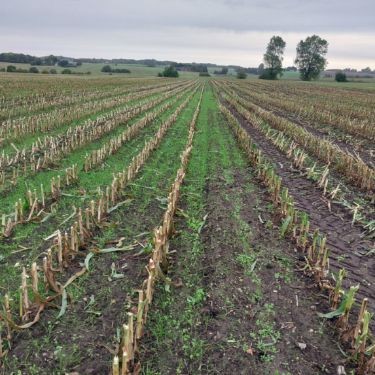 For the first time in Denmark, the N-Drone project—led by the Danish Technological Institute—is introducing methods for sowing catch crops and late foliar fertilisation in maize using drones weighing up to 200 kg. This technology enables large-scale operations at lower operating costs than tractor-mounted implements.
- The point is that the drones deploy precisely when the environmental benefit is greatest. This leads to better fertiliser utilisation and higher yields at a lower cost per hectare, says Thomas Nitschke, Senior Consultant and drone expert at the Danish Technological Institute.
In a novel development, the regulatory framework is now in place, and the project’s drone operator holds a general permit to fly heavy drones for these purposes.
Photo: Preliminary result from the establishment of demo plots in October 2026. To the left: drone-sown catch crops. To the right: no catch crops have been sown.
An Agile Response to New Environmental Requirements
With the new nitrogen regulations taking effect in 2027, the need for flexible solutions to prevent nitrogen from washing into fjords and marine environments — causing oxygen depletion — is growing.
- Agriculture is facing major adjustments to fertilisation practices following the phase-in of the new regulations, which is why we are actively searching for new methods to reduce nitrate leaching. New technologies such as drones could be part of the solution, says Torkild Birkmose, Chief Consultant at SEGES Innovation.
N-Drone builds on international experience, which is now being tailored to Danish growing and climatic conditions. By the time the project concludes, the solutions are expected to be ready for commercial rollout across large acreages. The project will also produce advisory materials and demonstrations to help farmers implement the technologies.
- Our goal is not merely to show that it is viable in practice, but to deliver a turnkey, economically viable solution ready for farmers and agricultural contractors to adopt, says Thomas Nitschke.
Project Partners
- Danish Technological Institute
- Vestjyllands Andel
- Scandinavian Drone Solutions
- SEGES Innovation