Robot eliminates bottleneck at biotech rising star
Facing increasing demand from clients, the Danish contract research organisation Minerva Imaging encountered a significant bottleneck in the laboratory. Impartial sparring and testing at the Danish Technological Institute's robotics laboratory paved the way for the ideal automation solution.
Great success and massive growth in recent years have placed immense pressure on Minerva Imaging’s advanced laboratory equipment and staff, who assist global pharmaceutical companies in developing and testing new drugs for the treatment of cancer and cardiovascular diseases.
Consequently, the Danish company turned its attention towards automation.
− We have experienced substantial growth and, as a result, increasing pressure on the equipment we use. This meant there was a need to explore the automation of the highly manual processes we had been running until now. Partly to increase efficiency and make better use of time, but very much also for the sake of our staff, as we work with radioactive material, explains Gitte Hansen, Director of Operations at Minerva Imaging.
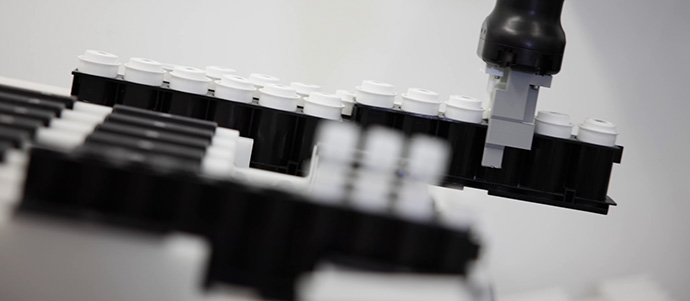
Previously, the work of preparing and weighing tissue samples was 100 per cent manual. It involved repetitive, monotonous work labelling tubes, pre-weighing tubes, physically placing tubes into the measuring instruments, and subsequently re-weighing all the tubes again.
− The fact that we now have a robot that can help us carry this out 24 hours a day, seven days a week, has saved us a tremendous number of working hours, she emphasises.
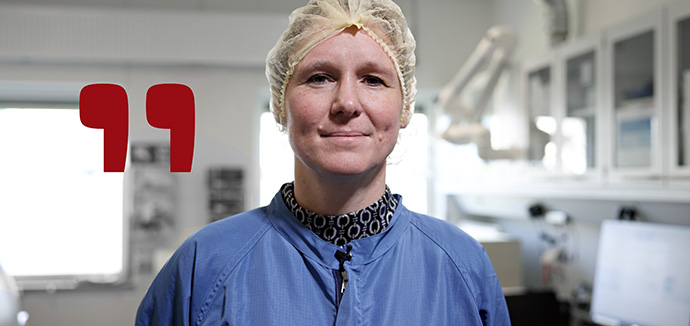 “The collaboration with the Danish Technological Institute has been crucial in kickstarting this automation for us.”
Gitte Hansen
Director, Operations
Minerva Imaging
Kickstart in the robotics laboratory
When Minerva Imaging decided to take the leap into robotics, they quickly encountered the classic questions: How do we get started, and which technology should we choose?
Here, the Danish Technological Institute (DTI) acted as the bridge to the right solution.
− The collaboration with DTI has been crucial in kickstarting this automation for us, says Gitte Hansen.
Through DTI’s robotics laboratory in Odense – as part of a Test-Before-You-Invest programme under the EU project EDOcobot – Minerva Imaging was given the opportunity to test various robots in an impartial testing environment.
− We could not have done without that sparring. It saved us a lot of time that we would otherwise have had to spend delving into things ourselves, perhaps hitting a brick wall. The sparring confirmed which direction we should take and how to develop the concept so that we had the right setup from the start.
Fact foldout: 3D simulation showed the right path
Before Minerva Imaging invested in the physical robotic solution, various cell layouts and capacities were tested in a 3D simulation at the Danish Technological Institute.
The starting point was a requirement for the system to handle 500 racks – based on calculations of how many racks the company's measuring instruments could process over a weekend. However, the numerous simulated solutions revealed that a setup with a full capacity of 500 racks was neither practically feasible nor advisable within the existing laboratory space.
The simulation made it possible to test alternatives and assess the impact on space requirements, robot movements, and capacity, among other factors, before any equipment was built or purchased.
The result was a scalable solution that fits Minerva Imaging’s current premises and needs – yet can be expanded to handle 500 racks once the system is relocated to a larger room.
Consequently, the company was able to make an informed decision and reduce the risk associated with the automation investment.
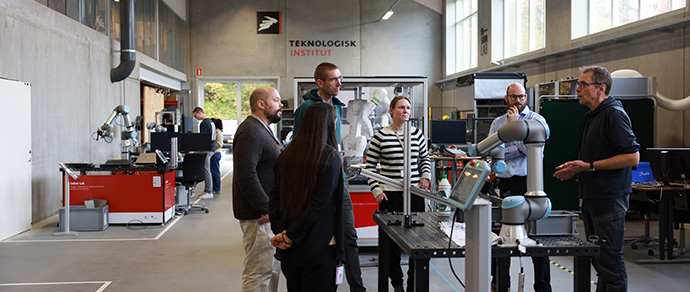
Senior specialist and robotics expert Martin Mølbach Olsen, together with colleagues Malaika Din Hashmi and Leon Philipson Andersen from DTI, helped Minerva Imaging thoroughly test different robotic technology options before the company decided to invest in equipment.
Hitting the mark takes time
Although the robot is now an indispensable part of the laboratory, the process has also provided valuable lessons. Automation in a high-tech laboratory demands precision.
− What has surprised me the most is probably how long it actually takes. Even with substantial sparring and support, it required a great many working hours on our part during development. The robot has to handle many different tasks, and we went through many iterations to find the exact right grippers and setup details. But we had the courage to experiment, and the outcome has been completely worth it, says Gitte Hansen.
With the new robot solution, Minerva Imaging can now make optimal use of their costly measuring equipment around the clock.
− The best part is unequivocally the time saved. Being a contract research organisation, we need to be extremely flexible and agile. Now the bottleneck is gone, and we can fully utilise our advanced equipment 24/7. It has been an enormous benefit and an investment that has rapidly paid for itself, concludes Gitte Hansen.
Test before you invest: Can your processes be automated?
If your company, like Minerva Imaging, wishes to explore the opportunities for automating manual processes, the Danish Technological Institute offers impartial consultancy and testing programmes in robot laboratory facilities in Odense.
This is facilitated through the project Automationsløft, which is led by Erhvervshus Fyn in collaboration with the Danish Technological Institute, Odense Robotics, MADE, and the South Denmark European Office – co-funded by the EU.
Through various testing programmes, small and medium-sized enterprises can obtain:
- Assistance in identifying the precise automation potential.
- Access to high-tech robotics facilities and impartial experts.
- Hands-on testing of robots, grippers, and processes – before major capital investments are made.
- Sparring on concept development, system integrators, and selecting the right equipment.
Learn more
About Minerva Imaging
Minerva Imaging is a leading Danish contract research organisation helping the global pharmaceutical industry develop and test new medicines – with a particular focus on cancer treatment and cardiovascular diseases.
Using advanced scanning technologies and radioactive tracers, they can precisely visualise how new drugs work in the body at a very early stage. This makes the process of developing and approving life-saving medicines faster, safer, and more efficient.