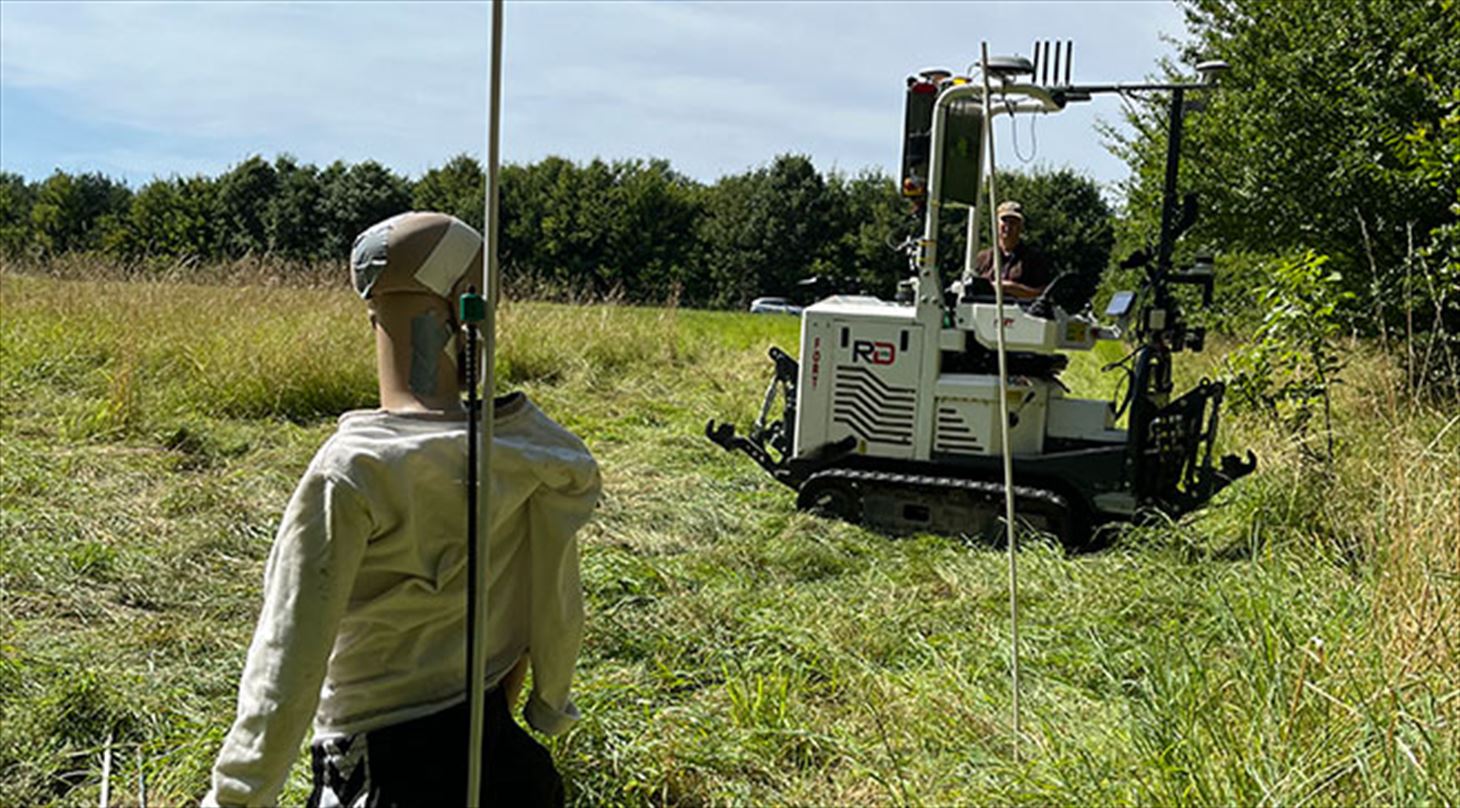
Test of autonomous mobile robots for crop production
Document quality and safety with independent testing of autonomous mobile robots.
We help product developers, distributors and procurement professionals test and validate autonomous mobile robots (AMRs) for crop production and green spaces. Our independent testing and documentation provide the solid foundation you need to bring robots safely to market, make informed purchasing decisions or optimise your product. With our specialised testing equipment and agronomic expertise, we can document everything from safety and precision to operating economics and usability.
How can Danish Technological Institute help you?
- Safety testing in accordance with ISO 18497-4:2024
- Validation of precision and manoeuvrability
- Agronomic validation using sensors and vision analysis
- Usability and operator testing
- Commercial partnerships or participation in national and international R&D projects
Safe autonomous mobile robots
Autonomous mobile robots for crop production and green spaces are a rapidly evolving technology. In parallel, international standards for testing and validating these technologies (e.g., ISO standards, the Machinery Directive, and the upcoming Machinery Regulation) are also developing. The journey from prototype to market-ready solution requires thorough knowledge of these standards, along with comprehensive documentation, validation and safety approvals. This is where independent testing becomes crucial to ensuring a safe and reliable robot.
At Danish Technological Institute, we act as your trusted testing partner throughout the entire development phase. We offer tailored testing programmes that match your product's maturity level and your specific needs – whether you are a product developer looking to test against future standards, a distributor needing to document performance, or a buyer seeking to validate supplier claims.
Safety and risk assessment
Safety is the foundation of any autonomous robot operating near people or in complex environments. We perform rigorous safety tests on your product. Our experts review the robot's sensor systems, emergency stop functions, collision avoidance and safety protocols.
Testing under realistic conditions
Precision and manoeuvrability are critical parameters for autonomous robots. Using our sensor setup, we can test under realistic conditions in the field or on green areas. Depending on your needs, we measure parameters such as navigation precision, safety performance, repeatability, the ability to handle sloping terrain and how the robot performs under various weather and lighting conditions.
The tests provide you with robust documentation of how the robot performs in practice – not just under ideal conditions, but also when facing real-world challenges. This is invaluable both during product development and as a strong selling point to potential customers.
Agronomic validation
For robots used in crop production, the agronomic impact is vital. It is not enough for the robot simply to operate – it must also deliver documented agronomic value. We can design and conduct field trials to compare the robotic solution with conventional cultivation systems and technologies.
This can include testing weed control, crop damage or other agronomic functions. Our trials follow scientific standards, providing you with statistically valid documentation.
Performance, capacity and operating economics
A robot may be technically impressive, but if the operating economics do not stack up, it will not gain market traction. We test and document the robots' work capacity, energy consumption, maintenance requirements and overall operating economics. This gives both you and your customers a realistic picture of the total cost of ownership and operation over time.
Usability
Even the most advanced technology fails if users cannot operate it. We conduct structured usability testing with representative user groups. These tests reveal how intuitive the robot is to programme and monitor. Feedback from these tests can guide product optimisations and help develop better user interfaces and instructional materials.
Testing methods
Our testing methods are based on international standards and best practices within robot testing and agronomic research. We document all tests thoroughly using precise measurements, as well as photo and video documentation, providing you with material suitable for both technical documentation and marketing communication.
Tailored testing programmes
We understand that every robot project is unique. Therefore, we tailor our testing programmes to your specific needs and your product's maturity level:
- Early stage: Focus on basic functionality and safety
- Development stage: Iterative testing for product optimisation
- Pre-launch: Comprehensive validation and documentation for marketing purposes
- Post-launch: Independent verification of product claims