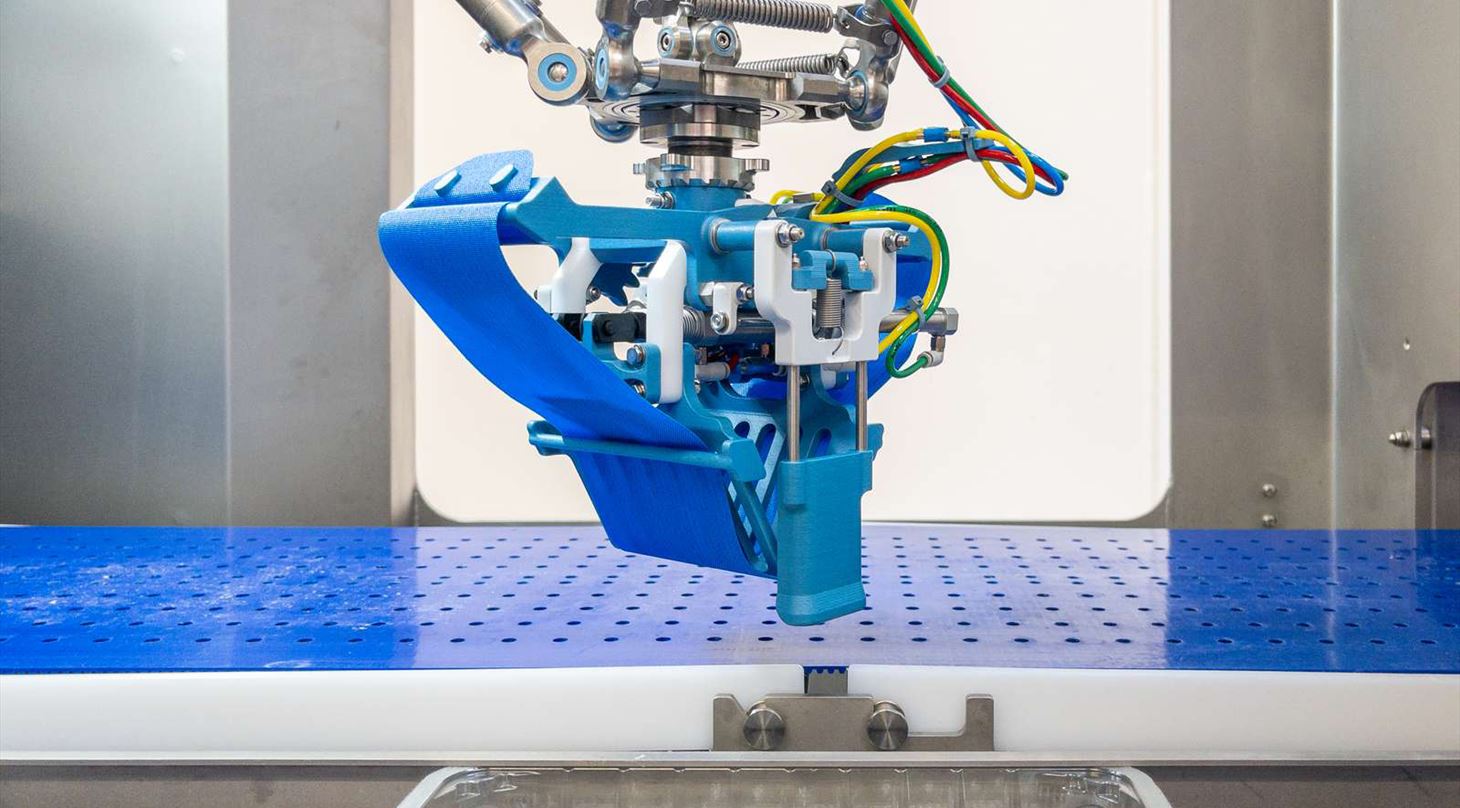
3D Printing for Food Contact - Get the best result from us
 In Danish
Get full traceability, greater design freedom, and documented food safety with 3D-printed components in metal and plastic.
3D printing for food contact is a manufacturing method where machine parts and production equipment are manufactured using approved materials in full compliance with food contact regulations. Danish Technological Institute is the only facility in Denmark with a 3D printing production that complies with current requirements for food contact materials with full traceability. We help the food industry and machine builders develop, optimize, and manufacture components that combine complex geometry with uncompromising hygiene.
The challenge: Strict hygiene requirements and costly changeovers
In food production, mechanical assemblies, welds, and gaskets pose a constant risk of bacterial accumulation. At the same time, conventional manufacturing methods place narrow constraints on the design of extrusion nozzles and grippers, and modifications to the production line often involve high tooling costs and long lead times.
The solution: Simplified designs and food-grade print materials
Fortunately, there is a solution. By using industrial 3D printing, traditionally complex assemblies can be reduced to a single integrated component. This eliminates unnecessary crevices and joints where dirt and bacteria can accumulate, while providing complete freedom to design internal flow channels.
- Design freedom - with internal channels in the parts, you can design e.g. extrusion nozzles for ice cream, chocolate and cakes with great freedom, as the nozzles can be made without joints - and re-designed without large tool costs.
- Production flexibility - it is easy and cheap to switch production to seasonal variants.
- Simplified constructions - you can assemble a number of functions and reduce the number of parts - with fewer joints, the bacterial accumulation is reduced.
- Fast development and short production times - and thus faster time-to-market
- Approved food contact materials - full traceability and declarations of compliance from the Danish Veterinary and Food Administration
How can Danish Technological Institute help you?
Danish Technological Institute assists throughout the entire process - from the initial design to the finished, documented component:
- Advisory services on design optimization for 3D printing (e.g., integrated channels and consolidating multiple parts into one)
- Production of food contact materials in both plastic and metal
- 3S surface treatment for optimal cleanability and bacterial reduction
- Production in BlueDP - patented blue, metal- and X-ray-detectable nylon
- Full traceability and compliance documentation throughout the entire manufacturing chain
- Rapid prototyping as well as series production of end-use components
We print in the following materials approved for food contact:
- 316L stainless steel: Well-suited for wear-resistant metal components
- Ti6Al4V titanium grade 5: High strength, low weight, and strong corrosion resistance
- PA12 nylon: Flexible and wear-resistant plastic material
- BlueDP blue metal and X-ray detectable nylon: Blue nylon developed by the Danish Technological Institute, detectable in both metal detectors and X-ray inspection systems
3S surface treatment: smooth and easy-to-clean surfaces
3S stands for super smooth surface and is a post-processing method for 3D-printed nylon parts that significantly enhances hygienic properties.
The treatment seals all surfaces, including internal channels, without altering the component's dimensions, color, or strength:
- Measured by residual bacteria, 3S provides a cleanability that is 12 times better than untreated nylon - on par with turned stainless steel
- Water-repellent: Unlike untreated nylon, 3S-treated parts do not absorb water at all
- Tested and approved: The treatment is odorless and tasteless, meeting the same compliance requirements as untreated nylon
Blue metal detectable nylon
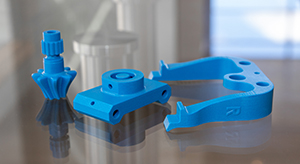 Metal detection is a requirement from several customers in the food industry. Therefore, the Danish Technological Institute has developed blue metal detectable nylon, which is accepted as food contact material. The metal detectability is achieved through a refining process where the blue nylon powder is mixed with metal in the right ratio, enabling the 3D printed nylon parts to be traced in metal scanners. Furthermore, metal detectable nylon can be treated with 3S, giving it an extra smooth and more easy-to-clean surface.
Documented food safety and traceability
When partnering with Danish Technological Institute, production is subject to documented control. Our production facilities ensure full traceability across the entire value chain, from raw material powder to the finished component.
View the Danish Veterinary and Food Administration inspection report for Danish Technological Institute

SEE EXAMPLES OF ADDITIVE MANUFACTURING IN THE FOOD INDUSTRY
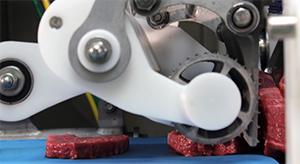 Marel - support element
Marel had an effective Additive Manufacturing development process with DTI concerning a support element for industrial cutting of meat. Where the product previously consisted of 40 loose parts, AM reduced this to one part - reducing bacteria and increasing food safety.
Read more
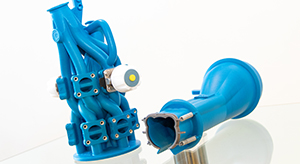 Tetra Pak - ice cream nozzle
Among other things, Tetra Pak makes systems for ice cream production. Here they have designed a nozzle where you can mix several colors of ice cream and place them on the production line in a number of different shapes. It is 3D-printed at the Danish Technological Institute.
Read more
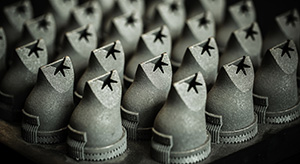 Bühler-Meincke - cookie nozzles
Bühler-Meincke's nozzles used to be welded together by several parts, and it was both complicated and time consuming. Now, they are 3D printed at DTI, resulting in freedom of design and simplified production, as the nozzles can be made in one piece with a smooth surface.
Read more
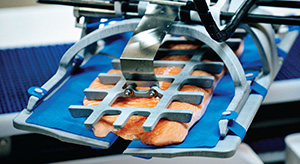 Marel - salmon side gripper
For a one of their food processing setups, Marel needed to develop a new gripper for handling entire salmon sides of 40-50 cm. Therefore, they contacted the Danish Technological Institute to find out if it was possible to 3D print in that size - fortunately it was.
Read more
Contact us for an assessment of your components
Should we have a chat about how you can utilize 3D printing for food contact in your production? Our technical specialists are ready to assess your 3D files or assist with the development of new food contact materials.