
EU Ecodesign and Energy Labelling for Heat Pumps
Accredited Testing, CE Marking Verification, and EPREL Registration Services for Manufacturers and Importers
The European Union has introduced mandatory Ecodesign and energy labelling regulations for space heaters and combination heat pumps. How EU Regulations Shape the Market by Phasing Out Inefficient Products
Regulated primarily under Regulations (EU) No 811/2013 and No 813/2013 under the overarching Framework Regulation (EU) 2017/1369, the objective is unambiguous: to eliminate fossil-fuel inefficiency, enforce strict seasonal performance baselines, and drive market adoption of high-efficiency heat pump systems.
In practice, Ecodesign minimum thresholds and energy labelling classifications operate as parallel, mandatory frameworks.
Legal Market Access versus Commercial Differentiation
While both frameworks share the goal of lowering energy consumption and the environmental impact, they serve two distinct regulatory and commercial functions:<br><br>
Ecodesign sets the mandatory baseline: It establishes strict minimum seasonal energy efficiency (ηs) and maximum sound power limits (LWA) that heat pumps must achieve to obtain CE marking. Units failing to meet these baseline metrics cannot legally be placed on the European market.
Energy labelling provides market differentiation: It classifies compliant units from A+++ down to D based on their verified seasonal efficiency, providing specifiers, installers, and consumers with comparable performance metrics backed by mandatory registration in the EPREL database.
Precision Testing as Market Insurance
The regulatory framework for heat pumps is tightening, with increasing scrutiny on seasonal efficiency calculations, sound power levels, and low-GWP refrigerants. To place heat pumps on the EU market, manufacturers and importers face rigorous requirements for physical climate-chamber testing, seasonal calculation modeling, and technical documentation.
Independent test data from the Heat Pump Test Laboratory at Danish Technological Institute, DANAK-accredited under ISO/IEC 17025, delivers globally recognised test reports which document compliance, prevent market surveillance sanctions, and secure market access.
The Two Pillars of EU Energy Compliance
Ecodesign Regulations - the Mandatory Baseline
Ecodesign (Regulation EU No 813/2013) defines the legal baseline for heat pumps and combination heaters. If a unit fails to meet the minimum seasonal efficiency or acoustic emission thresholds for its specific heating category, it cannot obtain CE marking and is prohibited from being sold within the EU and EEA.
- Minimum Seasonal Space Heating Efficiency (ηs): Enforces strict efficiency floors below which space heaters are barred from the single market.
- Acoustic Noise Limits (LWA): Restricts maximum permitted sound power levels measured in accordance with EN 12102-1.
- A Prerequisite for Energy Labelling: Units that do not clear the mandatory Ecodesign baseline cannot obtain an official energy label or be registered in EPREL.
Market Transparency with Energy Labelling Framework & EPREL
Where Ecodesign eliminates underperforming systems from the market, Energy Labelling (governed by Framework Regulation (EU) 2017/1369 and Regulation (EU) No 811/2013) rewards technical performance and informs buyers.
- Standardised Performance Metrics: The official label declares Seasonal Space Heating Energy Efficiency (ηs), rated heat output (Prated in kW) across three European reference climate zones, sound power levels (LWA), and water heating efficiency (ηwh) for combination units.
- Current and Future Scales: While space heaters currently use the A+++ to D scale under Regulation 811/2013, planned revisions will align heat pumps with the standardised, rescaled A to G layout under Framework Regulation (EU) 2017/1369.
- Mandatory EPREL Registration: Before placing a heat pump model on the EU market, manufacturers and authorized importers must register the model in the European Product Registry for Energy Labelling (EPREL), providing full technical fiches and verification documentation.
How Heat Pump Efficiency Is Verified
Heat pump energy efficiency ratings cannot be derived from theoretical modeling alone. They require physical testing in accredited climate chambers according to harmonised European standards:
- Empirical Part-Load Testing (EN 14511 & EN 14825): Measurement of capacity and Coefficient of Performance (COP) across standardised part-load test conditions (A, B, C, D).
- Seasonal Calculation (SCOP): Weighting measured part-load capacities and efficiencies against European reference bin hours to determine the seasonal coefficient of performance (SCOPnet).
- Primary Energy Conversion (ηs): Converting SCOP to Seasonal Space Heating Energy Efficiency (ηs) using the EU primary energy conversion factor for electricity (2.5) and applying correction factors (F(i)) for temperature controls and auxiliary standby consumption.
- Water Heating Efficiency (ηwh): For combination systems, measuring domestic hot water efficiency based on standardised tapping cycles under EN 16147.
Third-party testing conducted under ISO/IEC 17025 accreditation ensures that measurement uncertainties are controlled and that declared performance ratings remain robust.
Energy labelling compliance is crucial for entering certain markets. Here's what you need to know: Many regions – including the EU – have mandatory rules for energy labeling. This means that your product may only be sold in these markets if it comes with an accompanying energy label. While theoretical self-declaration is legally permitted in some frameworks, accredited third-party testing provides the only documented verification that withstands official market surveillance audits. Authorities in different regions perform market controls every year, where a number of products are selected and tested. As a manufacturer or supplier of a product, it is your responsibility to ensure that energy efficiency and performance are consistent for all products manufactured under the same model name. If the energy labelling is incorrect, you may be required to remove your product from the market and pay compensation to those consumers who have purchased your product based on the incorrect energy labelling.Understanding Energy Labelling


Market Surveillance and the Cost of Non-Compliance
Compliance with Ecodesign and Energy Labelling is legally binding. Manufacturers and importers carry full legal liability for all declared ratings:
- Strict Market Surveillance: National authorities across EU member states regularly test production units in independent laboratories to verify declared performance.
- Narrow Tolerances: Permitted verification tolerances (typically 8% for seasonal space heating efficiency and up to 2.0 dB for sound power levels) exist solely to account for lab measurement variances. They cannot be used by manufacturers as an engineering design buffer when declaring ratings.
- Sanctions for Non-Compliance: Discrepancies between declared and measured performance trigger immediate regulatory action:
- Forced product recalls and EU-wide sales bans
- Mandatory removal or downgrading of product ratings in the EPREL database
- Immediate loss of eligibility for national and regional financial subsidy schemes (such as BAFA in Germany or CEE in France)
- Administrative fines and civil liability claims from distributors or consumers for non-delivered energy savings
Independent testing provides the empirical documentation required to ensure that declared ratings hold up during official market surveillance audits.
Accredited Testing & Compliance Services for Heat Pumps
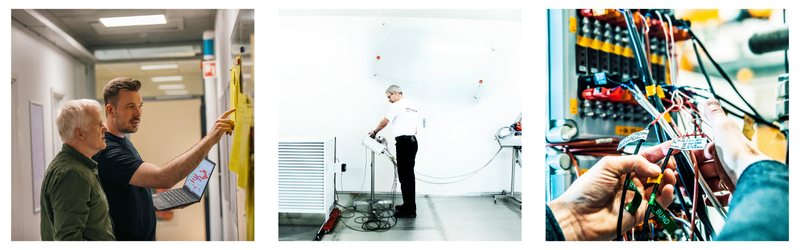
The Heat Pump Test Laboratory at Danish Technological Institute offers end-to-end ISO/IEC 17025 accredited testing and regulatory compliance verification across all system types, including air-to-water, water-to-water, brine-to-water, and air-to-air heat pumps.
Our state-of-the-art facilities handle all refrigerant alternatives, including flammable and high-pressure low-GWP natural refrigerants (R290 propane, R744 CO₂) as well as A2L/HFO blends.
How We Support Your Path to Compliance
Empirical measurement in calibrated climate and acoustic chambers under EN 14511, EN 14825, EN 12102-1, and EN 16147, providing globally recognised third-party documentation. Hands-on technical feedback during prototype setup and testing to identify efficiency bottlenecks, helping you secure higher energy classification tiers (e.g., A++ or A+++) where technically feasible. Verified extraction of declared metrics, energy labels, and technical product fiches formatted for straightforward submission to the European Product Registry for Energy Labelling. Robust, third-party test reports serving as documented, defensible evidence to protect your brand against regulatory audits, mandatory downgrades, or commercial sanctions.1. Accredited Laboratory Testing
2. Gap Analysis & Performance Optimisation
3. EPREL Data Preparation
4. Market Surveillance Defence
Navigating complex EU directives does not have to stall your product launch. At Danish Technological Institute, our specialists act as an extension of your team, providing guidance from initial prototype measurements to the final technical dossier, ensuring a predictable, hassle-free route to European market access.
Official EU Guidelines and Resources
You can find comprehensive regulatory overviews, testing guidelines, and official templates across all regulated product groups directly on the European Commission’s portal: European Commission: Energy Efficient Products Overview and Product List
Contact Our Energy Compliance Experts
Reach out to our specialists to discuss accredited testing requirements, seasonal calculations, or market access compliance for your heat pump portfolio.

Lasse has overall responsibility for the team, the laboratory and its technical direction. He has more than 25 years of experience in refrigeration and heat pump technology, covering product testing, laboratory measurements, and market surveillance, as well as energy efficiency and the implementation of international standards. He is an expert in testing in accordance with international standards and has extensive experience with heat pumps, refrigeration systems, condensing units and related components for both public authorities and industry.
Preben has worked in the energy sector for more than 20 years. He specialises in testing heat pumps as well as providing technical consultancy and product assessment. He is a member of national and international standardisation committees, and he is also a member of an international committee of test laboratories.