
Navigating Energy Labelling for Heat Pumps: Seasonal Calculations and EPREL Compliance
Back to main page The EU Heat Pump Energy Label categorises space heaters from A+++ to D based on their Seasonal Space Heating Energy Efficiency (ηs). Regulated under the EU Energy Labelling Framework Regulation (EU) 2017/1369 alongside Regulations (EU) No 811/2013 and 813/2013, the declared rating requires empirical test data from EN 14511 and seasonal calculation under EN 14825 across three European reference climate zones.Definition: The EU Heat Pump Energy Label
Note: While space heaters currently use the A+++ to D scale under Regulation 811/2013, future revisions will align the sector with the standardised A to G rescaled layout under Regulation (EU) 2017/1369.
Securing an accurate EU energy label requires rigorous laboratory testing, verified seasonal calculations, and compliance with European Ecodesign and labelling directives. Independent test data from Danish Technological Institute ensures documented energy classes and mitigates the risk of market surveillance failure.
Under EU Regulation No 811/2013 and Ecodesign Regulation (EU) No 813/2013, space heaters and combination heat pumps placed on the European market must display an official energy efficiency label and be registered in the EPREL database. Because heat pump efficiency fluctuates depending on outdoor ambient temperatures and supply flow temperatures, energy labelling is determined by empirical performance mapped across standardised climate profiles.
The Heat Pump Test Laboratory at Danish Technological Institute provides ISO/IEC 17025 accredited testing to determine Seasonal Space Heating Energy Efficiency (ηs), heating capacity, and sound power levels (LW A), establishing the documented foundation required for third-party certification and market access.
What Does the Heat Pump Energy Label Indicate?
The European energy label provides market authorities, specifiers, and purchasers with standardised, comparable performance metrics: Categorises heating performance on a scale from A+++ down to D based on the Seasonal Space Heating Energy Efficiency (ηs). Defines the declared thermal output under average, colder, and warmer European climate zones. Declares acoustic noise emissions in decibels (dB), measured in accordance with EN 12102-1 for both indoor and outdoor units. For combination heaters, the energy label indicates domestic hot water production efficeincy based on standardised tapping cycles (EN 16147).Energy Efficiency Class
Rated Heat Output (Prated in kW)
Sound Power Level (LWA)
Water Heating Efficiency (ηwh)
Deriving the Energy Label: From EN Standards to ηs
The declared energy efficiency class cannot be established through theoretical calculations alone. It relies on physical tests conducted according to harmonised European testing standards. Measuring COP and capacity at designated part-load conditions (A, B, C, D). Measured heating capacities and COP values are weighted across European reference bin hours for the selected climate zone to calculate the net Seasonal Coefficient of Performance (SCOPnet). The seasonal space heating energy efficiency is calculated using the EU formula: The resulting ηs value maps directly into the official efficiency scale.1. Empirical Part-Load Testing (EN 14511 & EN 14825)
2. Seasonal Performance Calculation (SCOP)
3. Primary Energy Ratio Conversion (ηs)
ηs = (SCOP / 2.5) x 100 % - ∑ F(i)
where 2.5 represents the EU primary energy conversion factor for electricity (average generation efficiency of 40 %) and ∑ F(i) represents regulatory correction factors accounting for temperature controls (typically 1-8 %) and auxiliary standby/crankcase heater power consumption.
4. Classification Table Match
Energy Efficiency Class Thresholds
The seasonal space heating energy efficiency (ηs) determined in step 3 defines the product’s official energy label class. In accordance with EU Regulation No 811/2013, the thresholds are divided into low-temperature (35 °C) and medium-temperature (55 °C) applications as shown below:
| Energy Efficiency Class | Low-Temperature Application (35 °C) |
Medium-Temperature Application (55 °C) |
|---|---|---|
| A+++ | ηs ≥ 175% | ηs ≥ 150% |
| A++ | 150% ≤ ηs < 175% | 125% ≤ ηs < 150% |
| A+ | 123% ≤ ηs < 150% | 98% ≤ ηs < 125% |
| A | 90% ≤ ηs < 123% | 75% ≤ ηs < 98% |
| B | 82% ≤ ηs < 90% | 70% ≤ ηs < 75% |
| C | 75% ≤ ηs < 82% | 65% ≤ ηs < 70% |
| D | ηs < 75% | ηs < 65% |
Heat pumps that fail to clear the minimum Ecodesign baseline cannot receive an energy label or enter the market. Learn more about mandatory requirements in our Ecodesign Compliance Guide. 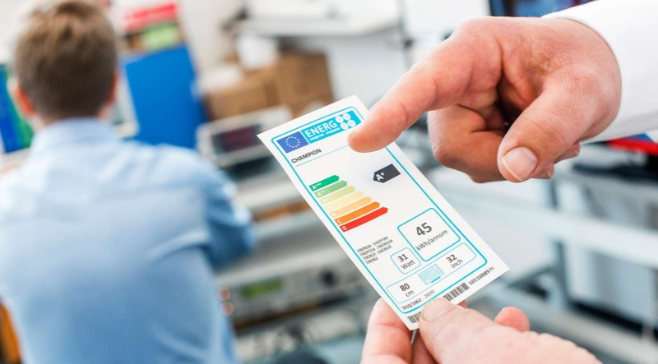
Mandatory EPREL Registration and Compliance Rules
Compliance with the EU Energy Labelling framework is legally binding for European market access. Placing a space heater or combination heat pump on the market requires strict adherence to three regulatory mechanisms:
Mandatory EPREL Registration
Before placing a heat pump model on the EU market, manufacturers and authorised importers must register the model in the European Product Registry for Energy Labelling (EPREL) database. Registration requires uploading of the official energy label, product information fiches, as well as full technical compliance documentation and third-party test verification data.
Commercial Differentiation and Subsidy Qualification
While Energy Labelling categorises compliant products into efficiency classes, Ecodesign (Regulation EU 813/2013) defines the mandatory minimum efficiency baseline across the EU. European subsidy programmes, such as BAFA in Germany, CEE in France, and national heat pump grants across Scandinavia, require a verified minimum rating of A++ or A+++. Accredited test reports provide the empirical proof demanded by subsidy bodies.
Legal Liability and Market Surveillance Tolerances
Manufacturers are legally liable for all declared ratings. National market surveillance authorities regularly acquire production units to conduct independent verification tests. If the tested performance deviates beyond narrow regulatory verification tolerances (typically 8 % for seasonal efficiency and up to 2.0 dB for sound power levels), authorities enforce immediate sanctions:
- Mandatory downgrading of energy labels in EPREL
- Product loses qualification for national subsidy schemes
- Product recall orders, commercial bans, and administrative fines
- Civil liability and commercial compensation claims from end-users or distributors for non-delivered energy savings
Independent testing from an ISO/IEC 17025 accredited laboratory establishes the documented, empirical buffer required to ensure that declared ratings remain compliant during official market surveillance audits.
Commercial and Regulatory Value Across the Supply Chain
Verified energy labelling serves two distinct purposes: securing mandatory compliance under European directives and providing the empirical documentation required in performance-driven procurement: Independent verification of declared performance ratings eliminates the legal and financial risks of product recalls, sanctions, and forced EPREL label modifications. Furthermore, accredited test reports provide the documented proof required to qualify for European subsidy programmes (such as BAFA in Germany and CEE in France), where an A++ or A+++ rating is a mandatory technical threshold. Independent batch testing and empirical validation of supplier specifications prior to major procurement contracts, framework agreements, and commercial tenders, ensuring products deliver to declared technical parameters.For Manufacturers and Importers
For Wholesalers and OEM Branders
Substantiating Environmental Claims with Empirical Data
Under current and incoming European regulations on environmental claims, efficiency and carbon-reduction claims must be supported by verifiable, empirical evidence rather than theoretical models.
Accredited ISO/IEC 17025 test reports from Danish Technological Institute provide independent, third-party data on key metrics such as Seasonal Coefficient of Performance (SCOP) and Seasonal Space Heating Energy Efficiency (ηs). This gives manufacturers and distributors an objective, standardised technical baseline to substantiate product performance declarations and support compliant communication.
For an overview of European framework directives, CE requirements, and cross-product rules, explore our general guide to EU Ecodesign & Energy Labelling Compliance. Rigorous measurement in calibrated climate and acoustic chambers under EN 14511, EN 14825, EN 12102-1, and EN 16147. Verified extraction of declared values, fiches, and technical parameters formatted for straightforward database submission. Technical feedback during setup and testing to identify efficiency bottlenecks, helping you secure higher energy classification tiers where technically feasible. Safe test execution across all refrigerant alternatives, including low-GWP natural refrigerants (R290, R744) and HFO blends.The Role of Independent Testing Laboratories
in the Energy Labelling ProcessAccredited Laboratory Testing
EPREL Data Preparation
Performance Optimisation
Refrigerant Flexibility
Meet Some of Our Experts
Accurate energy labelling requires precise laboratory measurements, validated seasonal calculations (ηs), and complete alignment with European EPREL requirements. When testing with Danish Technological Institute, you work directly with dedicated test engineers and regulatory specialists who follow your product throughout the entire process, from initial rig setup to final reporting.
Reach out to our team to discuss your energy labelling scope, verify seasonal calculations, optimise performance toward higher energy classes, or reserve testing capacity in our climate chambers.

Lasse has overall responsibility for the team, the laboratory and its technical direction. He has more than 25 years of experience in refrigeration and heat pump technology, covering product testing, laboratory measurements, and market surveillance, as well as energy efficiency and the implementation of international standards. He is an expert in testing in accordance with international standards and has extensive experience with heat pumps, refrigeration systems, condensing units and related components for both public authorities and industry.
Preben has worked in the energy sector for more than 20 years. He specialises in testing heat pumps as well as providing technical consultancy and product assessment. He is a member of national and international standardisation committees, and he is also a member of an international committee of test laboratories.
Frequently Asked Questions About Energy Labelling
If you have questions about energy labelling calculations, EPREL requirements, test tolerances, or the certification process, our FAQ provides a quick overview of key technical topics.
You can find answers to additional questions about heat pumps on our page Accredited Heat Pump Testing for Certification and European Market Access, and you are always welcome to contact our team to discuss your specific testing requirements using the contact information above or the form on the right.
Information for Homeowners and Private Buyers
If you are a consumer looking to compare energy-labelled heat pumps for private residential heating in Denmark, please consult Varmepumpelisten (The Heat Pump List).
INDSÆT FORMULAR TIL NYHEDSBREV UK