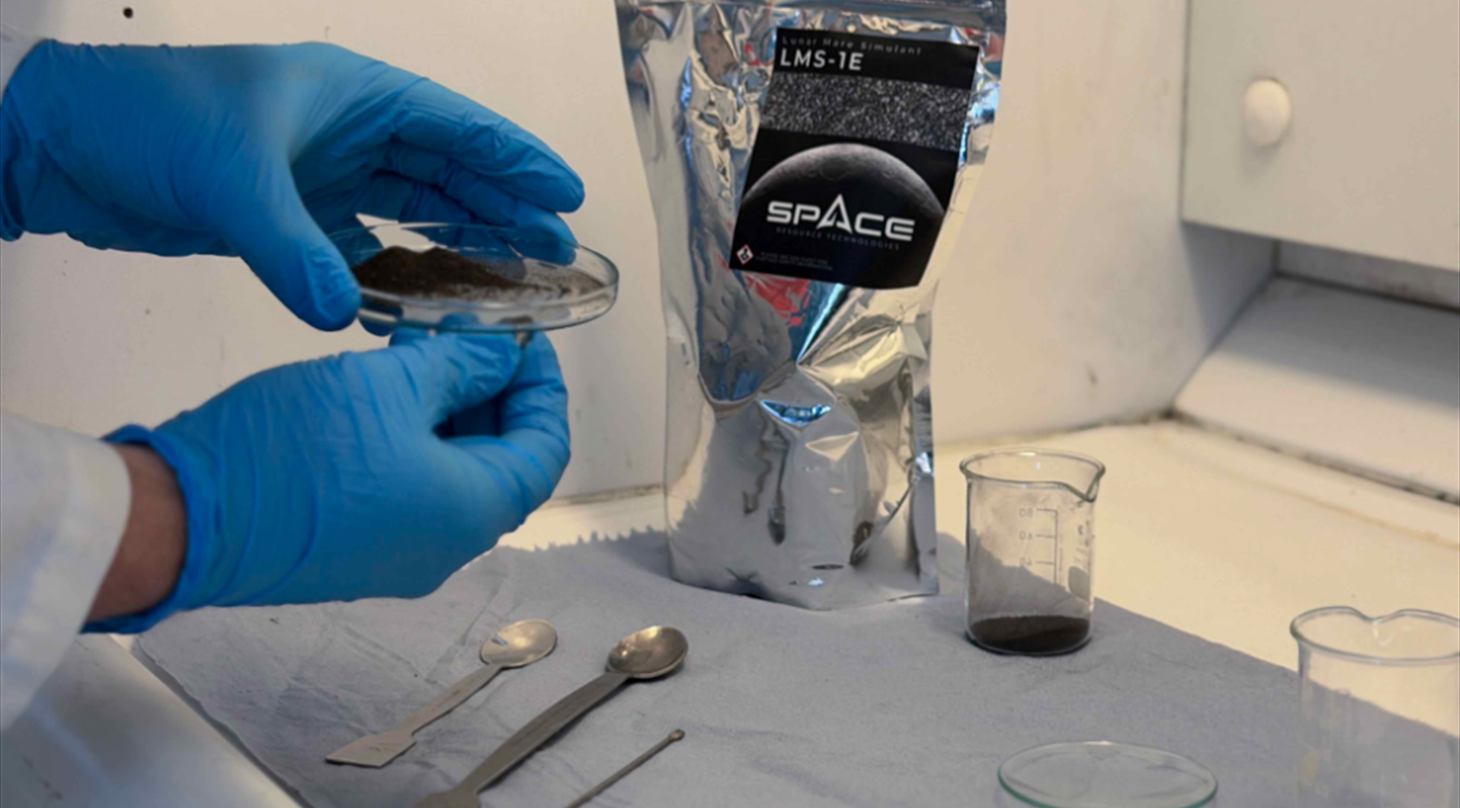
Regolith to Repairs: The potential of lunar soil for future moon missions
'Regolith to Repairs - ISRU for Additive Manufacturing of Electronics' is a proof-of-concept project funded by the European Space Agency (ESA). Here, Danish Technological Institute is working to transform lunar soil - also known as regolith - into usable materials that can be produced locally on the moon.
Specifically, this involves metal powder that can conduct electricity and ink for printing electronic circuits. The goal is to make future space missions more self-sufficient by reducing the dependence on supplies from Earth.
These missions face challenges due to the high costs and complexities of transporting materials from Earth. This project addresses these challenges by exploring the potential of lunar dust to become a local resource. Regolith contains a high percentage of oxygen, which can be separated through molten salt electrolysis, but it is the by-products that truly hold possibilities for future use.
Innovative solutions for lunar electronics
The aim of the project is to convert the otherwise unused metal residues from oxygen extraction into conductive metal powder and ink for printed electronics. Collaboration with several key players in the space industry, including ESA and manufacturers of space technology, will demonstrate how these materials can be used for the production of electronic circuits directly on the Moon.
If successful, the project could open new markets in the aerospace industry by enabling the production of electronics locally in space. The technologies may also be applied in harsh industrial environments on Earth, making them relevant for both international space organizations and private aerospace companies.
The Danish Technological Institute brings to the project expertise in conductive materials, printable inks, and metal powders. The institute has modern facilities for both metal 3D printing and the development of conductive inks, as well as techniques for printing electronics and embedding them in flexible materials and even textiles.
Environmental benefits
By producing electronic components on the Moon, the need to send materials from Earth is reduced, saving resources and decreasing CO2 emissions from transportation. The project expects to significantly reduce material consumption and CO2 emissions by utilizing local resources instead of supplies from Earth.
Project facts
- Title: Regolith to Repairs
- Project type: Proof-of-concept project under ESA's Discovery program
- Budget: 155,000 euros
- Project period: September 2025 - December 2026
- Partner: Danish Technological Institute