Raw material quality in plant-based crops and biomaterials

We assist businesses, plant breeders and producers in identifying, measuring and enhancing the quality parameters that determine the commercial suitability of crops.
Our services cover both food crops, including protein crops, fruits, vegetables and nuts and biomaterials such as stinging nettles and miscanthus (elephant grass) for textiles or construction materials.
We provide advice on the relationship between growing conditions, soil health and raw material properties, ensuring that crops are utilised optimally and sustainably.
Through our pilot facilities and cross-value-chain networks, we help establish partnerships and document raw material potential before you commit to full-scale investments.
How can Danish Technological Institute help you?
- Optimising the cultivation and processing of novel crops under Danish conditions.
- Characterising and documenting raw material quality for food and biomaterial applications.
- Phenotypic crop analysis (including size, roundness, colour, and purity).
- Pilot-scale trials in mechanical dehulling, cleaning, sorting and fractionating (up to approx. 10 kg).
- Developing and testing post-harvest processing methods for emerging crops lacking established industry standards.
- Facilitating partnerships and networking across the plant-based value chain.
- Advisory services on quality parameters from field to processed raw material.
Create value through precise documentation and strong value chains
The successful commercialisation of plant-based raw materials requires in-depth insight into the crop’s physical and biological characteristics. Whether the objective is food-grade ingredients or plant fibres for bio-based building materials and textiles, consistency, purity and processability are vital to the end product's value.
Danish Technological Institute helps you unlock crop potential early in the development cycle. By combining agronomic expertise with pilot-scale mechanical testing, we minimise both the technical and financial risks associated with scaling up.
Methods and equipment for analysis and pilot processing
We possess specialised equipment for quality analysis and mechanical post-harvest processing at laboratory and pilot scale (up to approx. 10 kg):
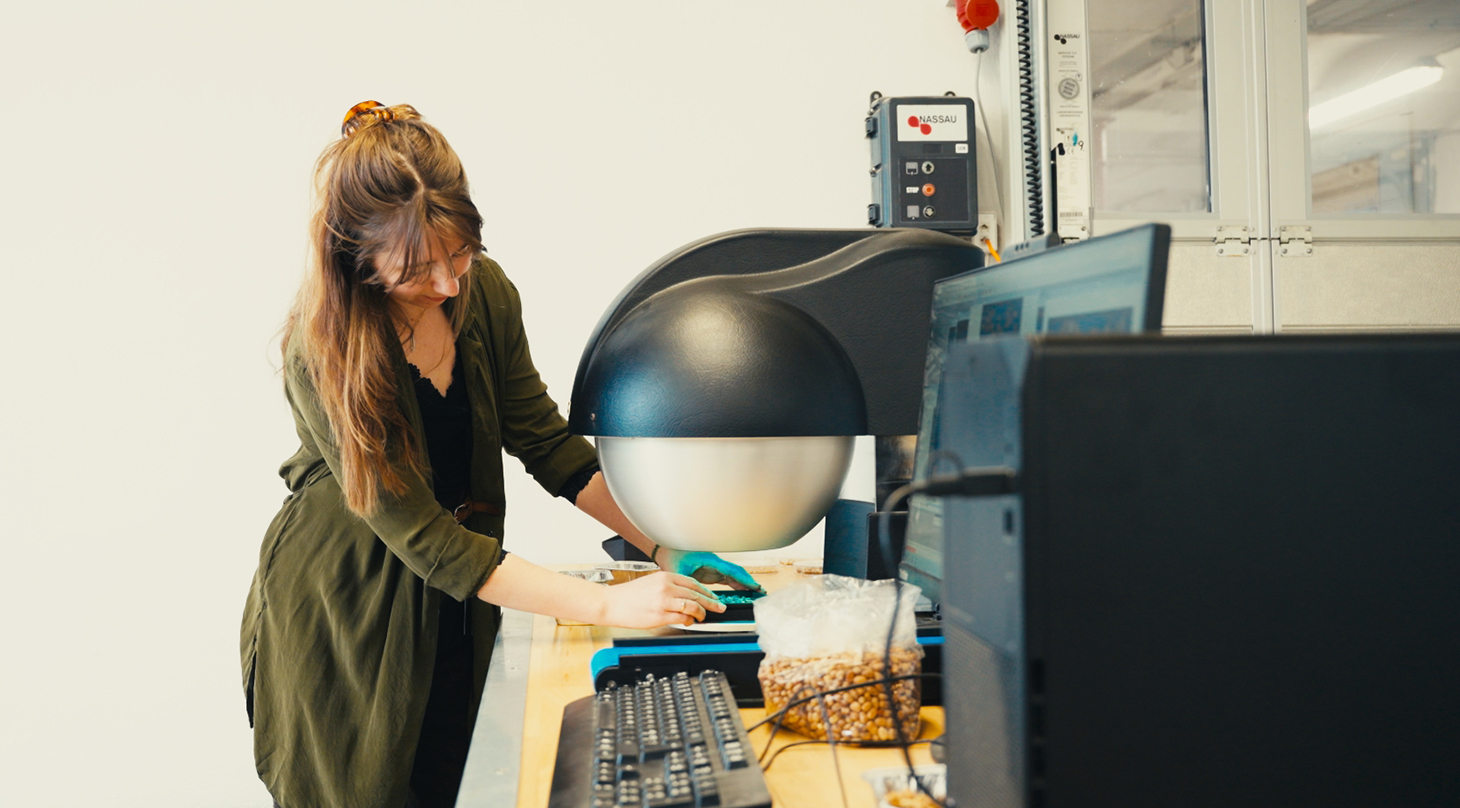
- VideometerLab: Multispectral imaging across 19 wavelengths for objective assessment of purity and morphological traits.
- Moisture analysis: Measurement of crop moisture content to ensure storage stability.
- NIT (Near-Infrared Transmission): Non-destructive rapid analysis of grains and pulse crops for crude protein content.
- Lab-scale dehullers: For mechanical dehulling of pulses, grains and seeds.
- Screen cleaners / Sieve separators: For separating and cleaning crops from sand, stones, dust and chaff/straw.
- Indented cylinder separators (Trieurs): For length-based sorting and cleaning, as well as separating intercropped/mixed crops.
For fibre crops, we assist with process understanding and method development, including advice on drying strategies and mechanical handling.

Photo: Faba beans (broad beans) viewed through Danish Technological Institute's VideometerLab.
Research and value chain development
The Danish Technological Institute participates in a range of development projects designed to enhance the utilisation of plant-based resources:
- Dansk Bælgboost (Danish Pulse Boost): Develops and strengthens the value chain for Danish-grown pulses from farm to fork.
- FABAPUZZLE: Investigates faba bean quality traits, drought tolerance, and potential applications in food products.
- CicerNord: Evaluates the potential and growing conditions for chickpeas in Nordic climates.
Contact Us for More Information
Would you like to assess the potential of a crop, conduct pilot-scale testing, or strengthen collaboration across your value chain?
Contact Danish Technological Institute for an expert discussion on the opportunities for your raw materials.