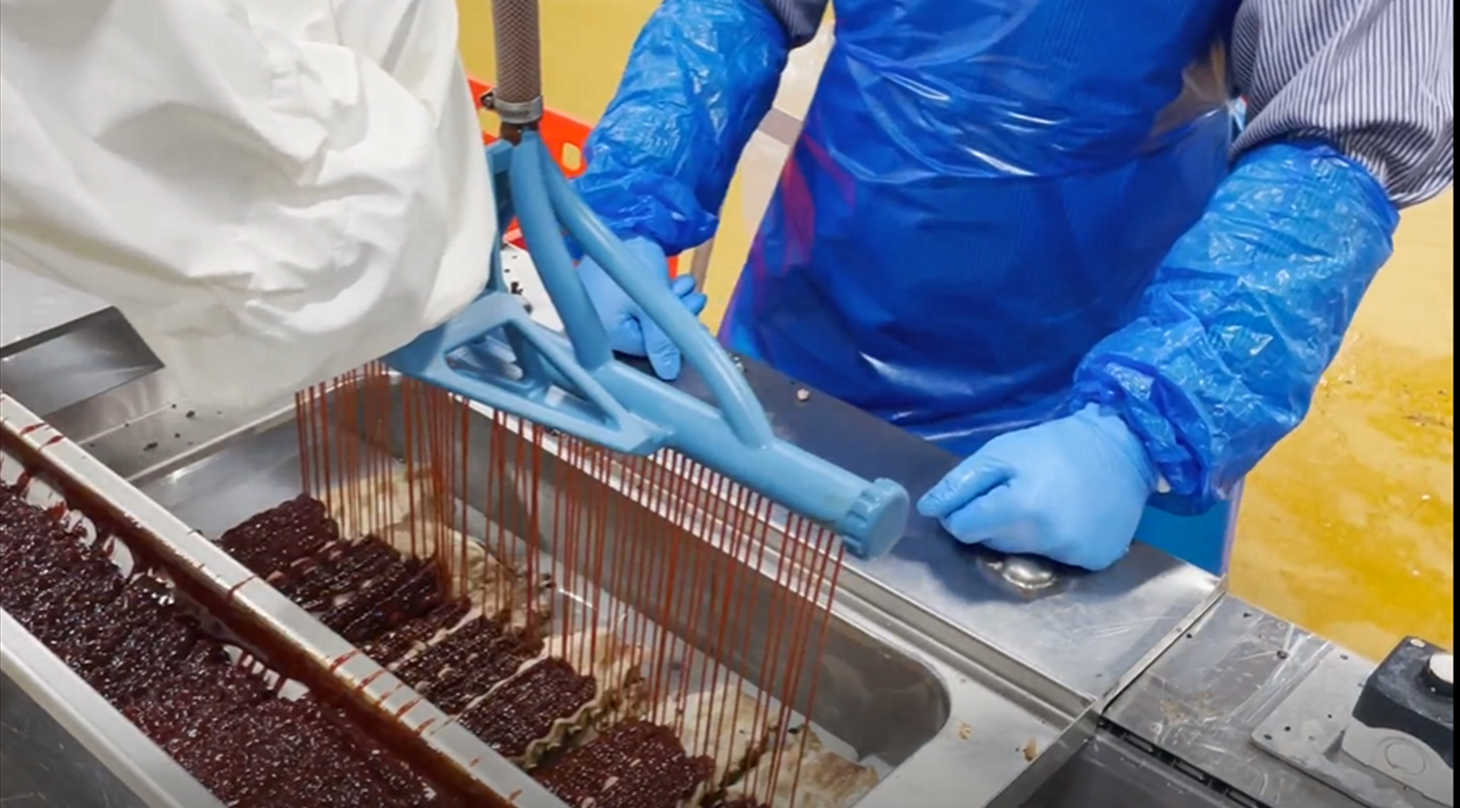
BILA optimizes BBQ nozzle with 3D printing – and the speed was impressive
When BILA needed to develop an automation solution for applying BBQ marinade to spare ribs, they turned to 3D printing and the Danish Technological Institute. This led to a completely different solution than the one originally planned.
Danish company BILA is one of the Nordic region’s leading integrators in robotics automation, supplying tailor-made solutions across multiple industries.
When tasked with developing an automation solution for a customer to apply BBQ marinade to spare ribs, a specific need emerged: a custom-designed manifold about the size of a tennis ball, capable of evenly distributing sauce to the pipes with small holes, through which the marinade would ultimately be applied.
In this context, BILA wanted a solution in which the manifold would be 3D-printed in stainless steel. Therefore, they sent a 3D file to the 3D printing specialists at the Danish Technological Institute.
A new direction – and cheaper handling of BBQ marinade
It was Kristian Rand Henriksen, business manager and 3D printing specialist, who received the 3D file from BILA’s mechanical engineer, Frederik Andersen. He quickly assessed that the proposed solution would be too expensive. So, he suggested a short initial online meeting to review the solution and requirements together.
I looked at the drawing and thought it would be quite costly compared to what I imagined the need was. Therefore, I suggested a brief meeting where he could show me what the part was to be used for, so I could get an understanding and guide him correctly
- Kristian Rand Henriksen, Danish Technological Institute
After reviewing the solution in the meeting, Kristian suggested designing and 3D-printing the entire nozzle as one piece - instead of just printing the manifold and then assembling it with other components. The nozzle would be printed in blue, metal-detectable nylon (BlueDP), which is approved for food contact. At the same time, the material is significantly cheaper than stainless steel - and it was perfect for this component, since load-bearing capacity was not a requirement.
They agreed to proceed with this solution.
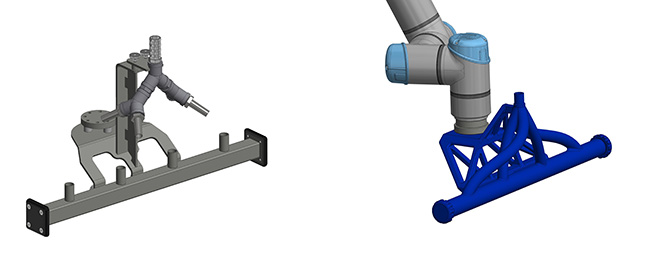
To the left, you see the original design, and to the right is the design for 3D printing.
Record-breaking design time
After the meeting, which was held in the morning, Frederik Andersen went back to the drawing board to redesign the solution - and by the same afternoon, he returned with the finished design.
- It was impressive that he took it from an idea in the morning to a finished 3D-printable design that was basically ready to print in the afternoon, says Kristian Rand Henriksen.
The Danish Technological Institute then printed a first version, which BILA tested. They discovered that the holes needed to be slightly larger to let out enough BBQ marinade. Fortunately, it’s easy to adjust a digital design for 3D printing, and once the new design was ready, the final version was printed - and it worked perfectly.
The advantage of 3D printing in this case was that the part could be designed quickly, and I had more freedom in terms of the construction. Cooperation with the Danish Technological Institute went well, with fast responses and good guidance from them regarding the use of 3D printing
- Frederik Andersen, BILA
The advantages of 3D printing: Speed, flexibility, and hygiene
1. Significantly faster development process
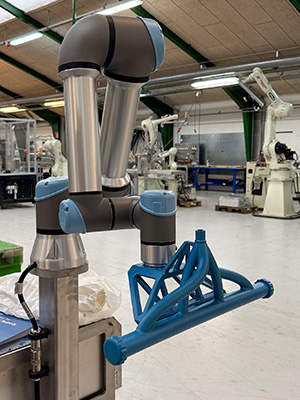
Where traditional manufacturing would require several suppliers, 2D drawings, and assembly of multiple parts, 3D printing made it possible to produce the entire nozzle in a single piece - and the design was developed within half a day.
2. Optimized cleanability
Manufacturing in one piece eliminates joints and surplus interfaces, making cleaning much easier—a major advantage in the food industry, where hygiene is crucial.
3. Design flexibility
3D printing made it possible to quickly adapt the design - with features like curves and precise channels, making the part reliable and easy to wash.
4. Reduction of manual procedures
Compared to conventional manufacturing, the time spent and the need for assembly work were significantly reduced.
3D printing wins on speed and hygiene
The material price with conventional production would probably have been slightly lower than the 3D-printed solution, but the total costs - including design time, sourcing suppliers, and assembling components - would have made the traditional solution more expensive in the long run. Moreover, the 3D-printed solution is more hygienic as it has no joints.
Through open collaboration and agile use of 3D printing technology, BILA managed to solve a complex challenge in record time. The case underscores the benefits of combining new technology with close customer dialogue and shows how digital production can act as an accelerator for both innovation and efficiency - not only in industry, but even at the dinner table.