From digital scanning to museum replica: 3D printing recreates historical whale artifacts in 1:1 scale
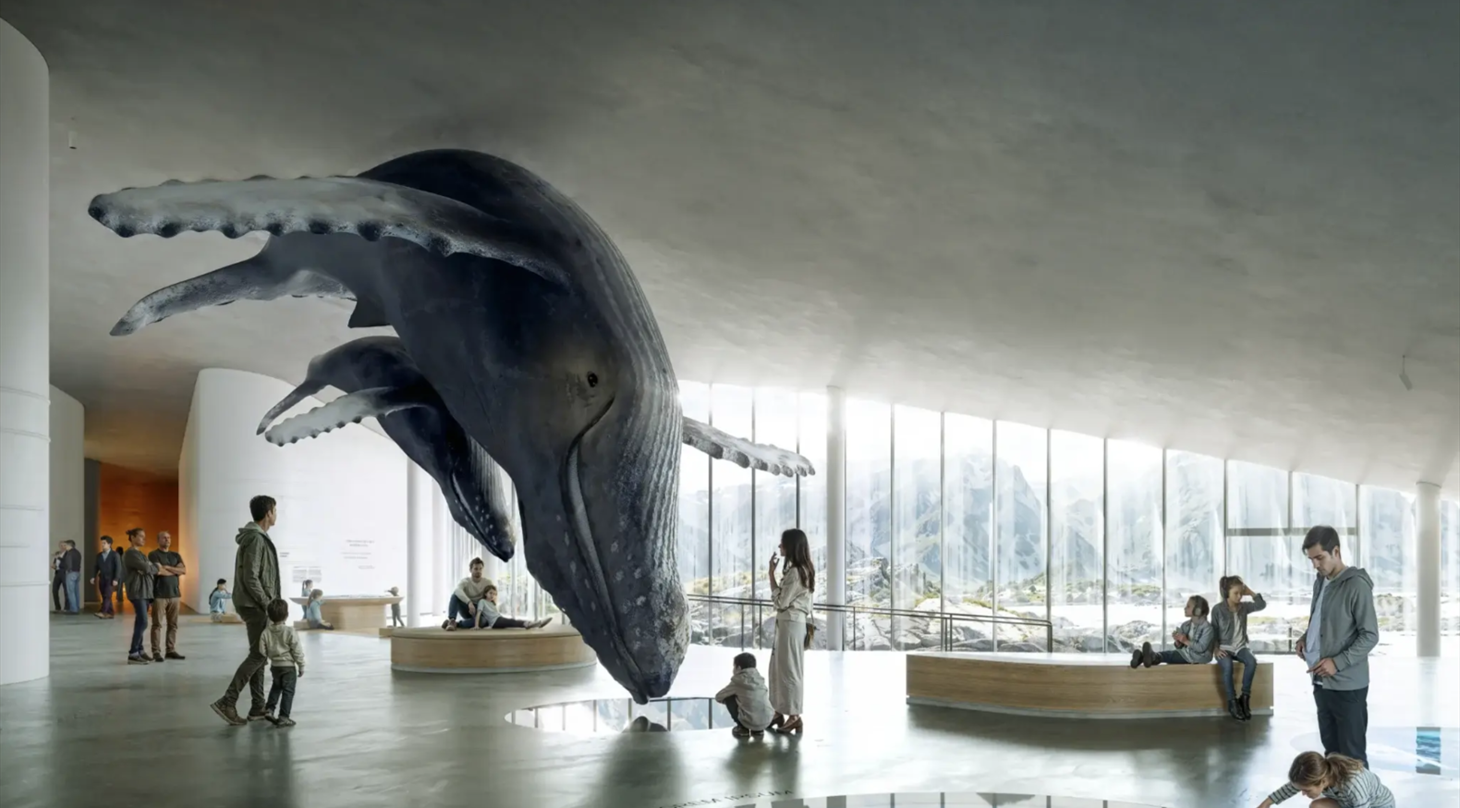
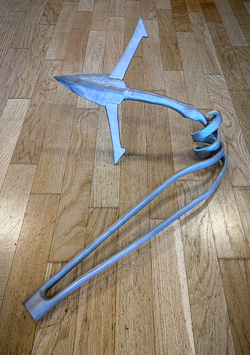
When the whale museum The Whale opens in Northern Norway in 2027, it will feature two remarkable objects created with 3D printing at Danish Technological Institute: a solid, twisted steel whale harpoon and a 1.5-meter-long replica of a whale penis. Both objects are intended to help make the story of whaling and whale anatomy tangible for museum visitors.
As part of the exhibition, the museum aims to convey two facets of the whale’s history: the brutal hunting practices of the past and the animal’s fascinating anatomy.
 The hunt for unattainable originals
Central to this narrative are two rare artifacts.
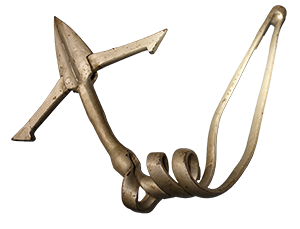
One is an original metal harpoon that, according to the story, was twisted by the immense forces of a whale during a hunt. The distinct bends and deformations make the harpoon a physical testament to the violent death struggle the museum wishes to convey.
The second artifact is a historical, inflated, and dried whale penis measuring approximately 1.5 meters.
However, this is where the challenge arose: although both items already existed, they were owned by other museums - and for obvious reasons, one cannot simply procure a new whale today.
- Originally, we had a loan agreement with a museum for the original whale penis, but that museum ultimately assessed the artifact as too fragile to lend out. As for the harpoon, it was fundamentally unavailable for loan. Furthermore, we wanted an object robust enough for the public to touch in an exhibition, says Joakim Engel, Exhibition Project Manager at The Whale museum.
Traditional craftsmanship was not readily feasible: recreating the distorted harpoon through a blacksmith would have been exceedingly costly and time-consuming, and organic mold casting of the fragile, irregular penis was practically impossible by hand.
The solution lay in digitization. The museum’s external conservator, who works with the digitization of artworks and natural history objects, was granted access to 3D-scan the originals. Armed with digital models, Danish Technological Institute was selected to recreate the complex geometries faithfully using 3D printing - in full scale and within the museum’s budget.
When the geometry exceeds the printer's build volume
For Danish Technological Institute, the task became an example of how additive manufacturing technologies can be applied far beyond industrial components. The two objects demanded vastly different materials, post-processing, and considerations for the upcoming exhibition.
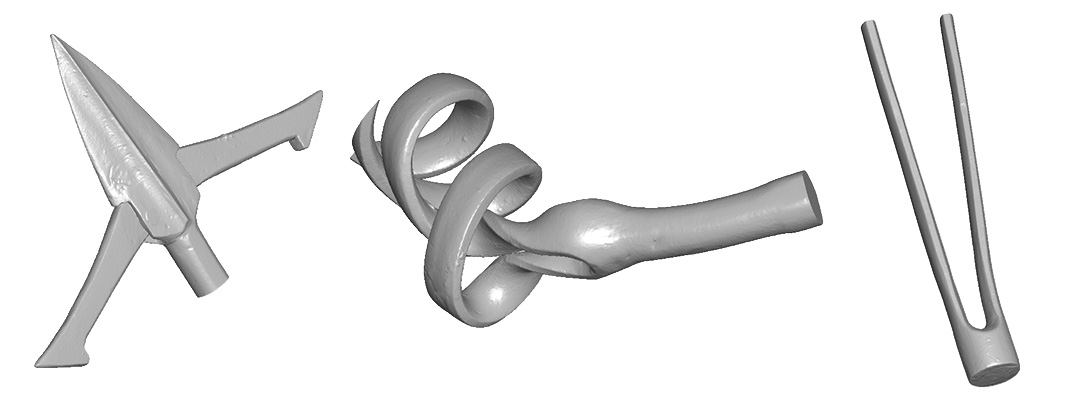
The harpoon needed to be a durable touchable object that museum guests could get up close to. Therefore, it was manufactured in stainless steel using Laser Powder Bed Fusion (LPBF) technology. Printing the large artifact in a single piece was not possible, so the model was digitally divided into five sections. The parts were printed, cleaned, welded together, and ground down to conceal the seams.
Stainless steel was chosen because the material is well-suited for both 3D printing and subsequent welding. Later, a specialist will patina the surface so that the pristine new steel harpoon takes on the appearance of an aged artifact featuring worn paint, traces of rust, and signs of use.
It demonstrates how metal 3D printing can also be used for large, solid museum artifacts that must withstand public handling for many years
- Lasse Nitschke, Danish Technological Institute
 A raw surface with a purpose
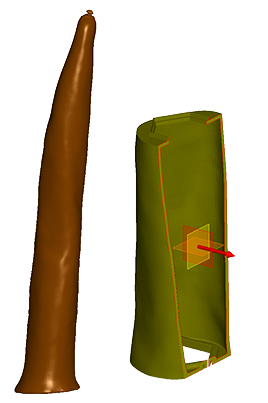
The 1.5-meter-long whale penis was produced in polymer. Here too, the dimensions exceeded the printer’s build volume, requiring the model to be split into three sections. Furthermore, because the scan data had been acquired using a handheld scanner, it required digital cleanup before the surface could be made uniform and print-ready.
- To keep weight, material consumption, and costs down, we made the model hollow with a wall thickness of approximately eight millimeters. The sections were designed with precise joints and subsequently bonded with epoxy adhesive, explains Lasse Nitschke.
The model is engineered to stand in the exhibition, but it will need to be cordoned off and supported, as it is not intended for visitors to touch.
Unlike the harpoon, the print’s slightly porous surface was preserved. This provides an expert painter or conservator with a better foundation for the detailed painting and patination required to make the replica look lifelike. An authentic rope will subsequently be attached to the top to complete the look.
From the museum’s perspective, the team is thrilled with the outcome.
It has been an excellent collaboration with good technical discussions throughout the process. We experienced great enthusiasm from Danish Technological Institute regarding the assignment, so it has been a positive experience - and the results turned out really well
- Joakim Engel, The Whale
 Digital data becomes living history
Through 3D printing, The Whale gains access to objects that would otherwise be impossible, extraordinarily time-consuming, or disproportionately expensive to produce using traditional methods. The technology allows 3D scans of protected museum artifacts to be transformed into robust, highly detailed, full-scale replicas.
- It was all about remaining open-minded toward unconventional challenges and exploring how our technologies could realize the client’s vision - creating something unique that adds value for the museum and its guests, says Lasse Nitschke.
Following final patination by conservators, the objects will be ready to take their place at The Whale in 2027 - serving as tangible proof of how industrial 3D printing technology can bridge the gap between digital cultural heritage and vibrant museum storytelling.
Actually, this is not the first time that Danish Technological Institute has 3D printed museum objects - previously, the specialists have printed bone remains found of the Koelbjerg Man, allowing visitors to now experience a faithful replica of the Nordic region's oldest human.