From potential to product: Danish startup gained momentum with 3D printing
How do you make a strong healthcare idea investable in a relatively short time? For LIITA Care, a targeted 3D printing development process with the Danish Technological Institute became a step from concept to concrete product.
Most startups begin in the same place: with an idea that makes sense on paper, and perhaps is even professionally sound. But between idea and product, the crucial question arises: When does it become something others can believe in? This is where a well-thought-out and well-designed prototype can be exactly what is missing.
For LIITA Care, it began with precisely such a strong idea. A well-known physiological principle indicated that a high salt level in the airways can make it harder for viruses to survive and multiply. The principles were well documented, and the potential to turn this into a concrete inhalation solution based on micronized salt was clear. The idea was an inhaler in which the salt could be inhaled in a controlled manner.
But potential is not the same as a product.
 A strong idea – but without weight in the market
LIITA Care had a strong idea, but lacked a physical product. The need was not just for a prototype, but for something that could build trust and make the potential tangible.
- We had a strong idea, but without a concrete product it was difficult to convince the market and investors. We needed a Minimum Viable Product that was more than a sketch—something you could hold in your hand and test in real life, says Martin Ohrt, founder of LIITA Care.
From drawing to testing in record time
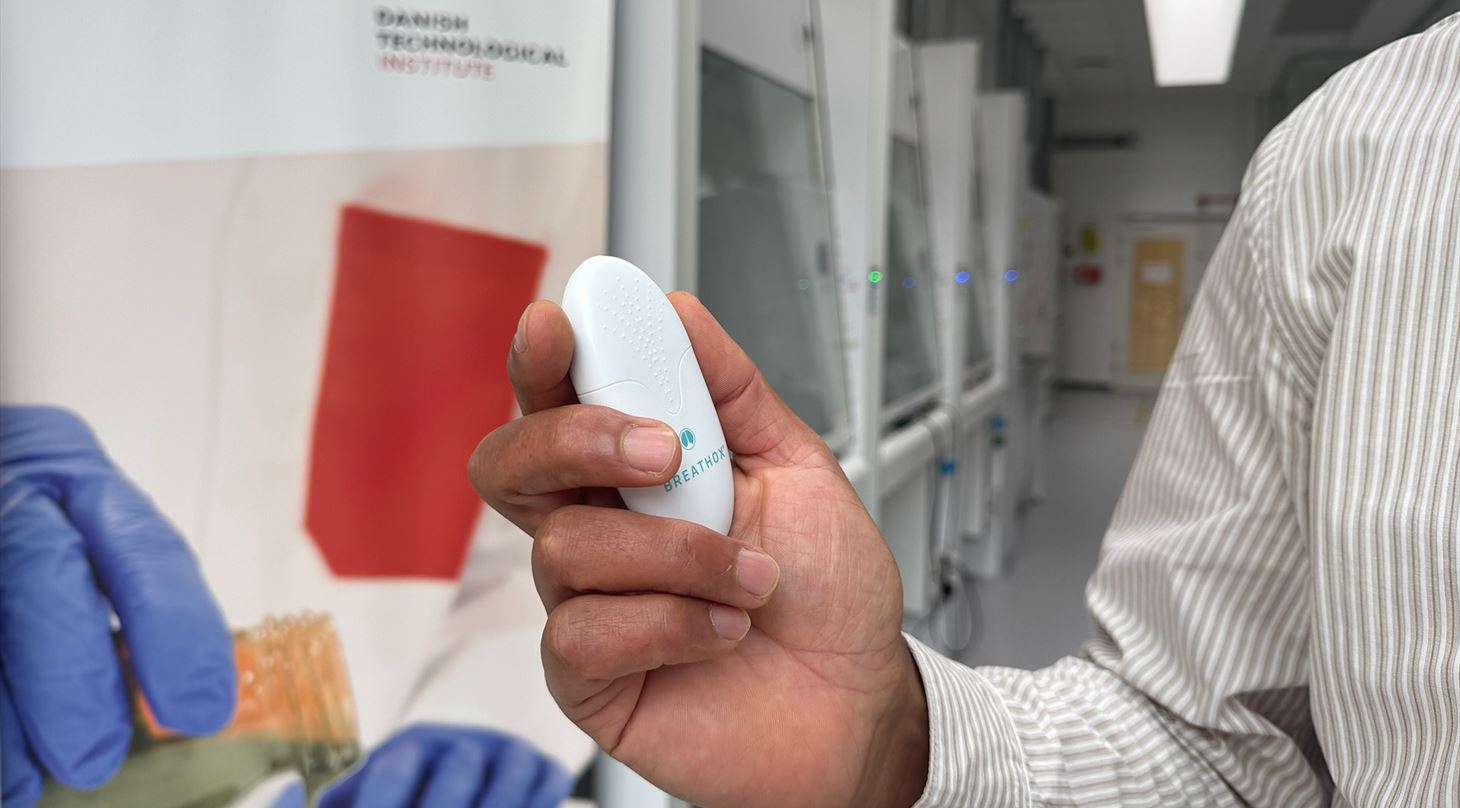
Together with the Danish Technological Institute, a 3D printing-focused development process was launched, with the goal of taking Breathox from sketch to a functional and presentable prototype.
Specialists at the Danish Technological Institute translated the initial sketches into 3D models and worked on specific parts of the solution, including airflow through the inhaler and protection of the micronized salt in an internal chamber.
At the same time, a relatively complex internal design was simplified so that the product became more robust and easier to manufacture.
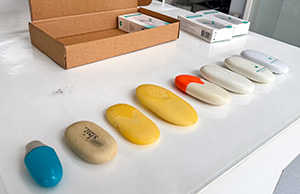
With 3D printing, design changes could be made directly from CAD drawings to physical parts. This made it possible, within just a few weeks, to test a larger number of variants without LIITA Care having to invest in expensive molds and tools in the early phase.
3D printing is really smart when it comes to product development. You have your drawing on the computer, press ‘print’, and shortly afterward you are standing with a physical object in your hand that you can test and adjust
- Jeppe Byskov, Danish Technological Institute
The 3D-printed units were both functional and visually refined enough to be photographed and sent to potential partners.
This meant that LIITA Care could no longer only talk about their solution—they could show it:
- The help from the Danish Technological Institute has been absolutely crucial. We had an idea for a concept, but the collaboration meant that we obtained a concrete product that we could use to demonstrate our concept and vision to investors and developers who were to help us realize our vision, says Martin Ohrt.
A prototype as an investment case
The transition from idea to something physical proved to be crucial. On that basis, an international stakeholder assessed that BREATHOX® could be scaled to as many as 250,000 units. This became an important element in LIITA Care’s capital raising journey.
Without the tailored 3D printing process, we quite simply would not be sitting here today. The prototypes made our idea tangible—both for investors and for ourselves
- Martin Ohrt, LIITA Care
- LIITA Care is an example of how 3D printing can be used to quickly test design choices and get a product ready for the first market tests. By working iteratively with functional 3D-printed prototypes, we were able, together with LIITA Care, to validate the design, optimize the user experience, and create a foundation that was strong enough for both testing and investor dialogue, says Jeppe Byskov.
A journey that began with 3D printing today means that the company’s product is already on the shelves for Danish consumers. LIITA Care is also further developing its product both for the civilian healthcare sector and with prospects within defense and emergency preparedness, where respiratory infections affect sick leave, combat capability, and medicine consumption.