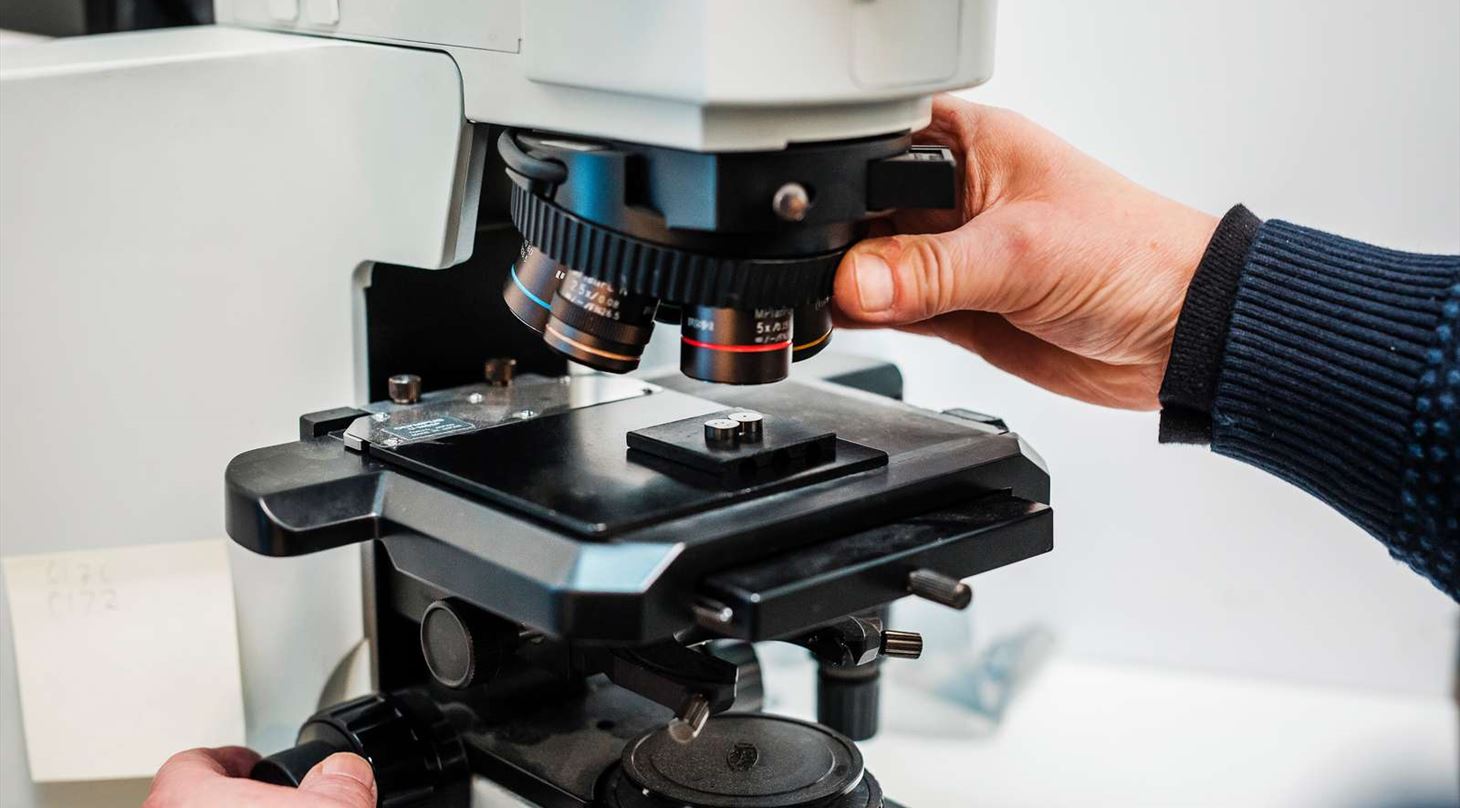
Surface characterization and analysis of surface coatings and materials
The high-tech analytical techniques that we at the Danish Technological Institute use ourselves to analyze and develop our surface coatings can also be offered for characterization of your products, materials, and surfaces.
Our range of surface analysis techniques can provide unique insight into improvement potential or opportunities for many different systems. We can help identify which analytical methods will be relevant for your specific situation.
Below you can see a selection of the surface characterization methods we use.
Analytical methods for measuring and testing physical and mechanical surface properties
Nanoindentation: A nanoindenter is an advanced hardness tester used for precise measurement of the mechanical properties of materials and surfaces, such as hardness and elastic modulus, on the nanometer scale. With our state-of-the-art nanoindenter, we can obtain highly accurate results that are ideal for assessing surface durability and strength. This method is indispensable for understanding how materials and surfaces will behave under load and can help optimize their performance and lifetime.
Pin-on-disc: Pin-on-disc testing is used to evaluate friction and wear properties of surfaces by simulating sliding contact between two materials. The test can be carried out with or without lubricant and in a well-defined environment that matches the real application of the tested materials. This method provides important information about wear resistance, which can help improve material selection or coatings. Learn more about pin-on-disc
Contact angle measurement: A technique that examines the interaction of liquids with surfaces to determine hydrophobicity or hydrophilicity. The results can be used to optimize the surface, which is important for, for example, self-cleaning surfaces.
Analytical methods for surface structure, crystal structure, and surface chemistry
Scanning Electron Microscopy (SEM): Makes it possible to obtain images of a surface’s structure on the micrometer scale. SEM is essential for visualizing small details and textures in materials, which can reveal defects, morphology, and other important structural features that determine the surface’s properties.
Energy Dispersive X-ray Spectroscopy (EDX): An analytical technique used together with SEM to determine the chemical composition of materials and surfaces. EDX can identify and quantify the elements present on a surface, making it possible to analyze the chemical composition of the surface or material. The technique is also well suited for identifying impurities or defects, which you can read more about here.
Profilometer: Our high-precision profilometer is used to map the topography and roughness of surfaces on the nanometer scale. The technique can be used to determine coating thickness with high accuracy and to measure stresses in surface coatings.
 Parallel Beam Grazing Incidence X-ray Diffractometer (XRD, GI-XRD): An X-ray diffraction technique used to analyze the crystal structure and phase of thin films, surface coatings, and materials. Our equipment is specially designed to focus the X-ray beam specifically on the surfaces and to obtain as much information as possible from the outermost layers (100–300 nanometers). The technique can also be used to study surface texture and stress as well as strains that can affect performance.
Synchrotron X-ray Diffraction (SR-XRD): We use X-ray diffraction with synchrotron radiation as a supplement to GI-XRD when the task requires exceptional resolution or when we need to study the evolution of a surface over time. With the very high-intensity X-rays from synchrotrons, it is possible to achieve very high time resolution in structural measurements. Therefore, the technique is often used in experiments where one needs to observe the structural development of a surface over time while it is being influenced from the outside. Examples include coatings on cutting tools measured while in operation, observing thin films being formed in the coating process, or watching functional surfaces in electrolysis devices during operation.
Grazing Incidence – Pair Distribution Function (GI-PDF): Grazing incidence PDF is a synchrotron technique used to identify small changes in the positions and structure of individual atoms at surfaces. The technique can also be applied to amorphous surface coatings, which makes it incredibly powerful for understanding the atomic-scale structure in all kinds of surfaces.