Navigating Ecodesign Compliance for Heat Pumps
Select Page
The EU Ecodesign framework sets legally binding minimum environmental and energy efficiency requirements for energy-related products placed on the European single market. For hydronic heat pumps, space heaters, combination units, and domestic hot water systems, Ecodesign baseline criteria are defined primarily under Commission Regulations (EU) No 813/2013 and (EU) No 814/2013 under the Ecodesign Directive 2009/125/EC. Compliance with these performance thresholds is a mandatory prerequisite for CE marking and legal market distribution across the European Union and EEA.Definition: The EU Ecodesign Framework for Heat Pumps
Note: The regulatory framework is undergoing progressive revision under the Ecodesign for Sustainable Products Regulation (ESPR), introducing stricter seasonal performance baselines, extended circularity criteria, and digital product passport documentation.
Meeting mandatory Ecodesign requirements is not optional. While Energy Labelling categorises compliant products into comparative efficiency tiers, Ecodesign functions as an absolute market barrier: units failing to meet minimum seasonal space heating efficiency or exceeding maximum acoustic limits are prohibited from entering the European internal market.
For heating appliance manufacturers, R&D teams, and authorized importers, navigating Ecodesign requires empirical laboratory testing to verify part-load performance, measure precise sound power emissions, and compile the technical compliance documentation demanded by national market surveillance authorities.
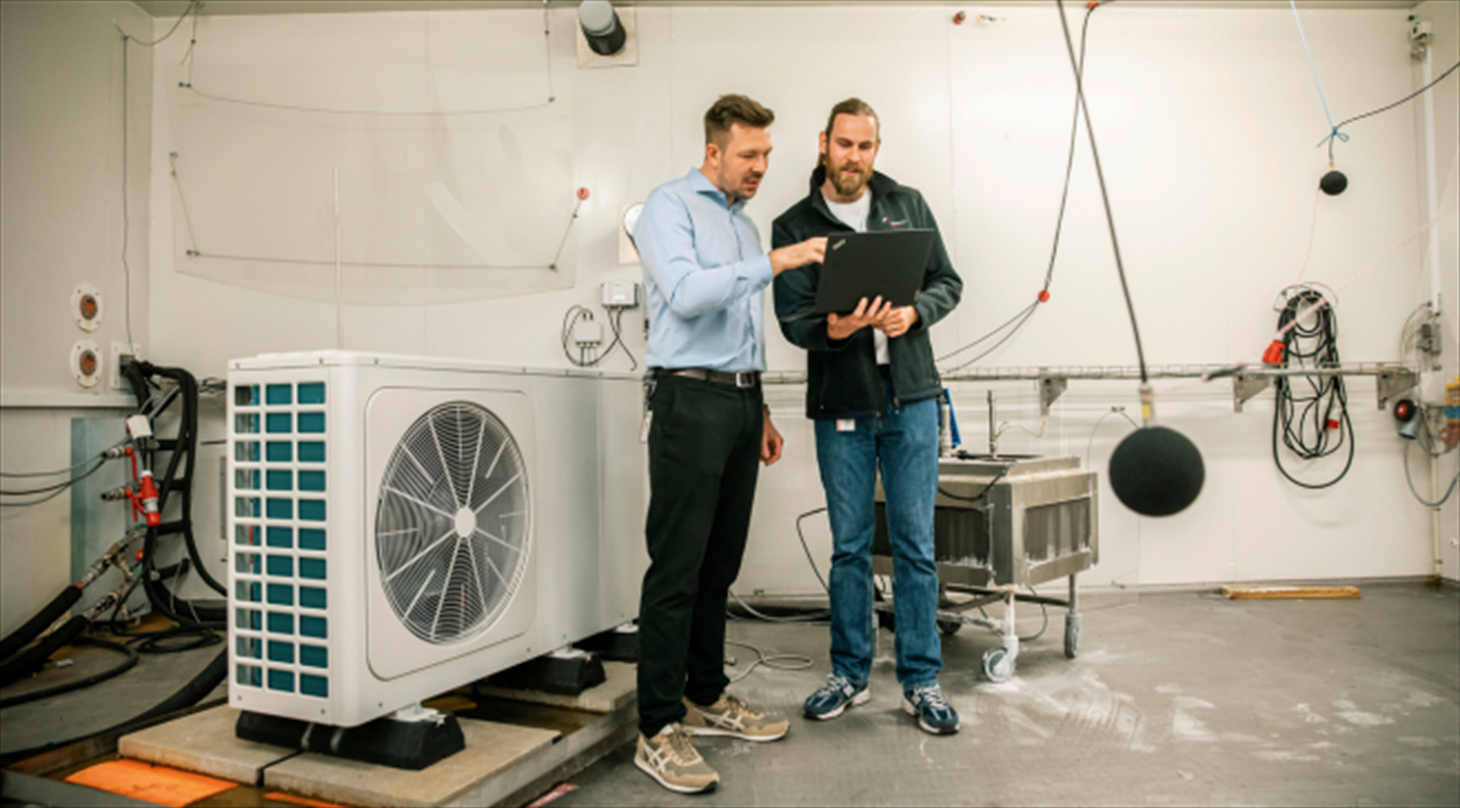
The Heat Pump Test Laboratory at Danish Technological Institute delivers ISO/IEC 17025 accredited performance and acoustic testing. Our independent test data verifies whether prototypes and serial production units clear mandatory Ecodesign thresholds, providing the technical basis required to secure CE marking with minimal regulatory risk.
The Four Core Ecodesign Pillars for Heat Pumps
Commission regulations enforce compliance across four distinc performance parameters:
Space heaters must clear minimum Seasonal Space Heating Energy Efficiency (ηs) baselines throughout the heating season. Units that fail these seasonal thresholds cannot be placed on the European market, cannot receive an energy label, and cannot be registered in the EPREL database. To protect public health and mitigate noise pollution, Ecodesign enforces strict ceiling thresholds for acoustic noise emissions measured in accordance with EN 12102-1. Distinct maximum sound power levels apply to indoor and outdoor units based on declared thermal capacity. For fossil-assisted hybrid heat pumps or gas absorption systems, Ecodesign establishes strict limits on exhaust nitrogen oxide emissions to curb urban air pollutants. Ecodesign encourages the use of climate-friendly refrigerants. Manufacturers must assemble an exhaustive technical dossier containing verified performance curves, seasonal calculations, disassembly instructions for end-of-life recycling, and publicly accessible product information fiches.1. Mandatory minimum energy efficiency
2. Maximum sound power limits (LWA)
3. Maximum emissions and refrigerants
4. Technical documentation & public disclosure
INDSÆT BILLEDER
The Interpaly Between Ecodesign & Energy Labelling
Understanding how Ecodesign and Energy Labelling interact is essential for product strategy and compliance management.
Ecodesign sets the mandatory baseline:
- It defines the legal minimum criteria (efficiency floors and sound ceilings).
- Its primary function is market push-eliminating the lowest-performing heating technologies from the European market.
- A heat pump that fails Ecodesign cannot obtain CE marking.
Energy Labelling provides market differentiation:
- Regulated under Framework Regulation (EU) 2017/1369 and Regulation (EU) No 811/2013, energy labelling classifies products that clear the Ecodesign baseline on a comparative scale from A+++ down to D.
- Its function is market pull-guiding consumers, specifiers, and subsidy programmes toward premium tiers.
For an in-depth breakdown of seasonal efficiency calculations, class thresholds, and EPREL registration requirements, read our guide to Energy Labelling for Heat Pumps - Accredited Testing and EPREL Compliance.
Empirical Performance Testing Under Harmonised Standards
Compliance with Ecodesign cannot be established through theoretical simulation alone. Regulatory validation mandates physical testing in climate-controlled test chambers in accordance with harmonised European standards:
Units are tested under designated part-load operating points (conditions A, B, C, and D) across representative outdoor air or source temperatures to determine net heating capacity and Coefficient of Performance (COP). Measured part-load metrics are weighted across reference European climate bin hours (Average, Colder, and Warmer zones) to calculate seasonal performance. SCOP is converted into Seasonal Space Heating Energy Efficiency by dividing by the EU electricity conversion factor of 2.5 and subtracting mandatory correction factors for temperature controls and auxiliary standby energy. Outdoor and indoor units must undergo sound power level testing in calibrated reverberation or hemi-anechoic chambers under defined thermal load conditions.Empirical Part-Load Measurement (EN 14511 & EN 14825)
Seasonal Calculation (SCOPnet)
Primary Energy Ratio Conversion (ηs)
Acoustic Power Determination (EN 12102-1)
Harmonised Standards and Ecodesign Regulations by Product Category
Testing protocols vary substantially depending on source medium, functional capacity, and target application. Below you find an overview of the test standards and EU Ecodesign regulations we test against, categorised by heat pump type:
AIR SOURCE & AIR-TO-WATER HEAT PUMPS
- EN 14511: Heating capacity and COP
- EN 14825: Seasonal space heating efficiency (SCOP / ηs)
- EN 12102-1: Sound power levels (LWA)
- Commission Regulation (EU) No 813/2013: Ecodesign space heaters
- Commission Delegated Regulation (EU) No 811/2013: Energy Labelling)
AIR SOURCE & AIR-TO-AIR HEAT PUMPS
- EN 14511 (Heating capacity and COP)
- EN 14825 (Seasonal performance: SCOP / ηs)
- EN 12102-1 (Acoustics and sound power levels)
- Commission Regulation (EU) No 813/2013 (Ecodesign)
- Commission Delegated Regulation (EU) No 811/2013 (Energy Labelling)
GROUND SOURCE & BRINE-TO-WATER HEAT PUMPS
- EN 14511: Heating capacity and COP
- EN 14825: Seasonal performance (SCOP / ηs)
- EN 12102-1: Sound power levels (LWA)
- Commission Regulation (EU) No 813/2013: Ecodesign space heaters
- Commission Delegated Regulation (EU) No 811/2013: Energy Labelling
EXHAUST AIR HEAT PUMPS
- EN 14511: Heating capacity and COP
- EN 14825: Seasonal performance (SCOP / ηs)
- EN 16147: Domestic hot water production efficiency
- EN 13141-7: Ventilation components and aerodynamic testing
- EN 12102-1: Sound power levels (LWA)/li>
- Commission Regulation (EU) No 813/2013: Ecodesign space heaters
- Commission Regulation (EU) No 814/2013: Ecodesign water heaters
- Commission Regulation (EU) No 1253/2014: Ecodesign ventilation units
MULTIFUNCTIONAL UNITS
- EN 14511: Heating and cooling capacity (COP and EER)
- EN 14825: Seasonal heating and cooling performance (SCOP, SEER, ηs)
- EN 16147: Domestic hot water Performance
- EN 13141-7 and EN 16573: Aerodynamic and heat recovery performance
- EN 12102-1: Sound power levels (LWA)
- Commission Regulation (EU) No 813/2013: Ecodesign space heaters
- Commission Regulation (EU) No 814/2013: Ecodesign water heaters
- Commission Regulation (EU) No 2016/2281: Ecodesign cooling and chillers
- Commission Regulation (EU) No 1253/2014: Ecodesign ventilation units
DOMESTIC HOT WATER HEAT PUMPS
- EN 16147: Domestic hot water heating efficicency and tapping profiles
- EN 12102-2: Sound power levels for water heaters
- Commission Regulation (EU) No 814/2013: Ecodesign water heaters/li>
- Commission Delegated Regulation (EU) No 812/2013: Energy labelling water heaters
We look forward to helping you optimise your products through precise and reliable testing in our advanced laboratory facilities.
Contact our Experts
Please contact our specialists for further information.

Preben has worked in the energy sector for more than 20 years. He specialises in testing heat pumps as well as providing technical consultancy and product assessment. He is a member of national and international standardisation committees, and he is also a member of an international committee of test laboratories.
Lasse has overall responsibility for the team, the laboratory and its technical direction. He has more than 25 years of experience in refrigeration and heat pump technology, covering product testing, laboratory measurements, and market surveillance, as well as energy efficiency and the implementation of international standards. He is an expert in testing in accordance with international standards and has extensive experience with heat pumps, refrigeration systems, condensing units and related components for both public authorities and industry.
Benefit from our partnership and get your heat pump faster to market with full Ecodesign and energy labelling compliance
Make the right design decisions early
Get independent data and technical feedback on component choices, refrigerants, and controls before moving into serial production.
Fast-track your time-to-market
Avoid costly redesigns and launch delays with accredited testing and development support that make your product ready for the market.
Stay ahead of the competition
With technical assistance, we help you maintain market leadership by accelerating the development of next-generation, high-efficiency heat pumps.
Future-proof your heat pumps
Gain specialised knowledge on the latest standards and upcoming Ecodesign updates, keeping your products compliant long after launch.
Upskill your team
Equip your team with tailored courses on test standards, calculations, and regulatory requirements – turning Ecodesign challenges into competitive opportunities.