Advanced surface solutions for defense and aerospace
 In Danish
Standard or customized PVD coatings, plasma nitriding, and ion implantation that ensure reliable performance under the most demanding operating conditions - from Arctic cold to desert operations.
Components for defense and aerospace must operate safely and reliably under extreme wear, severe temperature fluctuations, vacuum, corrosive environments, and sand/dust exposure – often without the possibility of conventional lubrication or routine maintenance. When a single moving surface fails, the entire system stops.
Danish Technological Institute develops, validates, and manufactures advanced surface treatments and coatings that increase wear resistance, reduce friction, and increase corrosion resistance. We also engineer surfaces with precisely tuned functional properties such as electrical, electromagnetic, thermal, and optical, tailored to the specific operating environments your components must withstand.
With more than 35 years of experience as a commercial supplier and R&D partner, along with a complete in-house value chain, we take your project from feasibility study and prototyping to full series production.
How can Danish Technological Institute assist you?
Danish Technological Institute's tribology specialists offer a wide range of surface treatments and coatings for defense and aerospace:
- Wear protection for gear parts, transmission components, hydraulic parts, firearm mechanisms, and other heavily loaded components
- Solid lubrication with DLC coatings for operation without oil and grease – in vacuum, extreme cold, desert environments, and contamination-sensitive systems
- Surface hardening with plasma nitriding - significantly increased hardness and wear resistance with minimal distortion
- Electromagnetic signature control - thin-film coatings for managing radar, IR, and optical response, as well as EMI shielding
- Electrically functional coatings - conductive, semiconductive, or insulating coatings for sensors, contacts, and connectors
- Corrosion protection against salt, moisture, aggressive media, and extreme climatic conditions
- Consultancy, testing, and development - from tribological troubleshooting to complete R&D project management with advanced in-house characterization
- Full traceability and documentation tailored to defense and aerospace industry standards
DLC - dry lubrication for demanding operational environments
Under harsh operating conditions, traditional lubricants lose their functionality. Oil thickens and freezes in Arctic cold. Grease attracts sand and causes abrasive wear in e.g. desert environments. In a vacuum, oil evaporates, and unlubricated metal surfaces seize together (cold welding).
DLC coatings (Diamond-Like Carbon) are hard, durable, and self-lubricating PVD coatings without the environmental limitations characteristic of fluid-based lubricants.
Typical operational environments:
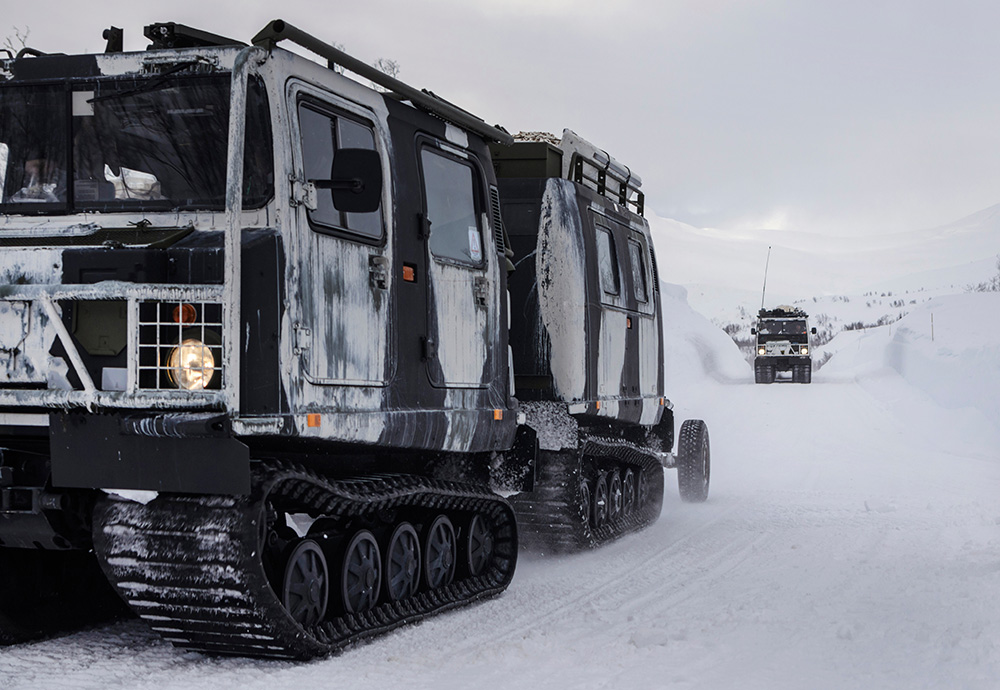
- Arctic / winter operations: Reliable movement down to below -50 °C without oil
- Desert / expeditionary environments: Dry and hard lubricating surface to which sand does not adhere
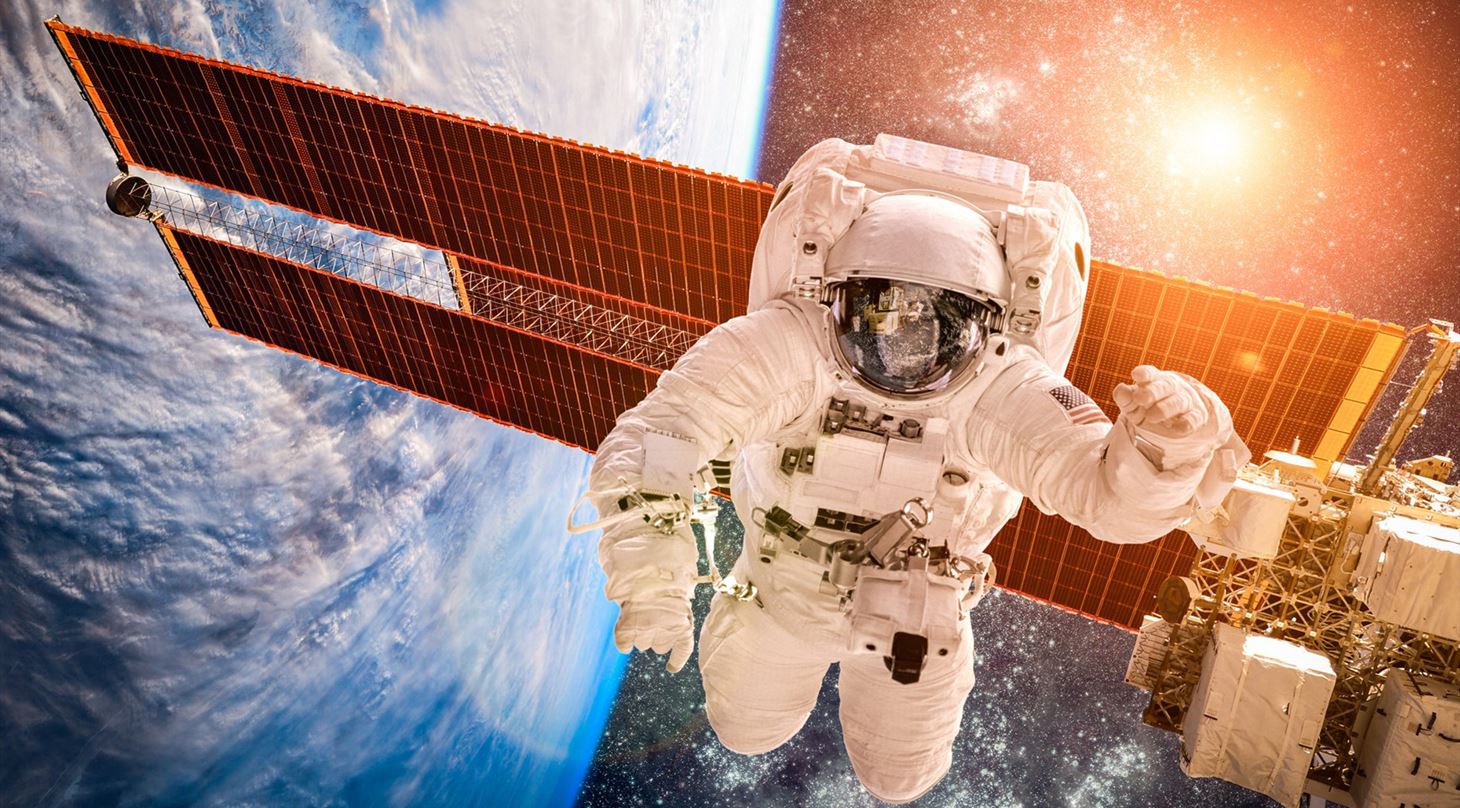
- Space / vacuum: Oil-free and non-outgassing - tested and well-documented protection for space applications. For several years, Danish Technological Institute has delivered DLC coatings for partscthat are currently in operation in space. Both as a dry-lubricant coating for moving parts and for blackening optical components
Plasma nitriding - surface hardening for heavily loaded precision components
Steel components subjected to continuous mechanical wear and loading under harsh conditions require a surface that can withstand millions of load cycles without failure. Plasma nitriding is a proven surface treatment that resolves many of the most common wear challenges in steel components.
Plasma nitriding is used for e.g.:
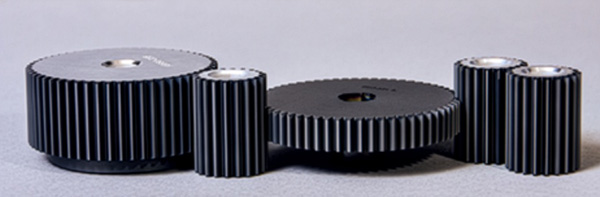
- Gears and drivetrain components: Plasma-nitrided tooth flanks resist wear and fatigue (pitting) under sustained cyclic loading, including in transmissions and actuator gear trains
- Gear racks and other moving parts: Wear-resistant and fatigue-robust surface that supports reliable sealing and a long service life
- Firearm mechanisms: bolts, trigger components, and cam surfaces that must endure millions of high-load cycles without galling or premature wear
- Fasteners and threaded components: improved resistance to galling and fretting in high-vibration environments, relevant for vehicles, aircraft, and naval systems
- Spare and legacy parts: a cost-effective method to restore or exceed hardness specifications on locally or additively manufactured replacement parts
Learn more about plasma nitriding
Electromagnetic signature control with thin-film coatings
Modern defense systems demand surfaces that do more than merely protect. They must control how a surface reflects, absorbs, or transmits electromagnetic radiation - from radar and RF frequencies to infrared and visible light. This control over a platform's electromagnetic signature is vital in modern defense technology.
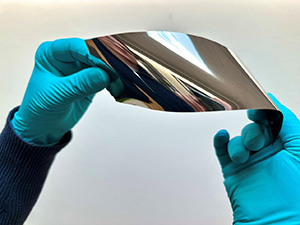 Traditional materials used for managing electromagnetic response are often heavy, bulky, expensive, and difficult to integrate into modern platforms. Precisely engineered thin-film coatings offer a light, ultra-thin alternative without compromising performance.
How it works: Using magnetron sputtering, precisely tuned resistive or conductive surface coatings are deposited in nanometer-thin layers – from single layers to complex multi-layer structures using masking techniques. These engineered thin films decouple the electromagnetic response from the base substrate, providing designers with direct control over the surface's interaction with incoming radiation.
Applications:
- Radar, IR, and optical signature management: coatings can be tailored to a single frequency band or broad-spectrum coverage, depending on the application
- EMI shielding: protection of sensitive electronics against electromagnetic interference
- Low weight and integration: thin surface coatings and structures integrated directly into weight-sensitive platforms such as drones (UAVs)
- Versatile platform technology: the same core technology enables tuning of electromagnetic response across radar, IR, and optical frequencies
Danish Technological Institute collaborates closely with other Danish competence centers to be leading capabilities in simulation, design, testing, and production of electromagnetically tunable materials with a focus on the radar frequency spectrum.
Functional surfaces for specialized applications
Beyond conventional wear protection and electromagnetic signature control, Danish Technological Institute develops and manufactures functional coating systems tailored to specific technical purposes:
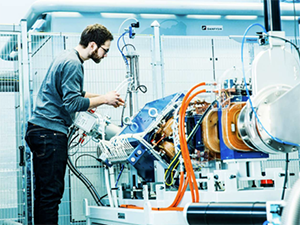 Electrically functional coatings: Conductive, semiconductive, or electrically insulating coatings for sensors, connectors, contacts, and similar components. This includes superconducting niobium films on flexible substrates, providing robust, lightweight transmission lines and connectors.
- Optical surfaces: Coatings with controlled reflection and transmission properties for specialized solutions in optics and detection systems.
- Protection of sensitive electronics: Ultra-thin metal oxide films providing precise electrical insulation where required – and protecting space systems against environmental degradation, including atomic oxygen.
- Barrier coatings for vacuum and fuel cells: Cerium gadolinium oxide (CGO) and other ion-selective barriers that remain stable in vacuum and prevent unwanted gas ingress and outgassing.
- Lightweight integration: Nanometer-controlled surface coatings on flexible substrates.
See our different coatings
Proven results: Big Science and space case studies
CERN – electrically insulating PVD coatings for 11 Tesla magnets
Danish Technological Institute custom-developed micrometer-scale electrically insulating PVD coatings for CERN's next-generation 11 Tesla superconducting magnets. The coatings were engineered to provide reliable electrical insulation under severe mechanical stresses and cryogenic temperatures down to approximately -269 °C (liquid helium). The project demonstrates Danish Technological Institute's capability to develop and produce advanced coatings for the most demanding operating conditions in Big Science.
How we helped CERN
ESO – analysis and maintenance of PVD equipment for the world's largest telescopes
In collaboration with the company Polyteknik A/S, Danish Technological Institute completed a commercial assignment for the European Southern Observatory (ESO) in the Atacama Desert in Chile. The task involved mapping and analyzing the condition of a 9-meter PVD coating system used for maintenance of telescope mirrors up to 8 meters in diameter across ESO's four Very Large Telescopes (VLT).
The coating process is based on magnetron sputtering of aluminum, where the coating's micro- and nanostructure must be optimized for peak reflectance – with a coating uniformity across the ~50 m² mirrors exceeding ±5 percent. Facilitated by the Big Science Secretariat, this project highlights how Danish Technological Institute's vacuum coating expertise is applied to the most advanced scientific instruments.
DLC coatings operating in space
For several years, Danish Technological Institute has supplied DLC coatings for aerospace components that are currently operating in space. This provides documented proof that our solid lubrication and wear-resistant coatings are fully tested and validated for the extreme demands of space environments.
See more examples of our coating applications
Quality, traceability, and documentation
Danish Technological Institute's production of surface coatings is certified according to ISO 9001. For defense and aerospace projects, we provide full traceability and process certificates that ensure batch-to-batch consistency and fulfill stringent audit requirements.
When project specifications dictate, we collaborate with the client to meet the dedicated standards and regulatory requirements of the defense industry.
This is how we work with quality
From development to series production
Danish Technological Institute covers the entire development lifecycle from initial concept to full series production. To ensure an efficient, low-risk transition to commercial manufacturing, our coating development is simulation-assisted and performed in the same systems used for production. This ensures rapid development cycles and direct scalability.
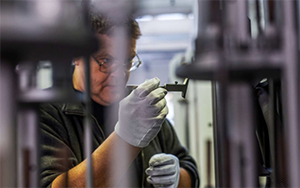 Feasibility study: We evaluate operating conditions and match them with the optimal materials and technologies
- Development and testing: We develop and test surface coatings under relevant load conditions using advanced in-house characterization
- Prototyping and pilot production: The coating is validated in production-scale systems
- Scale-up to series production: Transition to full industrial production in our facilities, including Class V cleanrooms for sensitive components
Danish Technological Institute is a major Danish Research and Technology Organisation (RTO) comprising 32 technology centers and more than 1,000 specialists. Our tribology specialists are a trusted supplier to demanding organizations, including CERN and ESO (European Southern Observatory).
Consultancy and development of surface solutionsrContact us regarding your project
Do you have components that must operate reliably under extreme service conditions? Danish Technological Institute's specialists can help you determine the optimal surface solution - from initial consultation to series production.
Henrik Horup Reitz – Phone: +45 72 20 15 48, E-mail: hre@dti.dk
Espen Hvidsten Dahl – Phone: +45 72 20 23 21, E-mail: ehd@dti.dk
Christian Zeuthen (Research & Development) – Phone: +45 72 20 17 18, E-mail: cmz@dti.dk