Crash test documents the safety of a seat system for vans
When a Danish company wanted to reuse a well-known design featuring a seat and a console in a converted van, there was a lack of documentation to prove that the components could function as a single, unified system. Testing specialists at the Danish Technological Institute built a test setup that provided the necessary basis for the company to get the solution approved.
The customer is a company that works with the conversion and customization of vans and trucks to meet specific customer needs – and which, in collaboration with vehicle importers, delivers specialized transport solutions to the business sector.
The challenge: Approved components – but not as a unified solution
In a specific project, the company wished to reuse a well-known design with a seat and a seat console, which they knew from experience worked well together. However, the problem was of a regulatory nature: there was a lack of documentation to prove that the components could be approved as a unified system when installed in the vehicle.
- The seat had its own approval, the console had its own, and the vehicle's frame did as well. But there was no approval of the parts as a single, combined two-component system, says Michael Perolle Jensen, Business Manager and Testing Specialist at the Danish Technological Institute.
This is an important distinction. The fact that the seat, console, and vehicle frame individually meet the requirements does not mean that the combination will do so under heavy load. To get the conversion approved for the market, the company therefore needed documentation proving that the combination could meet the requirements set out in the UN Regulation 17, which concerns the strength requirements of seats, seat anchorages, and their attachment in the event of a collision.
Crash test with 20G in under 30 milliseconds
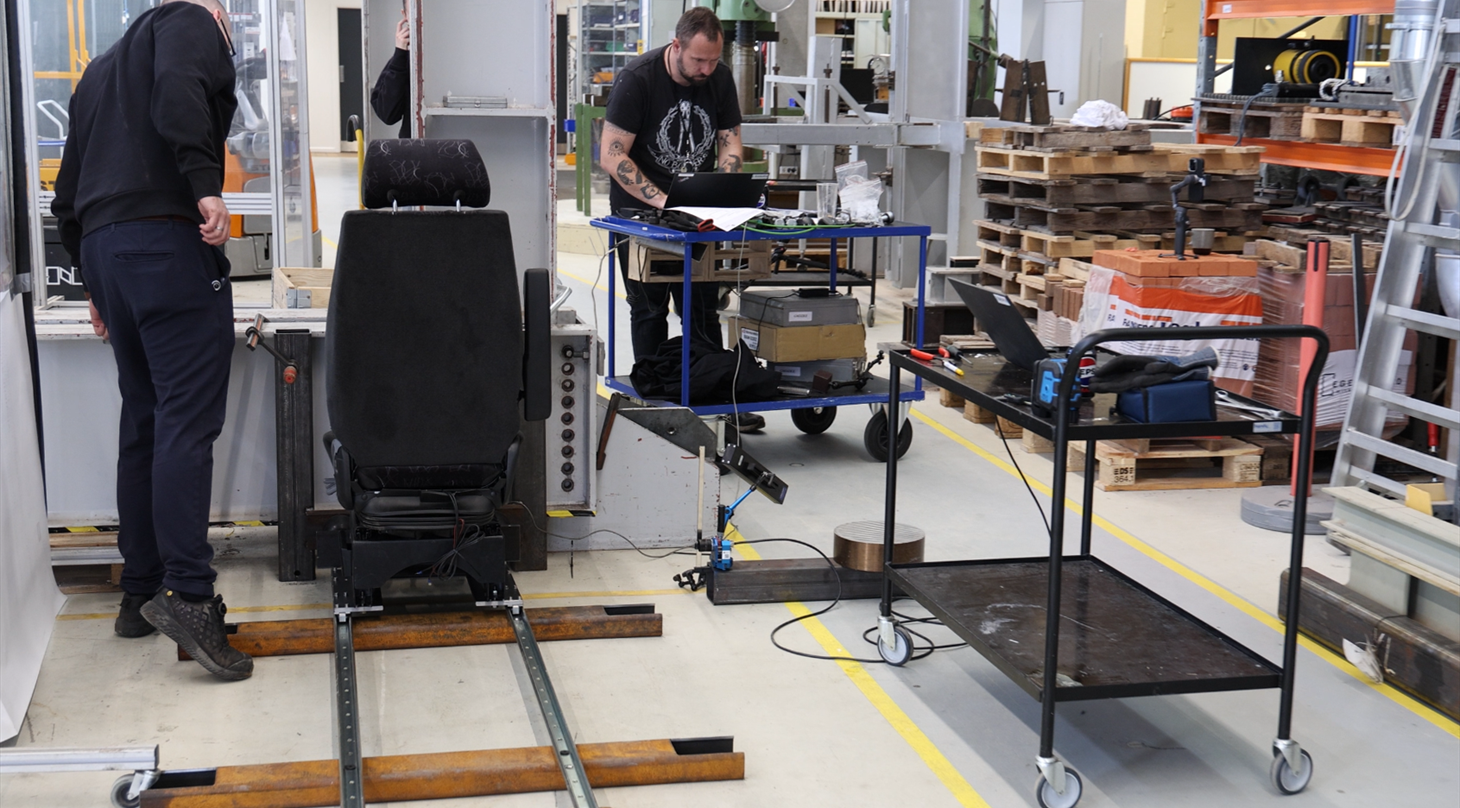
The Danish Technological Institute first thoroughly analyzed the relevant regulations and then designed a customized test setup that precisely matched the requirements of the standard.
The test itself simulates a severe head-on or rear-end collision: a deceleration equivalent to 20 times the acceleration due to gravity in under 30 milliseconds – a very short and high-energy impact
- Michael Perolle Jensen, Danish Technological Institute
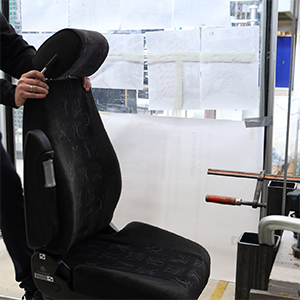
To document what actually happens during the impact itself, the setup was equipped with both standardized measuring equipment and Digital Image Correlation (DIC), which makes it possible to analyze deformations and movements with high precision. After the impact, the structure was disassembled, and each individual component – seat, console, bolts, brackets, and frame – was inspected for cracks, bending, and functional failure. The requirement was that both the seat and the console had to remain individually functional.
 Documentation paves the way to the market
The result was clear: the overall construction held up. The console, the seat, and all bolts passed the test with no signs of failure.
For the company, the test provided concrete business value. Although it was not an accredited test, the Danish Technological Institute delivered the necessary functional documentation that the company could use in the subsequent approval process with authorities and vehicle inspection bodies. This means the company now has a stronger technical foundation to get its conversions approved – and thereby bring the solution to market faster.
Do you have a similar testing need? Reach out to testing specialist and business manager, Michael Perolle Jensen at mpj@dti.dk or +45 7220 2490.