
Design verification and accredited testing of medical devices
 In Danish
Accredited testing and documentation ensure that your medical devices comply with MDR requirements - and reduce the risk of delays in the approval process.
Design verification is systematic documentation confirming that a medical product fulfills the specified requirements for function, safety, and performance throughout its expected lifespan. It is a central part of the technical documentation under the MDR (Medical Device Regulation) and a prerequisite for CE marking.
Insufficient or incomplete documentation is one of the most common causes of delays in dialogues with notified bodies and competent authorities. The Plastics Laboratory at the Danish Technological Institute assists manufacturers with accredited testing, method validation, and documentation that withstands regulatory scrutiny - the first time.
How can Danish Technological Institute help you?
The Plastics Laboratory at the Danish Technological Institute offers accredited testing and consultancy across the entire chain of design verification for medical devices:
- Luer lock and small-bore connectors: Test for leakage, durability, and resistance to separation in accordance with the ISO 80369 series.
- Syringe functionality: Test for glide force, break-loose force, leakage, and operating forces in accordance with ISO 7886-1 and the ISO 11040 series, among others.
- Packaging peel-open strength: Documentation of controlled and functional opening according to standards such as ASTM F88/F88M.
- Integrity of sterile barrier systems (CCI): Assessment of the packaging's protective function according to standards including ASTM F1929, ASTM F2096, and USP 671.
- Coring and resealability: For needle-based systems, septa, and vials, testing is performed for coring - the risk that needle insertion punches out or releases material from the septum - and for resealability, i.e., whether the closure can reseal and maintain its function after repeated punctures. Testing is performed according to relevant parts of ISO 8871-5 and the ISO 11608 series, among others.
- Fragment identification: Visual and materials science analysis of loose particles resulting from use or mechanical stress.
- Legibility, labeling, and visual inspection: Assessment under controlled lighting conditions according to ISO 20417, among others, as part of stability studies or exploratory test programs.
- Accelerated and real-time aging: Documentation of shelf life based on standards such as ASTM F1980 - a key requirement for the CE marking of sterile-packed medical devices. Accelerated aging allows for estimating the product's shelf life in a shorter timeframe. The results can often be used as a basis for an early market launch while real-time data is collected continuously. Real-time aging supplements the documentation of the product's actual declared shelf-life period and is typically a requirement for final approval.
- Transit/transport simulation: Testing the resistance and durability of the product and its packaging under distribution conditions. The simulation documents that the product and packaging maintain functionality and integrity after the stresses they are expected to encounter during distribution and storage. By combining accelerated aging with real-time data and transport simulation, you build a comprehensive documentation package covering the product's entire lifecycle – from release to end use.
- Test protocols and scientific rationales: Preparation or review of test plans tailored to your product and regulatory requirements.
Our accredited testing of plastics and rubber
 Why is design verification critical under the MDR?
Under the MDR (Medical Device Regulation), manufacturers must document that their product complies with the general safety and performance requirements – not only upon release, but throughout the entire declared shelf-life period. This includes the product’s functionality, packaging integrity, and the protective properties of the sterile barrier system after transport, storage, and aging.
Deficiencies and observations raised by notified bodies regarding technical documentation are among the most common reasons why the approval process is delayed. A systematic and thorough design verification supported by accredited test results mitigates this risk and provides a stronger foundation in discussions with regulatory authorities.
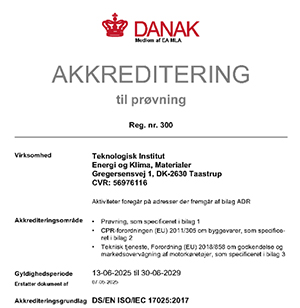
The Danish Technological Institute is accredited by DANAK (accreditation number 300) in accordance with ISO/IEC 17025, ensuring that test results carry the evidential weight and credibility expected by notified bodies and authorities.
From test protocol to accredited report
Danish Technological Institute assists not only with the physical testing itself, but also with the technical considerations before and after the testing process. This may include:
- Preparation or review of test protocols tailored to your product and regulatory requirements
- Selection of relevant standards and test methods based on the product’s risk assessment and intended purpose
- Scientific/technical justifications for the selection of test parameters and acceptance criteria
- Accredited test reports with traceable documentation suitable for direct inclusion in the technical documentation under the MDR
Is your specific standard or test method not listed above? The Danish Technological Institute has extensive experience in developing customized testing and documentation programs tailored to your specific product and requirements.
Contact us regarding medical device testing
Would you like to discuss how testing and documentation can be structured for your specific product? Contact our specialist, Lise Dahl Andersen, for an initial discussion about your needs and the relevant standards.