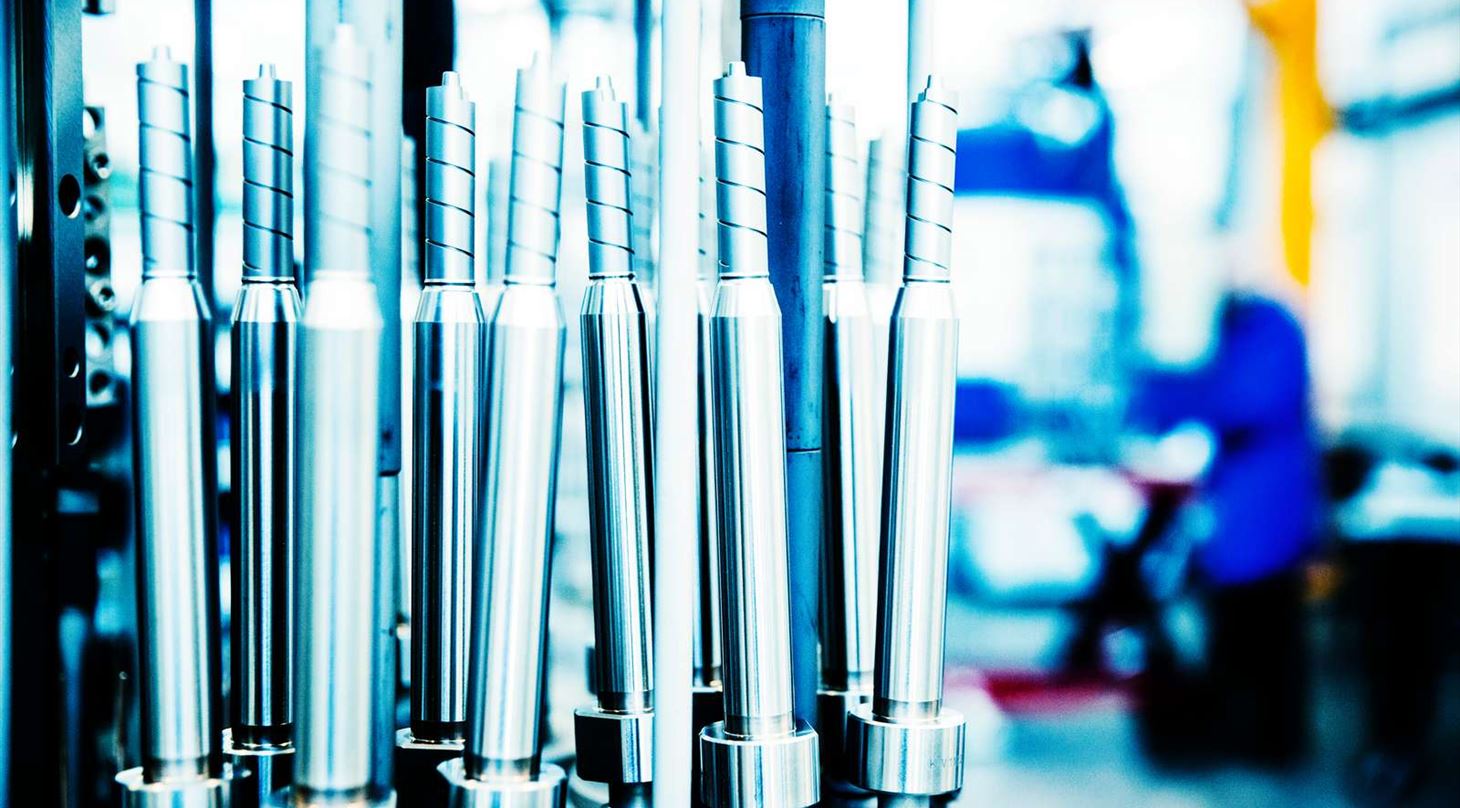
PVD coating of mould tools for injection moulding
 In Danish
Improved demoulding, reduced wear, and extended service life for injection moulds - that is what you achieve with our PVD coatings, developed for high-precision injection moulding.
Demoulding issues, wear on mould components, and unstable processes cost time and money in plastic injection moulding. Parts sticking in the cavity or on the core, high demoulding forces, worn ejector pins, and frequent maintenance stops can reduce uptime and increase scrap rates – particularly in production runs with stringent requirements for part quality and repeatability.
PVD coatings for mould tools are a proven solution to these challenges. The Danish Technological Institute develops and supplies PVD coatings that reduce demoulding forces, protect against wear, and extend the service life of cores, inserts, cavities, ejectors, and other critical mould components. The coatings are engineered for high-precision injection moulding within medical, pharmaceutical, food, packaging, and engineering plastics industries.
See our PVD coatings and other surface treatments
How can Danish Technological Institute help you?
We advise on and supply coatings for injection moulding tools, including:
- Improved demoulding - coatings that reduce demoulding forces and provide easier release from cores and cavities
- Wear protection of cores, inserts, cavities, ejectors, slides/jaws, and other exposed mould components
- Dimensional correction - coatings can be applied to selected areas in layer thicknesses of up to approx. 30 µm
- Clean processes - reduction or elimination of release agents in sensitive production environments
- Shorter cycle times through better release and more stable demoulding
- Wear monitoring - coatings featuring a visual wear indicator for planned maintenance
- Refurbishment of existing moulds with recoating rather than manufacturing new tooling
- Consulting on coating selection for specific plastic types, part geometries, and process conditions
Typical challenges in injection moulding
The release mechanisms in an injection moulding process are complex and influenced by polymer type, part geometry, tool design, surface texture, and process parameters. When the interplay between these factors is suboptimal, problems arise:
- Parts stick to cores or within the cavity
- Demoulding forces become too high and may damage the parts
- Wear on cores, inserts, ejectors, and guide surfaces shortens tool life
- The use of release agents becomes necessary, though undesirable in many sensitive production settings
- Unstable production and frequent downtimes negatively affect product quality and manufacturing economics
With the right PVD coating, these challenges can in many cases be significantly reduced or completely eliminated. The coating improves release, protects mould surfaces, and provides a more robust process window - without compromising part quality.
CrN-SS (SuperSlip) - targeted for superior demoulding
Tribology specialists at the Danish Technological Institute have developed CrN-SS (SuperSlip), a specialized coating for moulding surfaces such as cores and inserts in injection moulding tools. CrN-SS (SuperSlip) is a PVD coating with enhanced release properties. CrN-SS differs from conventional CrN coatings through a smoother, denser surface structure. This is combined with a post-treatment process where foreign ions are implanted into the surface. This method, performed exclusively by the Danish Technological Institute, provides exceptional release properties across a broad range of standard plastics.
The coating's performance is documented in collaboration with leading Danish toolmakers and injection moulding companies. In tests, a reduction in demoulding force of up to a factor of 7 has been measured when demoulding parts made of materials such as TPU. In practice, this means easier release, shorter cycle times, a more flexible process window, and the potential to reduce or eliminate the need for mould release agents.
Today, CrN-SS (SuperSlip) is routinely used in the moulding of medical products and other high-precision applications where requirements for part quality and process stability are stringent.
HiPIMS PVD - denser, smoother, and more wear-resistant coatings
The Danish Technological Institute has invested in 3 HiPIMS PVD systems, enabling the production of coatings with exceptionally high density, smooth surfaces, low defect levels, and high reproducibility. HiPIMS (High Power Impulse Magnetron Sputtering) technology represents the latest generation of PVD processes and is particularly relevant where stringent requirements are placed on coating quality and uniformity.
CrN-HP is our HiPIMS-based chromium nitride coating. It provides a smoother, denser, and harder surface compared to conventional CrN coatings and is well-suited for mould tools exposed to abrasive pigments, fillers, or high cyclic loads. CrN-HP resolves moderate release issues and contributes to more consistent part quality, reduced scrap rates, and extended tool life. The coating is also offered in a SuperSlip version for more severe demoulding challenges.
Read more about HiPIMS and advanced PVD coatings
VisiDur-HP - wear protection with a visual wear indicator
VisiDur-HP is a coating solution that combines wear protection with an integrated visual wear indicator. The coating consists of a wear-resistant top layer over a colour-contrasting indicator layer. The protective top layer is comparable to our CrN-HP. Once the top layer wears through in the most exposed areas, the indicator layer becomes visible - signalling that it is time for maintenance and recoating.
For high-value mould tools, this offers a substantial advantage. Even minor damage to mould surfaces can lead to compromised part quality, costly repairs, and unplanned production stops. VisiDur-HP enables early wear detection and planned maintenance before the substrate material sustains damage.
VisiDur-HP is especially relevant for mould components subjected to abrasive wear from fillers and pigments, including cores and cavities.
Documented performance and data-driven coating development
Our coatings for the plastics industry are not based merely on experience - they are backed by measurable data. In a Eurostars project focused on demoulding issues, our tribology specialists, together with Danish and international research institutions and industrial partners, developed an in situ test method that measures demoulding forces directly inside an injection mould under real production conditions.
Tests with materials including PP, POM, ABS, and TPU demonstrate that PVD coatings such as CrN-SS (SuperSlip) can significantly reduce demoulding forces.
Industries and quality assurance
Specialists in surface coatings at the Danish Technological Institute work broadly across the plastics industry, with a particular focus on sectors requiring high precision, cleanliness, and comprehensive documentation:
- Medical and Pharma - cleanroom requirements, repeatability, and stringent quality assurance
- Food and Packaging - hygiene, ease of cleaning, and regulatory documentation
- Technical/Engineering Plastics - complex geometries, tight tolerances, and high-volume production runs
As part of the Danish Technological Institute, our specialists can also assist with surface characterization, material analysis, and documentation to support compliance with customer and regulatory requirements.
Contact our specialists
Are you experiencing challenges with demoulding, wear, or tool life on your injection moulds? We can help assess which coating best fits your tooling, plastic materials, and operating conditions - whether for new moulds or for optimizing existing ones. Contact our specialists for a technical consultation regarding coatings for your mould tools.