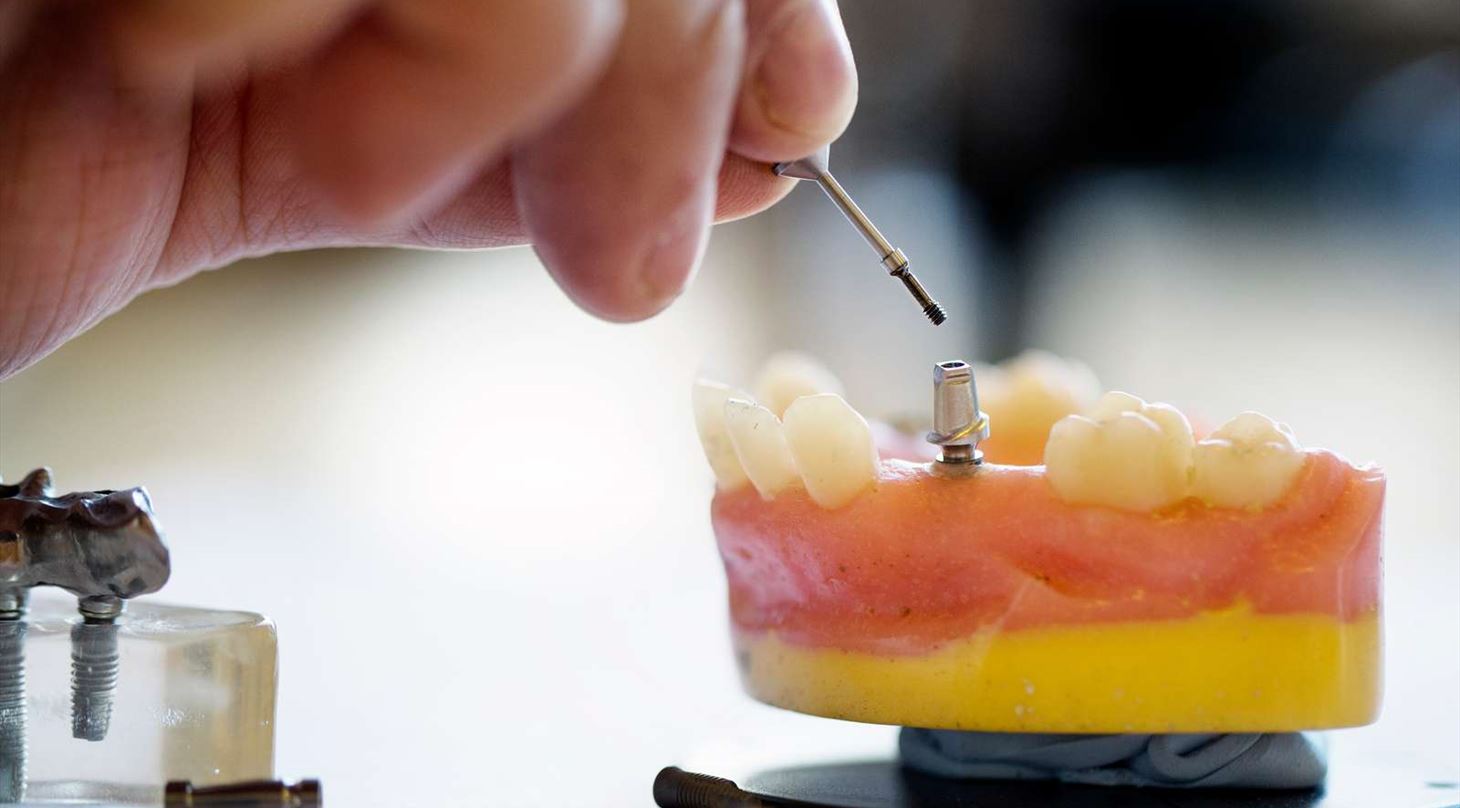
PVD coatings for medico and medical devices
 In Danish
Functional surfaces for implants, surgical instruments, sensors, and production equipment - designed to meet the medico industry's demands for functionality, biocompatibility, and documentation.
Medical devices and implants place some of the industry’s highest demands on surface performance, durability, and documentation. The surface must often do more than merely protect - for example, it must promote bone growth, reduce friction, improve electrical contact, or prevent bacterial adhesion. At the same time, everything must be fully documented in relation to biocompatibility, regulatory requirements, and consistent quality across long production runs.
PVD coating (Physical Vapour Deposition) is a technology that makes it possible to apply thin, durable coatings with precisely engineered properties onto metals, ceramic materials, and certain polymers. The tribology specialists at Danish Technological Institute develop and deliver PVD coatings for the medico and medtech industries - ranging from production-ready standard coatings to customized surface solutions tailored for specific medical applications.
How can Danish Technological Institute help you?
We work with functional surfaces across the entire medico value chain:
- Implants and medical devices: coatings that enhance biocompatibility, osseointegration, friction, wear resistance, or electrical properties
- Surgical instruments: wear-resistant, low-friction surfaces for repeated use and sterilization
- Electrodes and sensors: coatings with controlled electrical conductivity and signal stability
- Molds and tooling for injection molding of medico products: improved demolding, surface finish, and generally more consistent product quality for molded parts
- Production equipment: wear protection and friction reduction for items such as pump parts, valves, moving components, and conveying elements in medico production
- Development of novel functional surfaces: e.g., antibacterial, osseointegrative, or low-friction surfaces for specific applications
- Testing, characterization, and documentation of surfaces and coatings
- Sparring and scale-up from development to stable series production
Surface properties designed for medical requirements
PVD coatings can be engineered with a wide variety of functional properties, depending on the specific application. Danish Technological Institute develops and delivers coatings featuring, among other things:
- Enhanced wear resistance and reduced friction
- Controlled surface roughness or texture for increased surface area
- Enhanced or reduced wettability
- Improved biocompatibility and osseointegration
- Reduced adhesion of biological material
- Antibacterial properties
- Electrical insulation or enhanced electrical contact
This makes PVD coatings relevant for a broad spectrum of medical products - from implants and surgical instruments to electrodes, sensors, and wear parts in medical technology.
Examples of functional medico coatings
Danish Technological Institute offers a range of specialized coating solutions for medico applications. Here are three examples of how PVD coatings can be tailored to specific medical functional requirements:
Strontium-containing titanium dioxide coating for implants: A PVD coating based on strontium (Sr)-containing titanium dioxide that promotes bone growth (osseointegration) and can be designed with antibacterial properties. The coating is suitable for dental and bone implants, where fast and stable integration with bone tissue is critical to the implant’s performance.
Carbon-based coating for dental screws and implant components: A low-friction coating that reduces friction during assembly and loading, increases wear resistance, and minimizes the risk of galling (cold welding) and seizure. This ensures the correct pre-load torque during assembly and supports stable, long-lasting performance of implant components, while also facilitating disassembly.
Coating for nerve stimulation electrodes and sensors: A coating that improves electrical contact and signal stability, which can be tailored for specific conductivity levels and surface properties. This contributes to more precise and robust nerve stimulation as well as more reliable sensing performance in medical devices.
Coatings for tooling and production equipment
In addition to the medical products themselves, Danish Technological Institute also provides surface coatings for the production equipment used in the medico industry.
Tooling for medico plastics molding: In high-precision molding of plastic parts for medical use – such as single-use consumables, injection-molded medico components, and packaging – coating cores, cavities, and other mold components can improve demolding and surface finish. This delivers more uniform part quality, extends tool life, and reduces maintenance and production downtime.
Production equipment and wear parts: Pump components, valves, moving parts, and other critical elements in medico production equipment can be coated with wear-resistant, friction-reducing PVD coatings. This results in reduced downtime, more stable production, and improved cleanability - which is particularly vital in regulated manufacturing environments.
Read about coatings for molds in plastics molding
Read about PVD coatings and other surface treatments
Quality, documentation, and regulatory requirements
In the medico industry, documentation and traceability are not optional - they are a prerequisite. Danish Technological Institute supports medico companies’ regulatory requirements with:
- FDA clearance - surface coatings with FDA clearance for contact with pharmaceuticals and medical products
- ISO 9001-certified production of surface coatings with full traceability
- Food contact approval - relevant for equipment used for both food and medical products
- Surface characterization and documentation supporting customer-specific quality requirements and regulatory compliance
Danish Technological Institute is an independent, non-profit Danish Research and Technology Organization (RTO).
Contact us
Do you have a specific need for functional surfaces - for an implant, a surgical instrument, a sensor, or a production tool? We can help assess whether a PVD coating can solve your challenge and provide guidance on everything from coating design and material selection to scale-up and documentation.
Contact our tribology specialists for a technical dialogue on surface solutions for your specific medico application.