Accelerated aging and lifetime assessment of plastics
 In Danish
Get a data-driven basis for assessing a product's service life or the remaining lifetime of an installation - based on accelerated aging and accredited laboratory testing.
Suppliers praise their products for having a long lifetime - but does that promise hold true in your specific operating environment? And when is it time to renovate buried infrastructure if it is still functioning? Accelerated aging is a laboratory-based method that simulates long-term use in a short timeframe by exposing materials to controlled, intense environmental stresses.
Danish Technological Institute uses accelerated aging to provide you with a documented decision-making basis - either for the expected lifetime of a new product or for the remaining lifetime of an existing installation. The result is data, not guesswork.
How can Danish Technological Institute assist you?
Danish Technological Institute offers lifetime assessment as well as accredited environmental testing and service life evaluation of plastic products and components:
- UV and weathering resistance testing with artificial sunlight according to ISO 4892-2
- Salt spray testing to determine corrosion resistance according to ISO 9227
- UV-C exposure for evaluating embrittlement after decontamination (ASTM G224)
- Customized aging programs tailored to mimic your specific operating environment
- Post-aging mechanical testing - e.g., impact strength (ISO 179-1), degree of yellowing (ISO 17223), and surface abrasion resistance (ISO 9352)
- Remaining lifetime assessment of buried infrastructure components - district heating pipes, wastewater and drinking water pipes, as well as membranes
- Consulting on test design - identifying which exposures and proxy properties are relevant to your specific product
Our accredited testing of plastics and rubber
Product lifetime - document durability before launch
When developing a new product or considering a material shift, it is essential to know whether the material will endure in the environment where it is intended to perform. Some choose to carry out this assessment as a desktop study. Others prefer to obtain a data-driven basis for decision-making.
Danish Technological Institute can expose your products or test specimens to intense environmental stresses - UV light, humidity, salt spray, chemicals, or combinations thereof - under controlled conditions. The purpose is to induce the degradation mechanisms that would otherwise only appear after years in service.
The industry standard for thermal accelerated aging is an acceleration factor of 12: one year of real time is simulated in the course of one month in a climate chamber. However, speed must not compromise validity - the higher the temperature, the greater the risk of altering the degradation mechanism. Danish Technological Institute evaluates the polymer materials involved and provides a concrete recommendation for the optimal duration and temperature for your aging program.
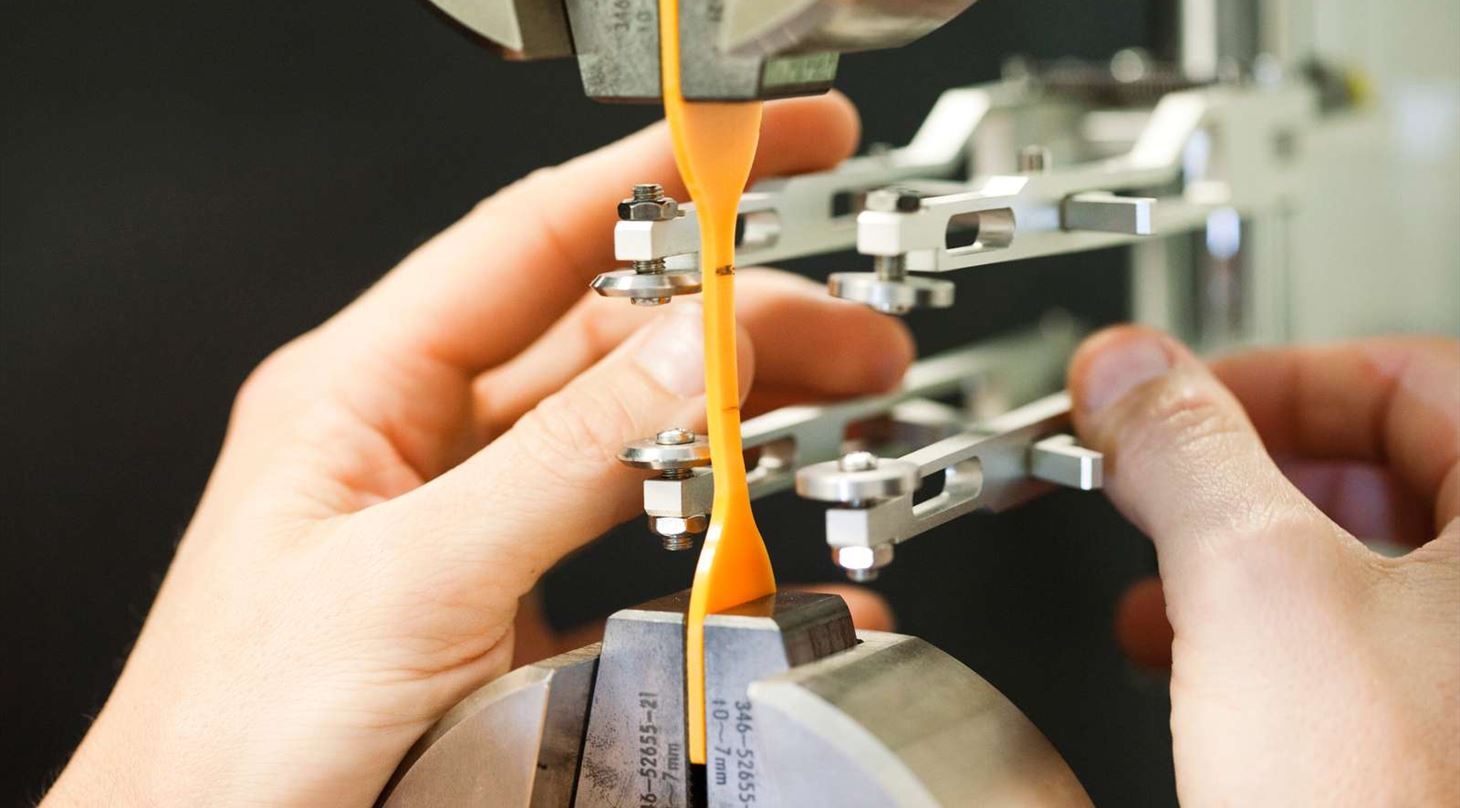
To monitor the extent of degradation, we measure selected proxy properties - that is, measurable properties that serve as reliable indicators of the product's overall performance. These can include impact strength, degree of yellowing, or surface abrasion resistance. Measurements are carried out in our climate-controlled mechanical testing laboratory.
Remaining lifetime - should infrastructure be renovated or can its service life be extended?
The condition of buried infrastructure components can be difficult to assess from behind a desk. As design life approaches and no issues have occurred with the installation, it is natural to ask: does it make sense to decommission the components, or could a lifetime extension be feasible?
Danish Technological Institute can assess the condition of:
- Membranes - e.g., according to DS/INF 466
- District heating pipes - e.g., according to EN 253
- Pipes for drinking water and wastewater
The process begins with a dialogue where we jointly define the project scope, such as the timeframe within which you need our decision-making basis. We then draft a testing program that evaluates the condition of a sample set - without making the program unnecessarily extensive. If sufficient time permits, we can also perform accelerated aging on the samples to predict what their condition will be in, for example, 10 years.
The outcome is a data-driven basis for deciding whether to renovate now or keep the installation in operation.
Accreditation and reproducibility
Danish Technological Institute’s laboratory has maintained ISO 17025 accreditation with DANAK for many years. This accreditation ensures that environmental tests are conducted reproducibly and that the degree of degradation is accurately tracked. Consequently, the results can serve as reliable documentation - internally, with customers, and in contractual contexts.
Plan ahead
Climate chambers and accelerated aging equipment may be booked by other clients. To prevent unnecessary delays, we recommend initiating the dialogue well in advance - even if the final test program has not yet been established. This allows us to reserve capacity and ensure that your project proceeds on schedule.
Contact us regarding accelerated aging and lifetime assessment
Do you need to document a product's service life, or are you considering whether an installation can operate beyond its original design lifetime? Contact Danish Technological Institute’s Plastics Laboratory, and let us discuss how an aging or testing program can be customized to your requirements.