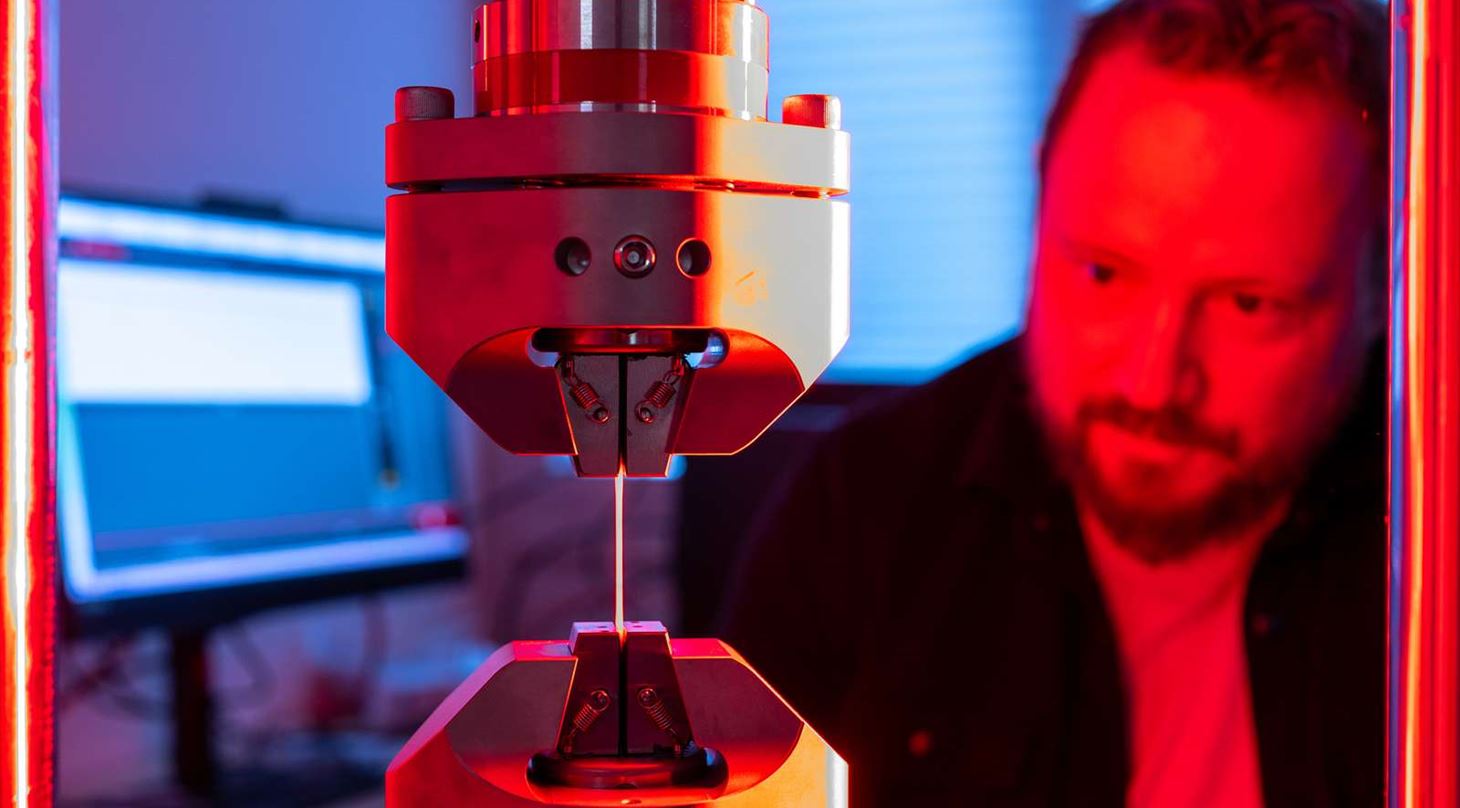
Mechanical characterization of plastics, rubber, and composites - as input data for simulations
 In Danish
Obtain test-based material models for your polymers, plastics, rubber, and composites - from static and dynamic testing to finalized model parameters and fatigue life assessments.
Material characterization is the foundation for reliable FEA simulations. Without accurate material data, you risk simulations that fail to reflect reality. This can lead to improper dimensioning, unnecessary prototypes, and delays in the development process.
Danish Technological Institute performs static, dynamic, and cyclic testing of polymers, plastics, rubber, and composites under controlled conditions. We convert the results into material models and fatigue life assessments that you can use directly in your FEA software - from validated raw data to ready-to-use model parameters and S-N curves.
How can Danish Technological Institute assist you?
We offer material characterization that covers the entire process from test planning to simulation-ready data:
- Tensile testing and compression testing at various temperatures and strain rates
- Creep testing and stress relaxation for time-dependent material behavior
- Dynamic Mechanical Analysis (DMA) to determine viscoelastic properties
- Cyclic testing and fatigue testing to assess material behavior under repeated loading
- Generation of S-N curves (Wöhler curves) for fatigue life assessment
- Characterization under varying temperatures, rates, frequencies, and loading conditions
- Material model fitting for your specific FEA software and simulation setup
- Data delivery - either raw data, processed datasets, or finalized model parameters
- Consultancy on the selection of material models, test strategies, and fatigue life assessment
All testing is conducted in our DANAK-accredited laboratory using fully traceable and calibrated systems - whether for standardized testing or a customized test program.
You can read more about our standardized work via the link below – for example, it can be based on ISO 527 and ISO 604, which describe the principles for tensile testing and compression testing, respectively.
Accredited testing of plastic materials
Why is accurate material characterization crucial?
An FEA simulation is only as good as the material data on which it is built. Standard data sheets from material suppliers typically specify only basic mechanical properties at a single temperature and strain rate. This is rarely sufficient when you need to simulate realistic material behavior under the actual conditions your product will experience.
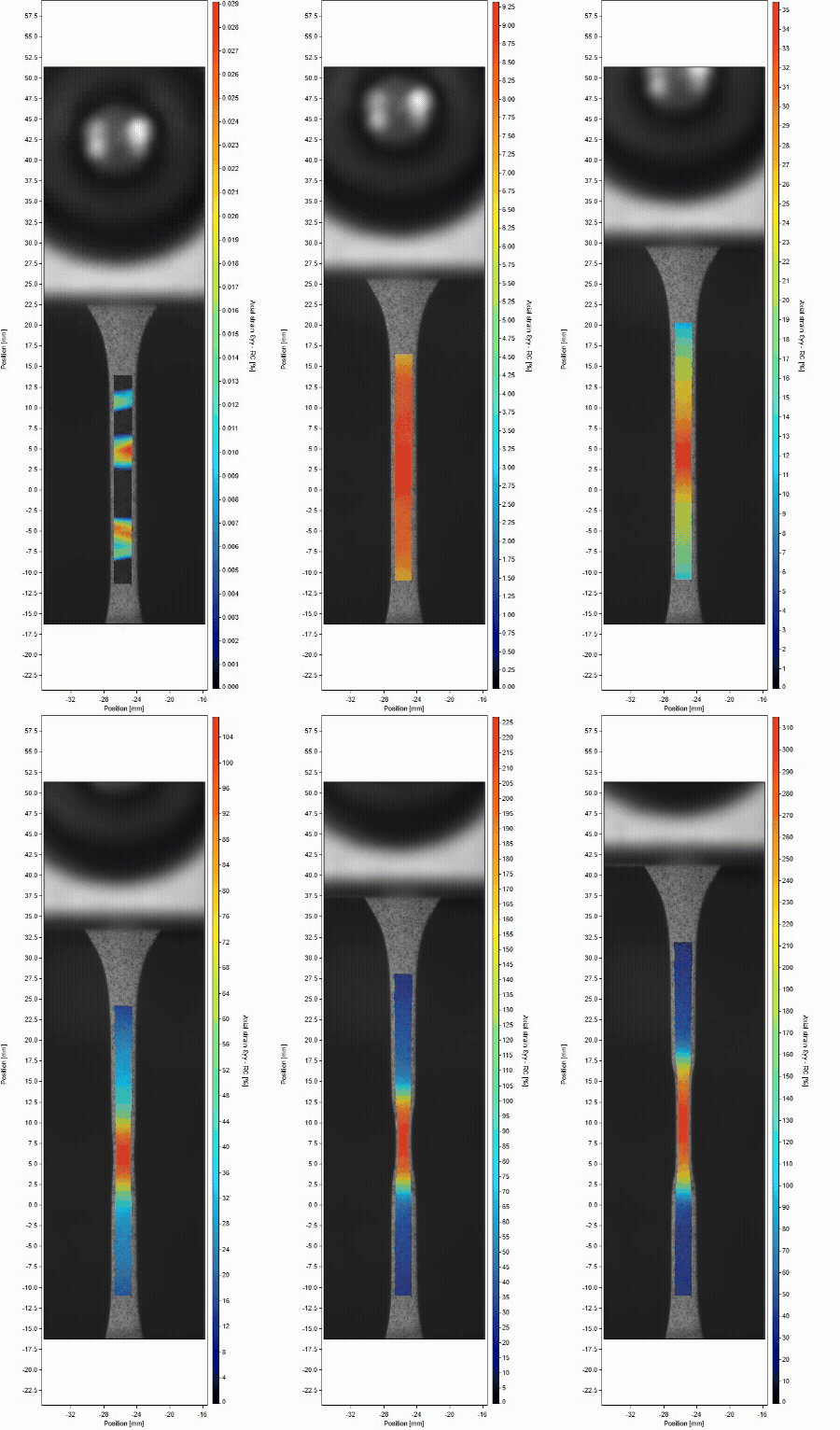 Polymers, plastics, rubber, and composites exhibit complex material behavior – including non-linear elasticity, viscoelasticity, creep, and temperature dependency. Correct characterization of these properties provides you with a simulation basis that reduces the need for physical prototypes and increases confidence in your design decisions.
From test data to simulation model
Danish Technological Institute delivers more than just test results - we help you convert data into usable material models. You can choose the exact delivery tier that fits your needs:
- Raw data: Test results that your own simulation team can work with directly.
- Processed data: Cleaned and processed datasets ready for model fitting.
- Finalized model parameters: Material cards with fitted parameters ready to be imported directly into your FEA software.
This flexibility makes it possible to tailor the delivery to your internal competencies and workflow - whether you have a dedicated simulation team or need a turnkey material model.
Dynamic testing and fatigue testing
Many products are subjected not only to static loads, but to repeated, cyclic stresses over time. Under dynamic loading, polymers and composites can exhibit significantly different behavior compared to static loading - including self-heating, changes in stiffness, and progressive damage accumulation.
Danish Technological Institute performs cyclic testing and fatigue testing that map how your material behaves under repeated loading at relevant temperatures, frequencies, and stress levels. The results provide you with a realistic baseline for evaluating product durability and service life - and for modeling fatigue behavior in your FEA simulations.
Fatigue life assessment and S-N curves
An S-N curve - also known as a Wöhler curve - describes the relationship between cyclic stress amplitude and the number of cycles to failure. The S-N curve is a key tool for fatigue life assessment and the dimensioning of components exposed to cyclic loading.
Danish Technological Institute generates S-N curves based on systematic fatigue testing of your specific material. The curves can be used to:
- Assess expected fatigue life under known operating loads
- Dimension components against fatigue failure
- Define safety margins in product development
- Benchmark candidate materials on an objective basis
For polymers and composites, fatigue life assessment is particularly relevant because fatigue properties often depend heavily on temperature, frequency, and loading mode – factors rarely covered by standard data sheets.
Materials and test conditions
Danish Technological Institute has experience with the characterization of a wide range of polymer-based materials, including:
- Thermoplastics (e.g., PA, PP, PE, POM, PEEK)
- Thermosets and epoxy
- Elastomers and rubber
- Thermoplastic elastomers (TPE, TPU)
- Fiber-reinforced composites
Testing can be performed at varying temperatures, strain rates, frequencies, and loading modes, ensuring that the material model accurately reflects the actual operating conditions of your product. The test program is designed in dialogue with you to target the specific conditions critical to your application.
Contact us regarding material characterization
Do you need accurate material data for your FEA simulations? Contact Danish Technological Institute, and let us discuss your material, loading conditions, and delivery requirements - and design a test program that provides you with the right foundation for simulation.
Frequently Asked Questions