Density measurements of liquids and solid materials
 In Danish
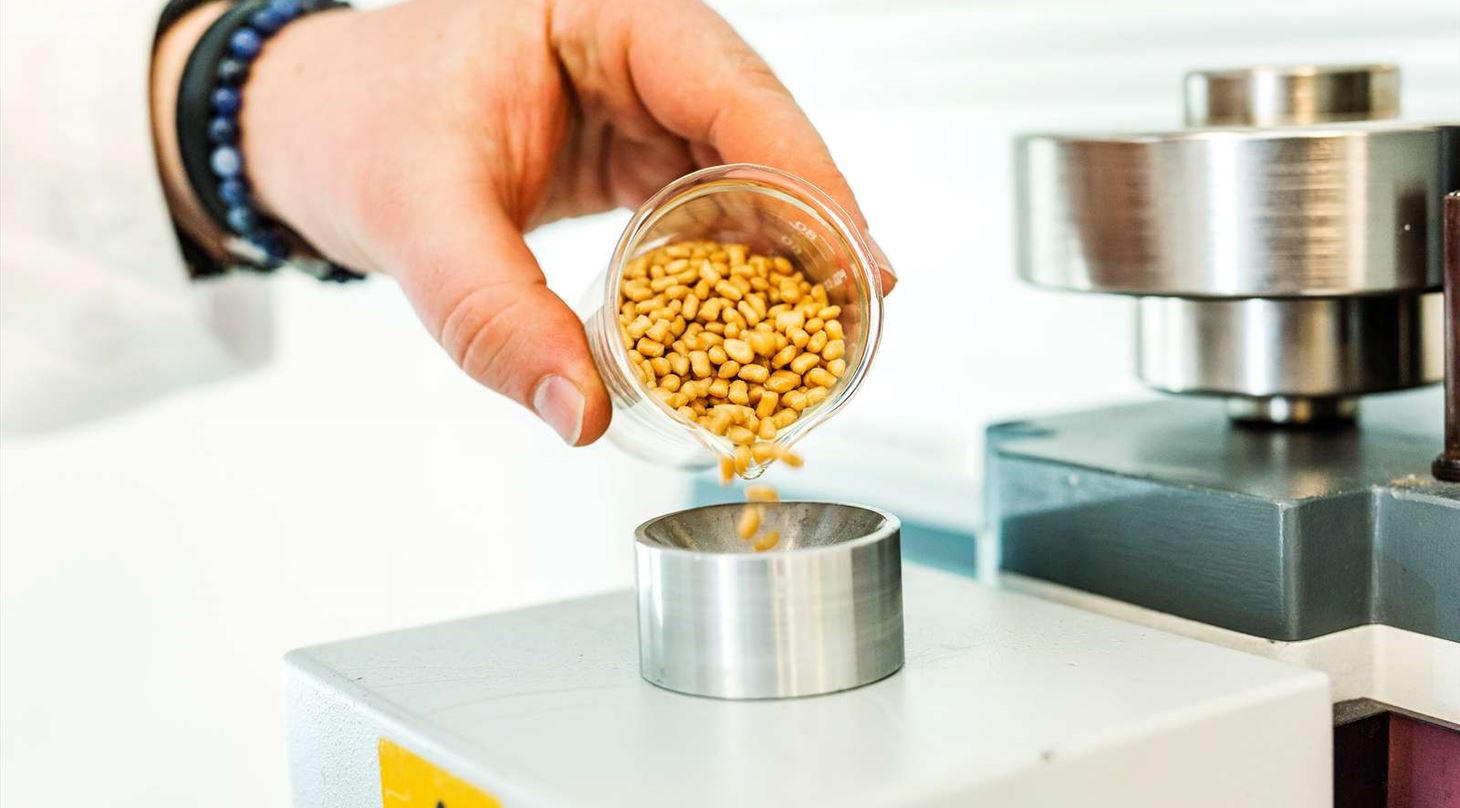
Obtain precise density measurements of liquids, granules, powders, pellets, and other solid materials - for quality control, material identification, and product development.
Density is defined as the mass per unit volume of a substance and is one of the most fundamental material properties. Density measurements are used to identify pure substances, estimate the composition of mixtures, determine the porosity of a material, and verify that a product complies with specifications.
Danish Technological Institute performs density measurements on solid samples - including liquids, granules, powders, and paper. These measurements provide you with documented data for quality control, research and development, or as a basis for further material analysis. In addition, we offer a range of supplementary analyses to provide a comprehensive profile of your material's properties.
How can Danish Technological Institute assist you?
Density measurements of solid materials:
- Liquids, e.g., according to ISO 2811-1, which is developed for high-viscosity liquids
- Granules, e.g., according to ISO 2781 or ISO 1183
- Powders, e.g., according to ISO 3923, which covers metallic powders and other 3D-printable raw materials
- Paper, e.g., according to ISO 534
- Other solid samples, e.g., porous foams according to ISO 845
Supplementary material analyses:
- Surface area
- Porosity
- Thermal conductivity
- Elemental analysis
- Crystal structure
- Determination of the volume percentage of open and closed cells (ISO 4590:2003)
These analyses can be combined according to your requirements to provide complete material characterization within a single testing process.
Our accredited testing of plastics and rubber
When are density measurements relevant?
Density measurements are relevant in a variety of situations where material properties must be documented, verified, or better understood:
- Quality control in production: The density of a granulate, powder, or finished product can reveal variations in composition, filling degree, or processing conditions. Routine density measurements provide an objective basis for assessing process stability and confirming that the material meets specifications.
- Material identification: Density can be used to identify an unknown material or confirm that a supplied raw material matches expectations. It is a fast and reliable method for distinguishing between materials with different compositions.
- Composition estimation: For mixtures and composite materials, density measurements can estimate the ratio between individual components - such as the filler content in a polymer composite or the active substance in a pharmaceutical formulation.
- Porosity determination: By comparing the true density (skeletal density) with the bulk density, the porosity of a material can be calculated. This is relevant for materials where porosity affects functionality, mechanical strength, or absorption capacity – such as catalysts, filters, construction materials, and pharmaceutical products.
Equipment for density measurements
- Pycnometers (typically for high-viscosity liquids)
- Helium pycnometer (typically for powder samples)
- Density gradient column (typically for polyethylene to differentiate between high- and low-density grades)
- Funnel apparatus and containers for powders and flakes (bulk density)
- Pressure-sensitive caliper for measuring foam samples
Supplementary material analyses
In addition to density measurements, Danish Technological Institute offers a range of analytical services to supplement and deepen the understanding of your material:
- Surface area: determination of the material's specific surface area, e.g., via BET analysis. Relevant for catalysts, powders, and porous materials.
- Porosity: characterization of pore structure, pore size distribution, and total porosity.
- Thermal conductivity: measurement of the material's ability to conduct heat. Relevant for insulation materials, electronic components, and construction products.
- Elemental analysis: determination of the material's elemental composition.
- Crystal structure: analysis of the crystalline structure of the material, e.g., by X-ray diffraction (XRD).
The analyses can be tailored to your specific requirements and delivered as a comprehensive material characterization report.
Contact us regarding density measurements
Do you need density measurements or supplementary material analyses? Contact Danish Technological Institute’s Plastics Laboratory to discuss which tests are relevant to your material and objectives.