Hazardous area classification - Mapping of areas with explosive atmospheres
 In Danish
Obtain a correct and documented basis for the zones applicable to your plant and work areas, and ensure that equipment, installations, and safety measures match the actual risk.
If your company handles flammable gases, vapours, mists, or combustible dust, the ATEX Workplace Directive 1999/92/EC requires you to identify where explosive atmospheres may occur and classify these areas into zones. However, many companies find it difficult to determine exactly where zone boundaries should be set, and whether their existing classification still reflects actual conditions.
Hazardous area classification is the systematic process in which areas with a risk of explosive atmospheres are identified and divided into zones (Zone 0, 1, 2 for gas, and Zone 20, 21, 22 for dust) based on the frequency and duration of an explosive atmosphere. Hazardous area classification forms the foundation for the correct selection of equipment and protective systems, as well as the execution of installations in hazardous areas.
Danish Technological Institute helps you carry out or update your hazardous area classification, ensuring it is technically sound, fully documented, and compliant with applicable requirements.
When does hazardous area classification become a challenge?
Hazardous area classification sounds straightforward in principle, but in practice, it often raises questions that are difficult to resolve without specialist expertise:
- New processes or new substances: You introduce new processes or materials, and it is unclear whether they alter zone types or extents.
- Modification or expansion of plant: Physical alterations can mean that existing zoning and boundaries are no longer accurate.
- Outdated or deficient documentation: Area classification drawings are old, and there is doubt as to whether they reflect actual plant conditions.
- Uncertainty regarding zone extents: It is unclear where zone boundaries start and end, or whether an area should instead be classified as a non-hazardous area (non-zone).
- Alignment with other ATEX documentation: Hazardous area classification must align with the extended workplace risk assessment (ATEX-APV / Explosion Protection Document), but the link is often unclear.
- Regulatory inspections or insurance requirements: There is a need for documentation that can be demonstrated and defended during audits.
Concrete assistance with hazardous area classification from Danish Technological Institute
Specialists from the Danish Technological Institute help you execute a technically correct hazardous area classification that serves as the foundation for all subsequent safety decisions in your potentially explosive areas:
- Identification of flammable substances and release sources: We map where and how flammable gases, vapours, mists, or dusts can be released.
- Classification of zones in accordance with DS/EN 60079-10-1 (gas/vapour) and DS/EN 60079-10-2 (dust): Determining zone types and calculating dimensional extents.
- Preparation of classification plans and zoning drawings: Documentation providing a clear visual overview of areas with a risk of explosive atmospheres.
- Assessment of ventilation conditions and release characteristics: Factors that directly influence hazardous area classification.
- Review and updating of existing classifications: We evaluate whether the current classification schedule remains compliant in light of changes to production, plant equipment, or chemical substances.
- Integration with the ATEX workplace risk assessment: We ensure consistency between the hazardous area classification and the rest of your ATEX documentation.
What are the benefits of a correct hazardous area classification?
A technically sound and up-to-date hazardous area classification provides you with:
- The right equipment in the right zones: The classification determines which Ex-marked equipment may be used in each area. Incorrect classification can mean that installed equipment is non-compliant, or that you invest in unnecessarily expensive equipment.
- Documentation that holds up: Classification schedules and reports can be presented with confidence during regulatory inspections, insurance reviews, or independent audits.
- Coherence in your ATEX setup: Hazardous area classification forms the bedrock of the ATEX workplace risk assessment, equipment selection, and installation design. When the classification is correct, the rest of the setup falls into place.
- Reduced explosion risk: A precise delimitation of zones makes it possible to target safety measures directly where the risk actually exists.
- Impartial assessment: Danish Technological Institute is an independent, self-governing body with no commercial interest in the equipment you select.
Explanation of the zones
Hazardous area classification categorises explosive atmospheres based on the likelihood and persistence of their occurrence:
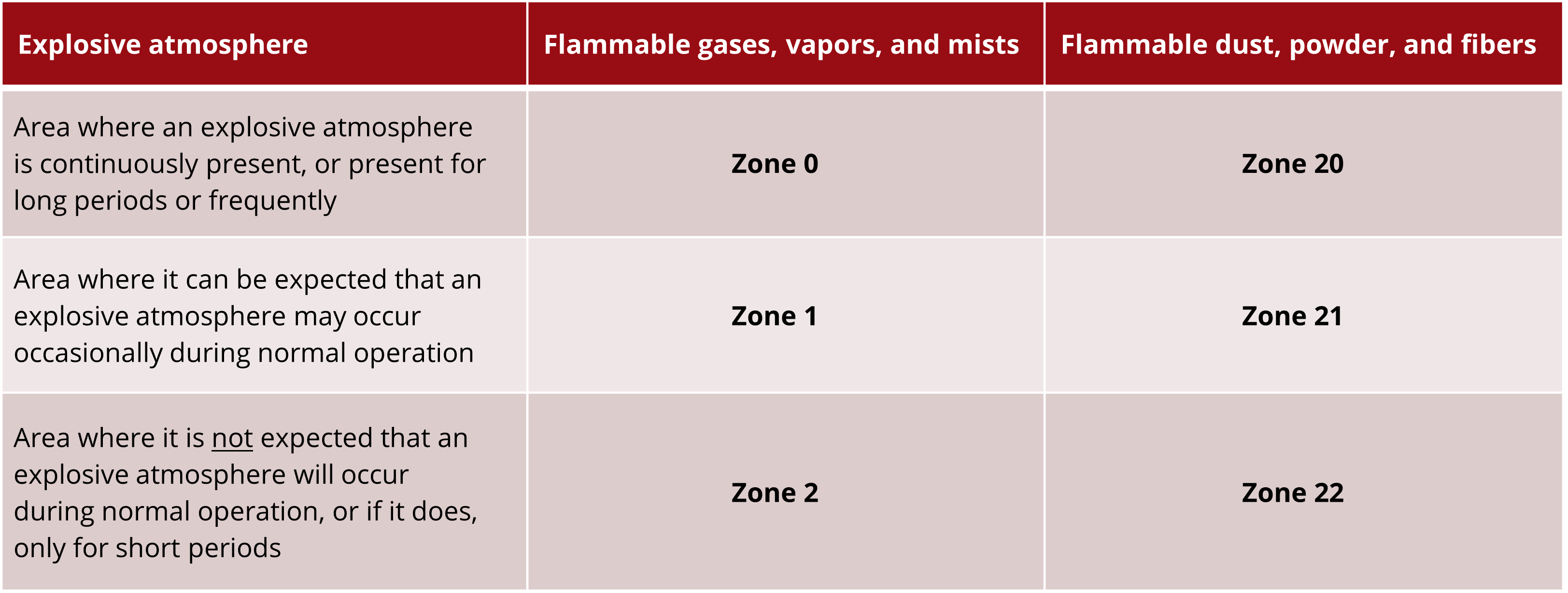
Gas, vapour, and mist:
- Zone 0: An explosive atmosphere is present continuously or for long periods.
- Zone 1: An explosive atmosphere is likely to occur occasionally in normal operation.
- Zone 2: An explosive atmosphere is not likely to occur in normal operation, but if it does occur, will persist for a short period only.
Combustible dust:
- Zone 20: An explosive dust atmosphere is present continuously or for long periods.
- Zone 21: An explosive dust atmosphere is likely to occur occasionally in normal operation.
- Zone 22: An explosive dust atmosphere is not likely to occur in normal operation, but if it does occur, will persist for a short period only.
Standards and regulatory framework
Hazardous area classification is performed in accordance with the ATEX Workplace Directive 1999/92/EC, which is implemented in Danish legislation. The technical standards governing the classification process are:
- DS/EN 60079-10-1: Classification of areas where explosive gas atmospheres may occur.
- DS/EN 60079-10-2: Classification of areas where explosive dust atmospheres may occur.
These standards detail methods for identifying sources of release, evaluating ventilation conditions, and establishing zone types and physical extents. The hazardous area classification forms an essential part of the company's overall ATEX workplace risk assessment (Explosion Protection Document).
Contact us
Do you need a hazardous area classification performed or updated? Contact Danish Technological Institute’s ATEX specialist, Karsten Bjerrum, for an exploratory dialogue about your plant and specific requirements.