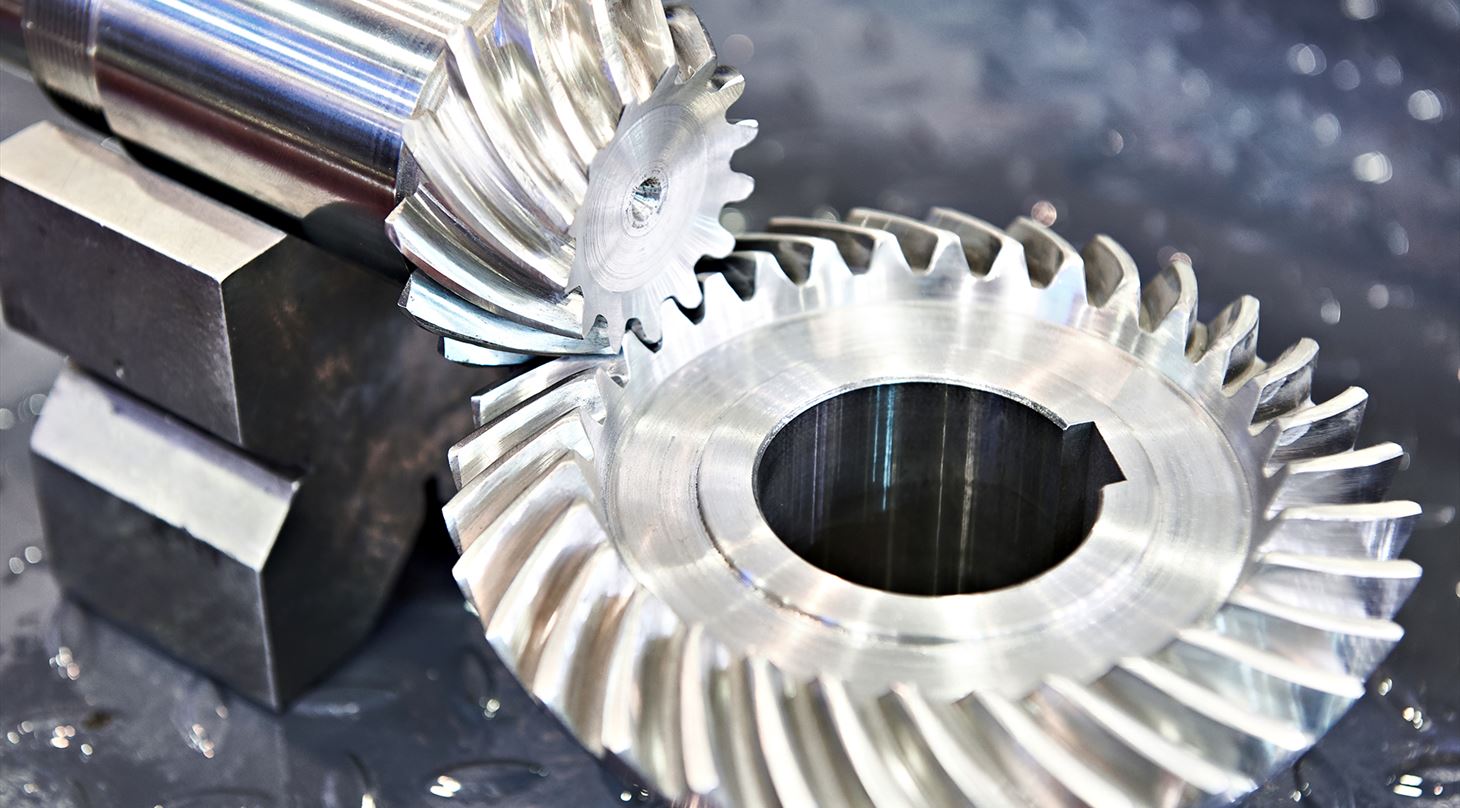
Plasma nitriding increases the hardness and wear resistance of steel tools and components
Plasma nitriding is a treatment that increases the surface hardness of steel using a plasma generated in a vacuum by electric fields. The treatment offered by the Danish Technological Institute provides a significant increase in the hardness and wear resistance of steel components.
Gears, press rams, and other machine components, as well as certain production tools, can achieve increased durability through plasma nitriding. The significantly increased surface hardness provides both higher compressive strength and much better wear resistance, which is vital for the longevity of the parts.
How plasma nitriding works
Plasma nitriding diffuses nitrogen into the surface of the steel under a vacuum and electric fields. The process increases surface hardness up to 1200 HV with minimal distortion. Nitrogen typically penetrates 0.1–1 mm into the surface. The treatment can be localized to specific areas and combined with oxidation (PLASOX) for enhanced corrosion protection.
Plasma nitriding can also be combined with PVD coatings, where the nitrided surface serves as a supporting layer for a subsequent coating.
What problems does plasma nitriding solve?
- Wear and pitting: Hardened surfaces resist abrasive and adhesive wear, which otherwise lead to premature component failure
- Fatigue: The hardened zone significantly increases the component's fatigue strength, thereby extending its service life under cyclic loading
- Galling and fretting: Plasma nitriding reduces the risk of material build-up and micro-motion damage, which are widespread in high-vibration environments
- Corrosion: The combination with oxidation (PLASOX) creates a corrosion-resistant layer
Hardness is increased and wear is reduced
Depending on the specific steel alloy, the treatment can increase the surface hardness of the steel by 2 to 8 times. The higher the steel is alloyed, the greater the hardness increase achievable. Depending on the steel grade, the treatment takes place at a temperature of 480 °C to 580 °C.
For example, you can select the material for a component focusing on properties such as strength, machinability, price, and the like—and then give the surface the required wear resistance and hardness using plasma nitriding
- Henrik Horup Reitz, Danish Technological Institute
Dimensional stability and localized treatment

Using a vacuum and electric fields, plasma nitriding activates a gas mixture containing, among other things, nitrogen and hydrogen. In the plasma, the nitrogen is brought into a state where it penetrates the steel surface and increases the hardness—specifically, the hardness of the material is increased in the outermost depth of up to 0.7 mm, depending on the steel alloy as well as treatment time and temperature.
A special advantage of plasma nitriding is that the process can also nitride stainless steel, which is generally not possible with more traditional processes.
During plasma nitriding, corrosion resistance is reduced slightly, while the surface hardness increases significantly due to the high chromium content of the stainless steels. In this regard, plasma nitriding differs from the traditional gas nitriding process.
Gas nitriding is usually performed at around 520 °C, and the treatment covers the entire surface of the workpiece. This can result in distortion and unintended brittleness in some components. On critical parts, plasma nitriding can be carried out at just 480 °C, reducing the risk of distortion. Furthermore, it is relatively easy to mask off areas that do not require treatment. This could be, for example, precision fits that must not change dimensions, or threads that must not become brittle.
Unhardened steels, quenched and tempered steels, and steels tempered at temperatures at least 20 °C higher than the plasma nitriding temperature can be plasma nitrided without affecting core hardness.
Fast and efficient treatment
Plasma nitriding is a surface treatment that can be relatively cost-effective while also being fast and efficient. It typically requires no post-treatment. As a result, industrial companies often find substantial advantages in utilizing this process.