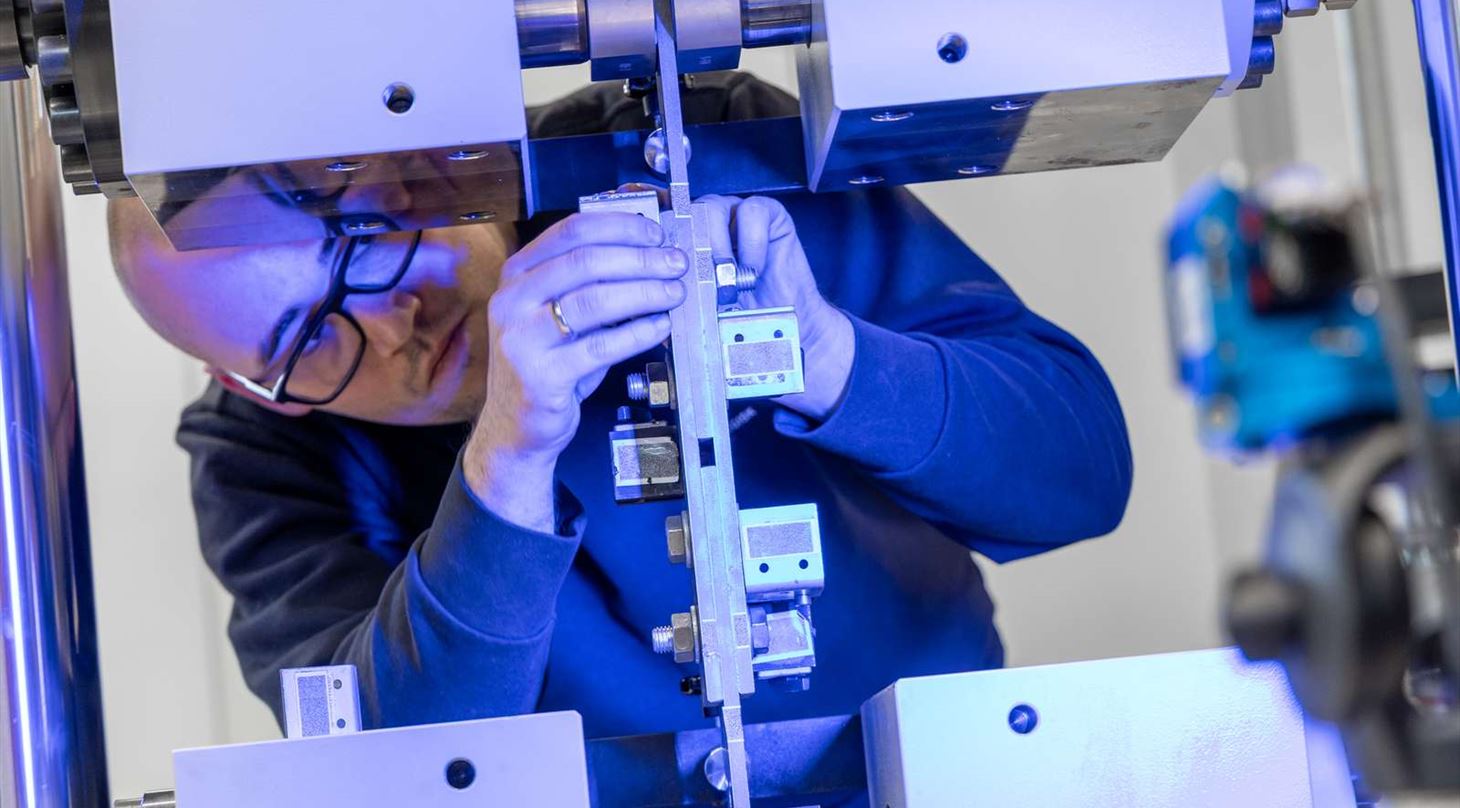
Testing of bolts and bolted connections
 In Danish
Obtain reliable documentation, qualification, and failure analysis of bolts and bolted connections - from standard testing to customized test programs that reflect actual load conditions in your structure.
Through the testing of bolts and bolted connections, we verify load-bearing capacity, preload, and fatigue strength under controlled conditions that closely simulate real-world operations.
Danish Technological Institute combines mechanical testing, materials technology, and specialized knowledge of bolted joints. We do not just test bolts - we understand how they behave under the loads that determine whether a connection holds.
This provides you with a solid foundation for product documentation, qualification, optimization, and failure analysis.
How can Danish Technological Institute help you?
Danish Technological Institute offers testing, analysis, and consultancy across the entire spectrum of mechanical and environmental influences on bolts and bolted connections:
- Static strength and proof load: Tensile testing, breaking load, deformation, and documentation of mechanical properties.
- Endurance: Axial fatigue testing of bolts under cyclic loading in accordance with ISO 3800, including dimensions above M39.
- Preload and slip: Testing of tightening torque, preload, and friction coefficients.
- Corrosion and corrosion fatigue: Testing of bolt resistance to environmental influences as well as combined corrosion and fatigue.
- Material and fracture analysis: Metallurgical analysis, microstructure examination, and failure analysis in the event of malfunction or fracture.
- Testing of complete bolted joints: Testing under realistic and combined loading conditions.
- Customized test programs: Development of test methods that replicate the actual conditions in your structure.
- Statistical evaluation of test data: Determination of characteristic values and statistical documentation.
When the standard test is not enough
A bolt in a standardized test is not the same as a bolt in a real-world structure. In practice, bolts are exposed to complex combinations of preload, axial loading, shear loading, vibrations, temperature fluctuations, and corrosion - often simultaneously and over repeated cycles.
Standard tests document baseline properties, but they rarely reflect the actual operating conditions that determine whether a bolted joint will endure throughout its entire design life.
Danish Technological Institute develops and executes customized test programs where loads are designed to reproduce the true conditions present in your structure. This provides you with documentation that is directly applicable to your design, qualification, or approval process.
Failure analysis and fracture investigation
The fracture surface shows how the bolt has failed. Finding out why requires a deeper analysis. The root cause of a failure may lie within the material, the manufacturing process, heat treatment, the preload level, corrosive exposure, load history - or a combination of multiple factors.
Danish Technological Institute combines mechanical testing, metallurgical analysis, and in-depth expertise in the behavior of bolted connections to identify the underlying failure mechanism. This provides you with an authoritative, technical basis to assess the cause and thus prevent recurrent failures.
From single bolts to complete bolted joints
Danish Technological Institute tests both individual components - bolts, nuts, washers, and other fastening elements - and complete bolted assemblies, evaluating the interaction between components under realistic conditions.
Testing the complete connection is often crucial to understanding how preload, contact surface conditions, load distribution, and structural stiffness influence overall joint performance and service life.
Documentation that holds up
Danish Technological Institute can assist you with:
- Standardized testing in accordance with applicable norms
- Development of new test methods when existing standards do not cover your specific challenge
- Statistical evaluation of test data and determination of characteristic properties
The documentation is tailored to meet the requirements of your approval or qualification process and can be utilized directly with customers, certification bodies, and regulatory authorities.
Standards:
| ISO 898-1 | Mechanical properties of fasteners made of carbon steel and alloy steel (up to M39) |
| ISO 898-2 | Mechanical properties of fasteners made of carbon steel and alloy steel |
| ISO 3506 | Mechanical properties of corrosion-resistant stainless steel fasteners (Part 1: Bolts; Part 2: Nuts) |
| ISO 3800 | Threaded fasteners – Axial fatigue testing |
| ISO 12107 | Statistical planning and analysis of data |
| EN 1993-1-9 | Eurocode 3: Fatigue of steel structures |
| ISO 16047 | Torque / preload testing and determination of friction coefficients |
| EN 1090-2, annex G | Determination of slip coefficient for slip-resistant connections |
| ISO 6157-1 / -2 / -3 | Surface discontinuities on bolts and nuts |
Contact us regarding bolt testing
Contact us regarding bolt testing Do you have a bolt or bolted joint that requires documentation, qualification, or investigation following a failure? Danish Technological Institute’s specialist in mechanical testing, Michael Perolle Jensen, assists you from problem definition to documented solution. Contact us for an informal, non-binding discussion of your needs.