Air Source & Air-to-Air Heat Pumps: Accredited Verification for Seasonal Efficiency, Cooling, and Compliance
Select Page
Accredited laboratory testing provides manufacturers, importers, and distributors of air source heat pumps (ASHP) and air-to-air heat pumps (AAHP / A/A) with the empirical documentation required to verify seasonal heating and cooling efficiency, capacity modulation, and acoustic sound power levels across diverse European climate zones.
Air-to-air heat pumps and reversible air source heat pump systems represent one of the highest-volume heating and cooling categories in Europe. Because these direct-expansion systems provide dual-mode space conditioning by heating or cooling indoor air directly, European regulations impose rigorous demands for seasonal performance across both operational cycles. Placing an air-to-air heat pump, ductless mini-split, multi-split, or packaged air conditioner on the European internal market requires verifiable documentation demonstrating compliance with Ecodesign Regulation (EU) No 206/2012 (for comfort air conditioners and air-to-air systems up to 12 kW), Energy Labelling Regulation (EU) No 626/2011, and Ecodesign Regulation (EU) 2016/2281 for commercial systems.
At Danish Technological Institute, our Heat Pump Test Laboratory delivers independent, ISO/IEC 17025 accredited testing according to EN 14511, EN 14825, and EN 12102-1. Backed by decades of specialized testing experience across aerothermal and air source technologies, we provide manufacturers, private-label brand owners, and distributors with traceable empirical data. Our accredited test reports reduce technical uncertainty, mitigate risks ahead of market surveillance audits, and provide the verified documentation required to support European product certification under recognized schemes including CEN Heat Pump KEYMARK, Eurovent, the EHPA Quality Label, and national subsidy frameworks. Find more information about the various European test schemes.
Controlled Testing Across Heating, Cooling, and Dynamic Defrost Cycles
Air-to-air and air source heat pumps (AAHP / ASHP) exchange thermal energy directly with dynamic air streams on both indoor and outdoor sides. Consequently, accurate performance verification demands psychrometric test facilities and calibrated airflow tunnels that precisely control air temperature, relative humidity, and aerodynamic pressure drops while managing transient operations such as reverse-cycle defrosting and variable-speed inverter frequency modulation.
Our specialized climate chambers simulate outdoor ambient temperatures from −20 °C to +45 °C and relative humidity levels from 20% to 100%, alongside precisely controlled indoor conditions, enabling concurrent testing of all regulatory parameters for single-split, multi-split, and commercial VRF systems:
Key Test Parameters Measured
- Seasonal Heating Performance (SCOP / ηs): Empirical part-load mapping (test conditions A, B, C, and D) across Average, Colder, and Warmer European climate profiles according to EN 14825.
- Seasonal Cooling Performance (SEER / ηc): Determination of energy efficiency ratios across standardised outdoor temperature steps (35 °C, 30 °C, 25 °C, and 20 °C) pursuant to EN 14825.
- Dynamic Defrosting and Transient Operations: High-precision measurement of cyclic energy penalties and thermal recovery during outdoor coil frost accumulation and automatic reverse-cycle defrost intervals.
- Acoustic Emissions (LWA): Sound power determination of indoor units (wall-mounted, cassette, ducted, or floor-standing consoles) and outdoor condensing units under full thermal load in accordance with EN 12102-1.
- Auxiliary Power Consumption: Precise electrical measurement during thermostat-off mode, standby mode, crankcase heater activation, and off-mode states.
- Regulatory Frameworks: Ecodesign Regulation (EU) No 206/2012, Energy Labelling Regulation (EU) No 626/2011, and Ecodesign Regulation (EU) 2016/2281 (air heating and cooling products).
Moving from Internal Prototype Data to Verified Third-Party Documentation
For technical directors, quality managers, and R&D engineers developing air-to-air heat pump systems, internal factory measurements and computational simulations must be verified by ISO/IEC 17025 accredited procedures to hold legal and commercial validity with European authorities and commercial buyers. Empirical laboratory testing confirms inverter modulation boundaries, airflow volumetric curves, and heat transfer efficiency. Independent test data eliminates engineering margins, ensures that rating plates are legally robust, and accelerates CE marking and KEYMARK or Eurovent certification. Importing or white-labelling split and multi-split air source heat pumps involves severe regulatory exposure. Independent batch verification verifies that factory-declared seasonal metrics (such as A+++ cooling or A++ heating) match production reality, mitigating the financial liability associated with underperforming units in the field. Testing according to harmonised European reference standards provides national market surveillance authorities with repeatable, legally defensible data for assessing product conformity.Technical Due Diligence for Manufacturers
Risk Mitigation for Wholesalers, Importers and OEM Branders
Objective Basis for Market Surveillance
Substantiating Environmental Claims with Empirical Data
With the implementation of the EU Empowering Consumers Directive and the incoming Green Claims Directive, environmental statements regarding seasonal efficiency, carbon reduction, and lower running costs must be substantiated by empirical data rather than theoretical projections.
Danish Technological Institute provides the independent testing required to document product performance. By generating verified performance metrics under standardised test cycles, we deliver the empirical foundation manufacturers and distributors need to substantiate energy label classifications, environmental product declarations (EPDs), and decarbonisation claims with full regulatory compliance.
The Testing Process: A Collaborative, Transparent Approach
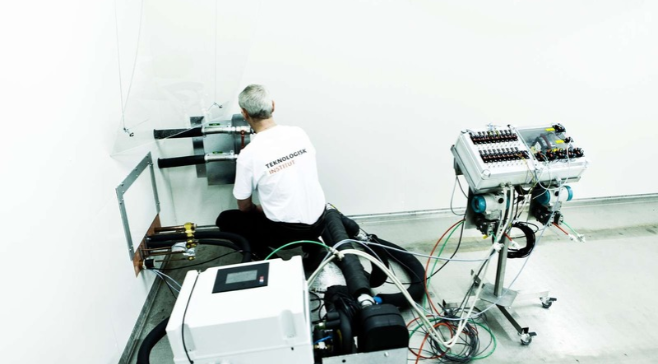
We operate on a transparent, 5-step model designed to keep technical teams informed throughout the measurement programme: We evaluate the technical specifications of your air-to-air unit (single-split, multi-split, ducted packaged system, or air source heat pump), designated reference climate profiles, airflow duct allowances, and targeted certification pathways. Your indoor and outdoor units are installed inside calibrated climate chambers and connected to precision air-handling measuring tunnels equipped with psychrometric temperature grids, nozzle arrays for airflow volume determination, and multi-channel power analysers. Testing is executed under strict laboratory tolerances to measure steady-state points, cycling degradations, standby auxiliary losses, and defrost intervals across the complete seasonal matrix. Engineering teams can follow live sensor streams, supply-air temperatures, compressor frequencies, and thermal output remotely via a secure portal, enabling immediate technical dialogue and adjustments. You receive a fully documented, ISO/IEC 17025 compliant test report detailing raw measurement logs, calculated seasonal values (SEER/SCOP), acoustic frequency spectra, rating plate imagery, and evaluated measurement uncertainties.1. Scope Definition & Test Matrix Alignment
2. Chamber Installation & Psychrometric Setup
3. Controlled Execution Across Bin Profiles
4. Real-Time Remote Data Access
5. Accredited Test Reporting
Technical Facilities: Specialised Climate and Acoustic Chambers
Testing air-to-air heat pumps and comfort air conditioners requires specialized facilities capable of balancing dynamic thermal and aerodynamic forces simultaneously: Calibrated test chambers with separate indoor and outdoor rooms capable of maintaining constant air conditions and precise airflow measurements across broad capacity and temperature envelopes. Specialised reverberant and semi-anechoic test environments configured to measure airborne acoustic sound power (EN 12102-1) while the unit operates at continuous full thermal capacity. Chambers equipped to evaluate cold-climate air source heat pumps at continuous sub-zero outdoor temperatures (down to −20 °C and below) to determine true bivalent heating capabilities. Safe laboratory facilities configured to test systems charged with conventional fluorinated refrigerants as well as mildly flammable (A2L) and flammable (A3) low-GWP refrigerants.Dual-Room Balanced Psychrometric Facilities
Combined Acoustic & Thermal Test Chambers
Low-Temperature Climate Capabilities
Multi-Refrigerant Infrastructure
Comprehensive Testing for Synthetic, HFO, and Natural Refrigerants
The transition toward climate-friendly refrigerants under the revised EU F-gas Regulation (Regulation (EU) 2024/573) and prospective PFAS restrictions is profoundly impacting the air source and air-to-air heat pump sector. In residential split systems, moving toward lower-GWP alternatives requires balancing thermodynamic cycle efficiency with strict indoor charge limits under product safety standards (such as EN 60335-2-40):
- Mildly Flammable HFO Blends & Lower-GWP HFCs (A2L): Dedicated testing infrastructure for current and transitional refrigerants, including R32, R454B, R454C, and HFO alternatives like R1234ze.
- Natural Refrigerants (A3, A1): ATEX-compliant safety protocols and infrastructure equipped to safely evaluate hydrocarbon air source prototypes, such as Propane (R290), under controlled ventilation conditions.
- Traditional Synthetic Refrigerants (A1): Complete baseline validation for legacy split systems operating with R410A or R134a.
Our test chambers feature continuous refrigerant gas detection arrays, mechanical ATEX emergency ventilation, and spark-free electrical interfaces to handle flammable charge limits safely during testing.
Discuss Your Air-to-Air Testing Requirements
Whether you are preparing a new R32 or R290 split-system air source heat pump platform for European launch, verifying seasonal Ecodesign metrics under EN 14825, or generating accredited data for European certification schemes (such as CEN Heat Pump KEYMARK or Eurovent), our team provides the technical expertise and capacity you need.
Contact our Heat Pump Testing Laboratory to review your testing matrix, boundary conditions, and lead times.
Meet Some of Our Experts
Navigating European Ecodesign directives, psychrometric airflow tolerances, and shifting refrigerant safety rules requires specialised technical and regulatory expertise. When testing with Danish Technological Institute, you work directly with dedicated test engineers and regulatory specialists who follow your product throughout the entire process, from rig installation to final reporting.
Reach out to our team to discuss your specific testing requirements, clarify harmonised standards, evaluate prototype feasibility, or plan testing capacity in our climate chambers.

Lasse has overall responsibility for the team, the laboratory and its technical direction. He has more than 25 years of experience in refrigeration and heat pump technology, covering product testing, laboratory measurements, and market surveillance, as well as energy efficiency and the implementation of international standards. He is an expert in testing in accordance with international standards and has extensive experience with heat pumps, refrigeration systems, condensing units and related components for both public authorities and industry.
Preben has worked in the energy sector for more than 20 years. He specialises in testing heat pumps as well as providing technical consultancy and product assessment. He is a member of national and international standardisation committees, and he is also a member of an international committee of test laboratories.
Frequently Asked Questions About Air-to-Air Heat Pump Testing
If you have questions about testing standards, seasonal heating and cooling calculations (SCOP/SEER), acoustic measurements, or certification pathways for air-to-air and air source heat pumps (AAHP / ASHP), our FAQ provides a quick overview of key technical topics.
Back to main page