Electrically insulating PVD coatings secure the next generation of CERN magnets
When CERN upgrades its particle accelerator — the Large Hadron Collider — it is not only about higher energy and more particle collisions. It is also about materials that can survive conditions that very few technologies are designed for: shifts from extreme heat to cooling down to absolute zero, powerful magnetic fields, and irradiation. The solution is a PVD coating from the Danish Technological Institute.
In the upcoming High-Luminosity upgrade of the Large Hadron Collider, CERN must create space for additional beam optics in the 27-kilometre-long tunnel, making it possible to achieve more particle collisions in the world’s largest physics experiment, which provides new knowledge about the smallest building blocks of the universe.
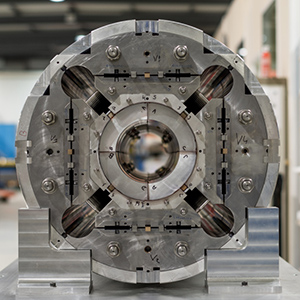 Among other things, this requires new dipole magnets with magnetic fields of up to 11 Tesla - significantly more powerful than the current 8 Tesla magnets. But the jump to 11 Tesla entails a technological shift.
The image to the right shows a model of a quadrupole magnet for the High-Luminosity LHC. Image credit: CERN
The challenge: insulation under extreme conditions
The new magnets require electrical insulators that can withstand a process in which the materials are first exposed to temperatures above 650 °C and must then function at cryogenic temperatures close to absolute zero (minus 273.15 °C) in liquid helium.
This places extreme demands on the coating on the magnets. It must provide electrical insulation, adhere extremely well, and at the same time withstand the mechanical stresses that arise when different materials expand and contract during major temperature changes.
- If the material beneath the coating expands or contracts more than the coating, the coating can crack. And if the coating flakes off, you no longer have the insulation you need, explains Bjarke Holl Christensen, team manager and specialist in surface coatings at the Danish Technological Institute.
For CERN, the consequences of failure are serious. Defective electrical insulation can, in the worst case, mean that a magnet fails - an expensive and critical incident in a facility where precision and operational reliability are essential.
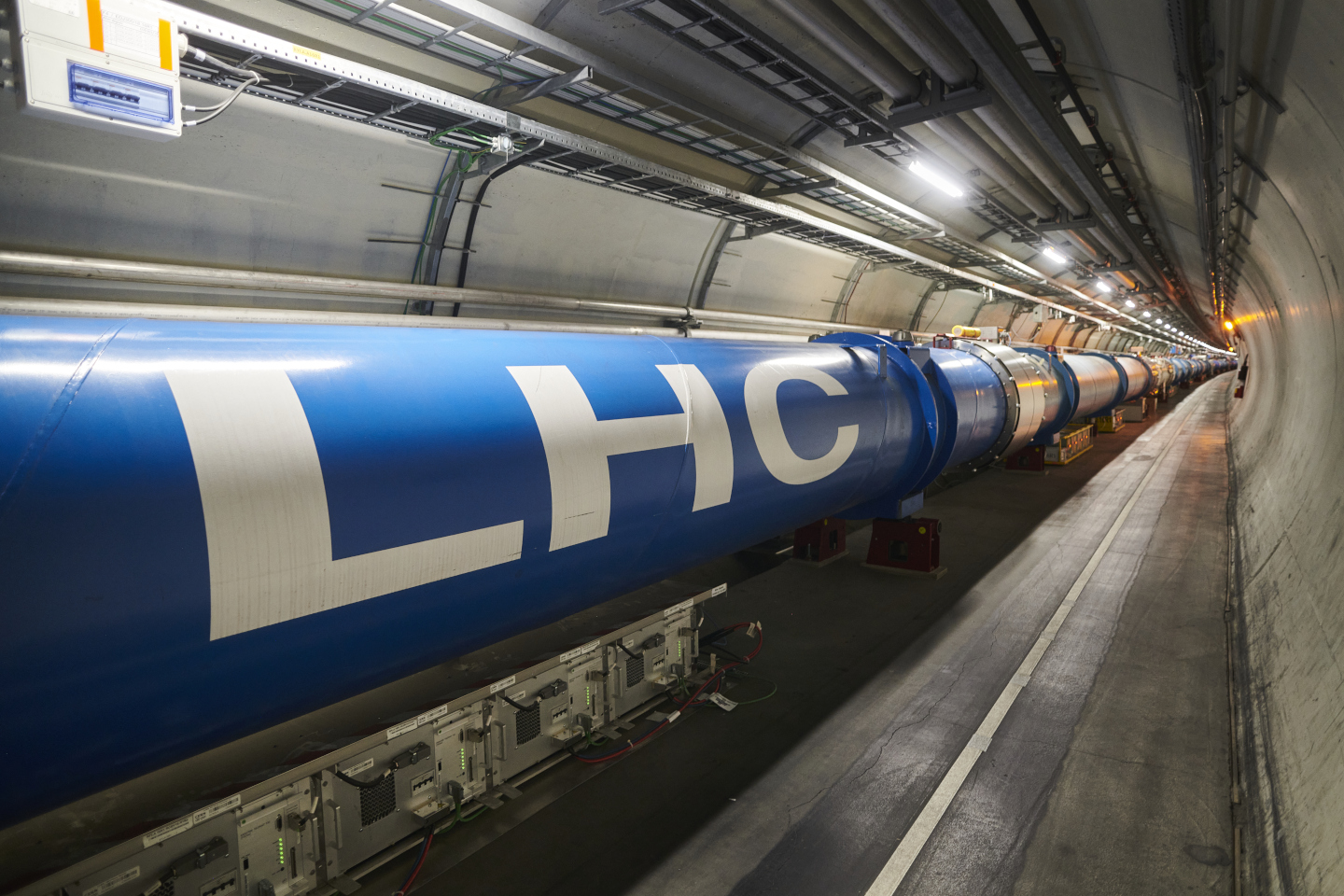
LHC dipole magnets in LHC tunnel at CERN. Image credit: CERN
Specially designed PVD coating at micrometre level
The Danish Technological Institute is working with CERN to develop and validate an electrically insulating PVD coating for the new magnets. PVD technology makes it possible to design the coating’s properties with high precision — not only its chemical composition, but also its structure and functionality.
This is crucial because the insulator must be adaptable to both the electrical requirements and the mechanical loads in the magnet design. At the same time, the PVD coating can be produced in highly controlled layer thicknesses at micrometre level, giving CERN the necessary tolerance control in the components.
When CERN calls us, it is because we can understand their problem and develop a solution for it. At the same time, we can also produce the solution we develop. In this way, CERN gets the entire process from a thought or an idea to a finished product
- Bjarke Holl Christensen, Danish Technological Institute
From CERN to new applications
The collaboration is not only about one generation of magnets. When CERN tests the coatings under cryogenic temperatures and irradiation, documentation is created that may have value far beyond accelerator physics.
The technology could potentially be used in other advanced systems where electrical insulation, temperature stability, and mechanical robustness are critical - e.g. in fusion technology, cryogenic environments, and other high-performance magnet applications.
For CERN, the value is clear: a robust surface insulator makes it possible to realise the magnet design required by the physics experiments of the future. For the Danish Technological Institute, the case is an example of how advanced surface technology tailored to the customer’s specific needs can solve materials engineering problems where standard solutions are no longer sufficient.